Quality Risk Management for New Products, Processes, Equipment, Facilities, Technology Transfer and Scale-Up
Introducing a new pharmaceutical product, manufacturing process, equipment, facility modification, technology transfer, scale-up activity, or process change can create significant quality risks. A change that appears technically simple may affect:
- Critical Quality Attributes (CQAs)
- Critical Process Parameters (CPPs)
- Material attributes
- Process capability
- Contamination and cross-contamination controls
- Cleaning and sterilization
- Data integrity
- Validation status
- Stability
- Product quality
- Regulatory commitments
- Patient safety
For pharmaceutical manufacturers operating in the United States, quality risk management should therefore be integrated into the pharmaceutical quality system (PQS) rather than treated as a standalone documentation exercise.
A scientifically justified risk-management approach helps organizations identify potential failure modes before implementation and establish appropriate controls based on the level of risk.
The principles of ICH Q9(R1) Quality Risk Management and ICH Q10 Pharmaceutical Quality System provide an important framework for connecting risk management with change management, knowledge management, CAPA, technology transfer, and continual improvement.
What Is Pharmaceutical Quality Risk Management?
Pharmaceutical Quality Risk Management (QRM) is a systematic process for identifying, evaluating, controlling, communicating, and reviewing risks that may affect the quality of pharmaceutical products and processes. The fundamental concept is:
Risk should be assessed based on scientific knowledge and ultimately linked to protection of the patient.
Quality risk management should not simply answer: “Is this change acceptable?”
It should answer:
“What could go wrong, how could it affect product quality or the patient, how significant is the risk, what controls are required, and how will we verify that those controls remain effective?”
Why Risk Assessment Is Critical for Pharmaceutical Changes
Pharmaceutical operations are interconnected. A modification to one element can affect several other systems. For example:
New Equipment
↓
Equipment Design
↓
Material Contact Surface
↓
Cleaning
↓
Process Parameters
↓
Validation
↓
Product Quality
↓
Stability
Therefore, risk assessment should consider both direct and indirect impacts.
A robust assessment can help organizations:
- Identify potential quality hazards
- Prioritize resources
- Define appropriate controls
- Determine validation requirements
- Establish monitoring requirements
- Identify additional studies
- Support change-control decisions
- Reduce unexpected deviations
- Strengthen inspection readiness
- Protect product quality and patient safety
Regulatory Foundation for Quality Risk Management
For U.S.-regulated pharmaceutical manufacturing, risk-based decision-making should be consistent with applicable FDA requirements and relevant international guidelines. Important references include:
1. ICH Q9(R1) – Quality Risk Management
ICH Q9(R1) provides principles and examples of tools for quality risk management throughout the pharmaceutical product lifecycle.
It emphasizes that the level of effort, formality, and documentation should be commensurate with the level of risk.
2. ICH Q10 – Pharmaceutical Quality System
ICH Q10 establishes a model for an effective pharmaceutical quality system and connects:
- Process performance and product quality monitoring
- CAPA
- Change management
- Management review
with knowledge management and quality risk management.
3. FDA Pharmaceutical CGMP Requirements
U.S. manufacturers must ensure that manufacturing processes, equipment, facilities, controls, and changes remain capable of consistently producing products meeting established quality requirements.
4. FDA Process Validation Guidance
Process validation follows a lifecycle approach that includes:
- Process Design
- Process Qualification
- Continued Process Verification
Risk assessment should therefore support process understanding and validation activities throughout the lifecycle.
When Should a Pharmaceutical Quality Risk Assessment Be Performed?
Quality risk management should be applied whenever a change or new activity could potentially affect product quality. Common triggers include:
New Product Introduction
Risk assessment should begin during development and technology transfer and continue through commercialization. Areas to consider include:
- Formulation
- Manufacturing process
- Raw materials
- Packaging components
- Analytical methods
- Manufacturing equipment
- Cleaning requirements
- Stability
- Specifications
- Process validation
Risk Assessment for New Manufacturing Processes
A new process may introduce unknown or insufficiently understood risks. Examples include:
- New formulation technology
- New manufacturing steps
- New sterilization process
- New filling process
- New blending or granulation technology
- New coating process
- New packaging process
The assessment should identify relationships between:
Material Attributes → Process Parameters → CQAs → Finished Product Quality
Questions should include:
- Which process parameters are critical?
- What happens if the parameter moves outside its acceptable range?
- Are process interactions understood?
- Are there scale-dependent risks?
- What controls are required?
- Is process validation required?
- What additional development studies are needed?
Quality Risk Assessment for New Equipment
Installation of new equipment can introduce risks involving:
- Equipment design
- Automation
- Software
- Materials of construction
- Product-contact surfaces
- Cleaning
- Sterilization
- Calibration
- Maintenance
- Utilities
- Operator interaction
- Data integrity
A risk assessment should evaluate the equipment across its lifecycle.
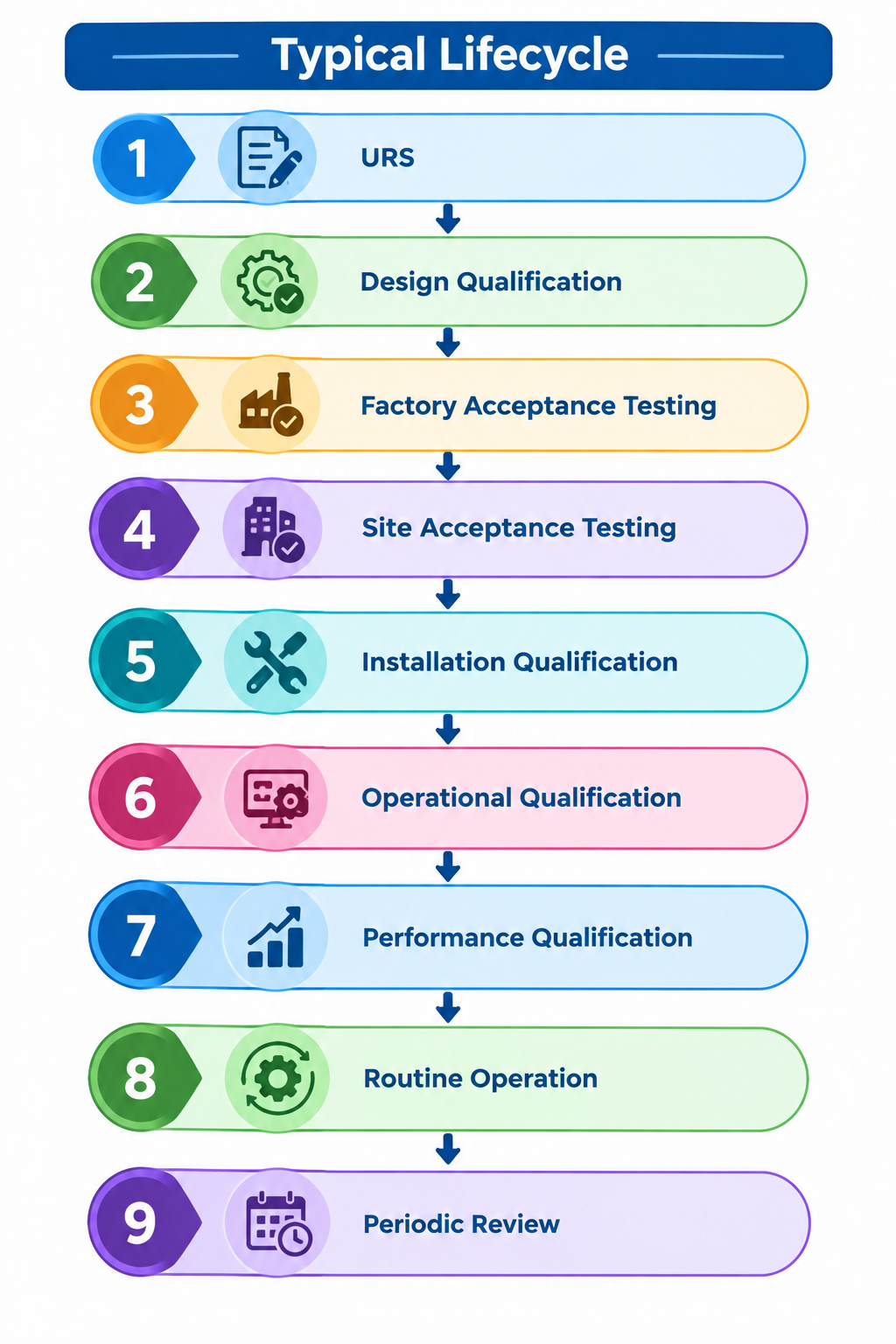
Risk assessment should help determine which equipment functions are critical to product quality and therefore require appropriate qualification, controls, monitoring, or verification.
Risk Management for Facility Modifications
Facility changes can create significant risks that extend beyond the physical modification itself. Examples include:
- New manufacturing rooms
- Room reclassification
- HVAC modifications
- New personnel/material flows
- Warehouse expansion
- New utilities
- Production area redesign
- Installation of new equipment
- Cleanroom modifications
- Pressure differential changes
- Environmental monitoring changes
For sterile manufacturing, facility modifications may also affect:
- Airflow patterns
- HEPA filtration
- Pressure cascades
- Personnel flow
- Material flow
- Cleaning and disinfection
- Environmental monitoring
- Contamination Control Strategy (CCS)
A facility risk assessment should therefore evaluate the potential impact on both product quality and contamination control.
Quality Risk Management for Technology Transfer
Technology transfer is a particularly important risk-management activity because knowledge is transferred from one organization, site, laboratory, or manufacturing environment to another. Examples include:
- R&D → Manufacturing
- Development site → Commercial site
- One manufacturing site → Another site
- Internal site → CDMO
- Contract manufacturer → Marketing authorization holder
Technology transfer risks may include:
- Incomplete process knowledge
- Differences in equipment
- Different batch sizes
- Differences in raw materials
- Different analytical equipment
- Different utilities
- Different environmental conditions
- Inadequate documentation
- Unresolved development deviations
- Differences in operator practices
A robust technology-transfer risk assessment should identify knowledge gaps before commercial production.
Technology Transfer Risk Assessment Framework
A practical approach is:
Source-Site Knowledge
↓
Process Understanding
↓
Gap Assessment
↓
Risk Assessment
↓
Transfer Plan
↓
Engineering/Trial Batch
↓
Process Qualification
↓
Continued Process Verification
↓
Lifecycle Monitoring
The receiving site should not simply receive documents.
It should receive sufficient process knowledge and scientific understanding to manufacture the product consistently.
Quality Risks During Scale-Up
Scale-up is one of the most common sources of unexpected pharmaceutical process behavior. A process that works successfully at laboratory or pilot scale may behave differently at commercial scale. Potential scale-up risks include:
- Mixing efficiency
- Heat transfer
- Mass transfer
- Granulation behavior
- Drying characteristics
- Compression behavior
- Coating performance
- Filling accuracy
- Sterilization performance
- Hold times
- Equipment operating ranges
For example, changing from a 50 kg batch to a 500 kg batch may affect:
- Mixing time
- Blend uniformity
- Temperature distribution
- Granule properties
- Moisture distribution
- Compression parameters
Therefore, scale-up should be supported by scientific process understanding rather than simply multiplying batch quantities.
Risk Assessment for Process Changes
Process changes can range from minor operational adjustments to significant manufacturing modifications.
Examples include:
- Changing mixing time
- Changing temperature
- Changing batch size
- Changing raw material supplier
- Changing equipment
- Changing manufacturing location
- Changing process sequence
- Changing hold time
- Changing sterilization cycle
- Changing filtration parameters
- Changing packaging materials
Every proposed change should be evaluated for its potential impact on:
Identity → Strength → Quality → Purity → Safety → Efficacy
Risk Assessment Methodologies
ICH Q9 recognizes several risk-management tools. Common pharmaceutical applications include:
1. FMEA – Failure Mode and Effects Analysis
FMEA systematically identifies:
- Failure mode
- Potential effect
- Potential cause
- Existing controls
- Severity
- Occurrence
- Detectability
It is particularly useful for:
- Equipment
- Manufacturing processes
- Technology transfer
- Facilities
- New product introduction
2. FMECA
Failure Mode, Effects and Criticality Analysis adds criticality considerations to FMEA. It can be useful when organizations need to identify failures that may have particularly significant consequences.
3. HACCP
Hazard Analysis and Critical Control Points can be useful for identifying hazards and establishing critical controls.
It is particularly relevant when contamination or process hazards need systematic evaluation.
4. Fault Tree Analysis
Fault Tree Analysis starts with an undesirable event and works backward to identify possible causes.
For example:
Sterility Failure
↓
Potential Causes
- Container closure failure
- Microbial contamination
- Inadequate sterilization
- Environmental control failure
- Personnel intervention
This approach can help investigate complex quality risks.
5. Risk Ranking and Filtering
Organizations may use risk-ranking approaches to prioritize risks based on defined criteria. However, scoring should not become an automatic substitute for scientific judgment.
Risk Assessment Should Not Become a Mathematical Exercise
One common weakness in pharmaceutical QRM is excessive dependence on numerical scoring. For example:
Severity × Occurrence × Detectability = Risk Priority Number
An RPN can help prioritize issues, but the number alone should not determine whether a risk is acceptable. Two risks can have the same numerical score while having very different scientific significance. Therefore:
Risk assessment should combine quantitative tools with scientific and subject-matter expertise.
The rationale behind the decision is often more important than the score itself.
A Practical Pharmaceutical Risk Assessment Workflow
A robust workflow can be structured as follows:
Step 1 – Define the Risk Question
Clearly define:
- What is changing?
- Why is it changing?
- What product/process is affected?
- What quality attributes may be impacted?
Step 2 – Assemble a Cross-Functional Team
Depending on the activity, participants may include:
- QA
- QC
- Production
- Engineering
- Validation
- R&D
- Regulatory Affairs
- Supply Chain
- IT/CSV
- Technology Transfer
Cross-functional participation helps prevent risks from being considered from only one department’s perspective.
Step 3 – Identify Hazards and Failure Modes
Ask:
What could go wrong?
Consider:
- Product quality
- Process performance
- Equipment
- Facility
- Materials
- Utilities
- Human factors
- Data integrity
- Contamination
- Validation
- Regulatory requirements
Step 4 – Determine Potential Effects
Ask:
If this failure occurs, what could happen?
Potential effects may include:
- Out-of-specification result
- Out-of-trend result
- Batch failure
- Microbial contamination
- Cross-contamination
- Stability failure
- Process variability
- Regulatory non-compliance
- Patient risk
Step 5 – Identify Causes
Ask:
Why could the failure occur?
Possible causes include:
- Inadequate process understanding
- Equipment limitations
- Human error
- Poor procedure
- Insufficient training
- Utility variability
- Material variability
- Inadequate controls
- Software configuration
- Facility design
Step 6 – Evaluate Existing Controls
Determine whether current controls can prevent or detect the failure.
Controls may include:
- SOPs
- Automation
- Alarms
- Interlocks
- In-process testing
- Environmental monitoring
- Calibration
- Preventive maintenance
- Training
- Validation
- Analytical testing
Step 7 – Determine Residual Risk
After implementing controls, reassess the risk.
The objective should be to demonstrate that the remaining risk is appropriately controlled.
Step 8 – Define Risk-Reduction Actions
Actions may include:
- Additional qualification
- Process validation
- Cleaning validation
- Analytical method verification/validation
- Additional monitoring
- Additional sampling
- Equipment modification
- SOP revision
- Operator training
- Engineering controls
- Automation
- Additional studies
Step 9 – Implement Through Change Control
Risk assessment should be integrated into the site’s formal change-management system.
A typical sequence is:
Change Proposal
↓
Impact Assessment
↓
Quality Risk Assessment
↓
Approval
↓
Implementation
↓
Validation/Verification
↓
Training
↓
Effectiveness Verification
↓
Change Closure
Step 10 – Verify Effectiveness
Risk management does not necessarily end when the change is implemented. The organization should determine whether the implemented controls actually worked. Effectiveness indicators may include:
- Deviations
- CAPA
- OOS/OOT trends
- Process capability
- Environmental monitoring trends
- Complaints
- Stability results
- Batch rejection
- Yield
- Right-first-time performance
Integrating Risk Management With the Pharmaceutical Quality System
Quality risk management becomes significantly more effective when connected with other quality systems. A strong closed-loop model is:
Quality Risk Management
↓
Change Control
↓
Implementation
↓
Validation
↓
Training
↓
Routine Monitoring
↓
Trend Analysis
↓
CAPA
↓
Management Review
↓
Continual Improvement
This creates a lifecycle approach rather than treating risk assessment as a one-time document.
Risk Management and Continued Process Verification
After implementation of a new process or major process change, continued process verification can provide important evidence that the process remains under control.
Relevant data may include:
- Critical process parameters
- Critical quality attributes
- Yield
- Process capability
- In-process controls
- Finished-product results
- Deviations
- OOS/OOT
- Complaints
- Stability
- Environmental monitoring
Trending this information can identify emerging risks before they become significant quality events.
Risk Management for Data Integrity and Digital Systems
Modern pharmaceutical manufacturing increasingly depends on computerized systems.
New equipment and process changes may introduce risks involving:
- Electronic records
- Audit trails
- User access
- Data transfer
- Interfaces
- Electronic signatures
- System configuration
- Backup and recovery
- Cybersecurity
- Data retention
Therefore, quality risk assessments should consider data integrity whenever a change involves computerized or automated systems.
ICH Quality Guidelines
Risk Management for Artificial Intelligence and Advanced Manufacturing Technologies
As pharmaceutical companies adopt automation, advanced analytics, machine learning, and other digital technologies, risk assessment should evolve accordingly.
Potential areas include:
- Automated decision-making
- Algorithm performance
- Data quality
- Model changes
- System interfaces
- Cybersecurity
- Electronic records
- Human oversight
- Validation and ongoing monitoring
The fundamental principle remains the same:
Understand the risk → establish controls → verify performance → monitor throughout the lifecycle.
Common Weaknesses in Pharmaceutical Quality Risk Assessments
1. Treating Risk Assessment as a Form-Filling Exercise
A completed template does not necessarily demonstrate effective risk management.
2. Using Generic Risk Statements
Statements such as:
“No impact on quality.”
should be supported by scientific justification.
3. Ignoring Cumulative Risk
Several individually minor changes may collectively introduce significant risk.
4. Poor Cross-Functional Participation
A single department may not identify risks associated with engineering, validation, regulatory, or operational activities.
5. No Link to Change Control
Risk assessment should directly support implementation decisions.
6. No Residual-Risk Evaluation
Controls should be evaluated after implementation.
7. No Effectiveness Verification
Organizations should determine whether risk-control actions actually achieved their intended purpose.
8. Excessive Reliance on Risk Scores
Numerical scores should support—not replace—scientific judgment.
Pharmaceutical Quality Risk Assessment Checklist
Before approving a new product, process, equipment, facility modification, technology transfer, scale-up, or process change, consider the following:
- Product CQAs identified
- CPPs identified
- Material attributes evaluated
- Process interactions evaluated
- Equipment impact assessed
- Facility impact assessed
- Utility impact assessed
- Cleaning impact assessed
- Contamination/cross-contamination risk assessed
- Analytical impact assessed
- Validation impact assessed
- Stability impact assessed
- Regulatory impact assessed
- Data integrity impact assessed
- Human-factor risks assessed
- Technology-transfer gaps evaluated
- Scale-up risks evaluated
- Existing controls identified
- Additional controls defined
- Residual risk assessed
- Change-control linkage established
- Training requirements identified
- Effectiveness verification defined
- Post-implementation monitoring established
Example: Risk Assessment for a New Manufacturing Equipment
Consider the installation of a new high-shear mixer. Potential risks could include:
| Risk Area | Potential Risk | Possible Control |
|---|---|---|
| Mixing | Inadequate blend uniformity | Mixing study/process validation |
| Speed | Incorrect operating range | Defined CPP and alarm |
| Temperature | Product degradation | Temperature monitoring |
| Cleaning | Residue carryover | Cleaning validation |
| Material contact | Product contamination | Appropriate material specification |
| Automation | Incorrect parameter setting | Access control and validation |
| Data | Loss or alteration of records | Audit trail/access controls |
| Maintenance | Equipment performance deterioration | Preventive maintenance |
| Operator | Incorrect operation | SOP and training |
The final assessment should be based on the actual equipment, process, product, and site-specific knowledge rather than a generic template.
Building a Risk-Based Change Management Culture
A mature pharmaceutical organization should move from:
“Change → Document → Approve”
to:
“Change → Understand → Assess Risk → Control → Verify → Monitor → Improve.”
This approach encourages quality professionals to ask better questions before implementing changes. A mature risk-management culture also encourages teams to identify potential risks before deviations occur.
Conclusion
Pharmaceutical quality risk management is a critical component of an effective pharmaceutical quality system.
Whether an organization is introducing a new product, new process, equipment, facility modification, technology transfer, scale-up, or process change, the objective should be the same:
Understand the potential risks, establish scientifically justified controls, verify effectiveness, and continuously monitor the process throughout its lifecycle.
For U.S. pharmaceutical manufacturers, integrating risk management with FDA GMP expectations, ICH Q9(R1), ICH Q10, process validation, change control, CAPA, technology transfer, and continued process verification can strengthen the overall quality system.
The most effective QRM program is not the one with the largest number of risk assessments. It is the one that helps an organization identify meaningful risks early, focus resources appropriately, prevent quality failures, and protect patients.
Risk management should begin before the change is implemented—not after the deviation occurs.
A proactive lifecycle approach can transform quality risk management from a compliance activity into a powerful tool for process robustness, regulatory readiness, continual improvement, and pharmaceutical quality excellence.
Frequently Asked Questions (FAQs)
What is quality risk management in the pharmaceutical industry?
Quality risk management is a systematic approach for identifying, evaluating, controlling, communicating, and reviewing risks that may affect pharmaceutical product quality and patient safety.
What does ICH Q9(R1) cover?
ICH Q9(R1) provides principles and tools for applying quality risk management throughout the pharmaceutical lifecycle, including risk identification, analysis, evaluation, control, communication, and review.
When should a pharmaceutical quality risk assessment be performed?
Risk assessment should be considered for new products, new processes, equipment, facilities, technology transfer, scale-up, process changes, and other activities that could affect product quality.
What is the relationship between QRM and change control?
Quality risk management helps determine the potential impact and controls required for a proposed change. The findings should be incorporated into the organization’s change-control process.
Which tools are commonly used for pharmaceutical risk assessment?
Common tools include FMEA, FMECA, HACCP, Fault Tree Analysis, risk ranking and filtering, and other scientifically appropriate approaches.
Is FMEA mandatory for pharmaceutical companies?
FMEA is a commonly used risk-management tool, but organizations should select a methodology appropriate to the nature and complexity of the risk rather than automatically applying one tool to every situation.
How does risk management support process validation?
Risk assessment helps identify critical process parameters, critical quality attributes, potential failure modes, and areas requiring qualification, validation, monitoring, or additional process understanding.
Why is technology transfer risk assessment important?
Technology transfer can introduce differences in equipment, materials, processes, facilities, analytical methods, and personnel. Risk assessment helps identify and control these differences before routine manufacturing.
How should residual risk be managed?
Residual risk should be evaluated after controls are established. The organization should determine whether the remaining risk is appropriately controlled and whether additional actions are required.
How can pharmaceutical companies improve their QRM program?
Organizations can improve QRM by strengthening process knowledge, using cross-functional teams, linking risk assessments to change control and CAPA, improving data and trend analysis, and verifying the effectiveness of risk controls.
Continual Improvement of the Pharmaceutical Quality System: A Practical FDA, ICH & PIC/S Framework