Pharmaceutical eQMS & Digitalization FDA Compliance: A Practical Guide for FDA-Regulated Companies
Digital transformation is changing how pharmaceutical companies manage quality, compliance, documentation, and operational risk.
For many years, pharmaceutical Quality Assurance departments relied heavily on paper-based systems, spreadsheets, email approvals, and manually maintained quality records. While these approaches can support basic operations, they can become increasingly difficult to control as organizations grow, regulatory requirements become more complex, and quality data expands across multiple systems and sites.
An electronic Quality Management System (eQMS) provides an opportunity to transform these processes by creating a controlled digital environment for managing quality events, documents, training, CAPA, change control, complaints, audits, quality risks, and performance metrics.
However, implementing an eQMS is not simply a matter of purchasing software.
A successful pharmaceutical digitalization program requires:
Quality Process Assessment → System Requirements → Risk Assessment → Configuration → Validation → Data Migration → Training → Go-Live → Monitoring → Continual Improvement
For companies operating in the United States or supplying products to the U.S. market, eQMS implementation should also consider applicable FDA requirements, electronic records and electronic-signature controls, data integrity principles, computerized-system validation or assurance approaches, cybersecurity, and lifecycle management.
Building an Integrated eQMS Architecture
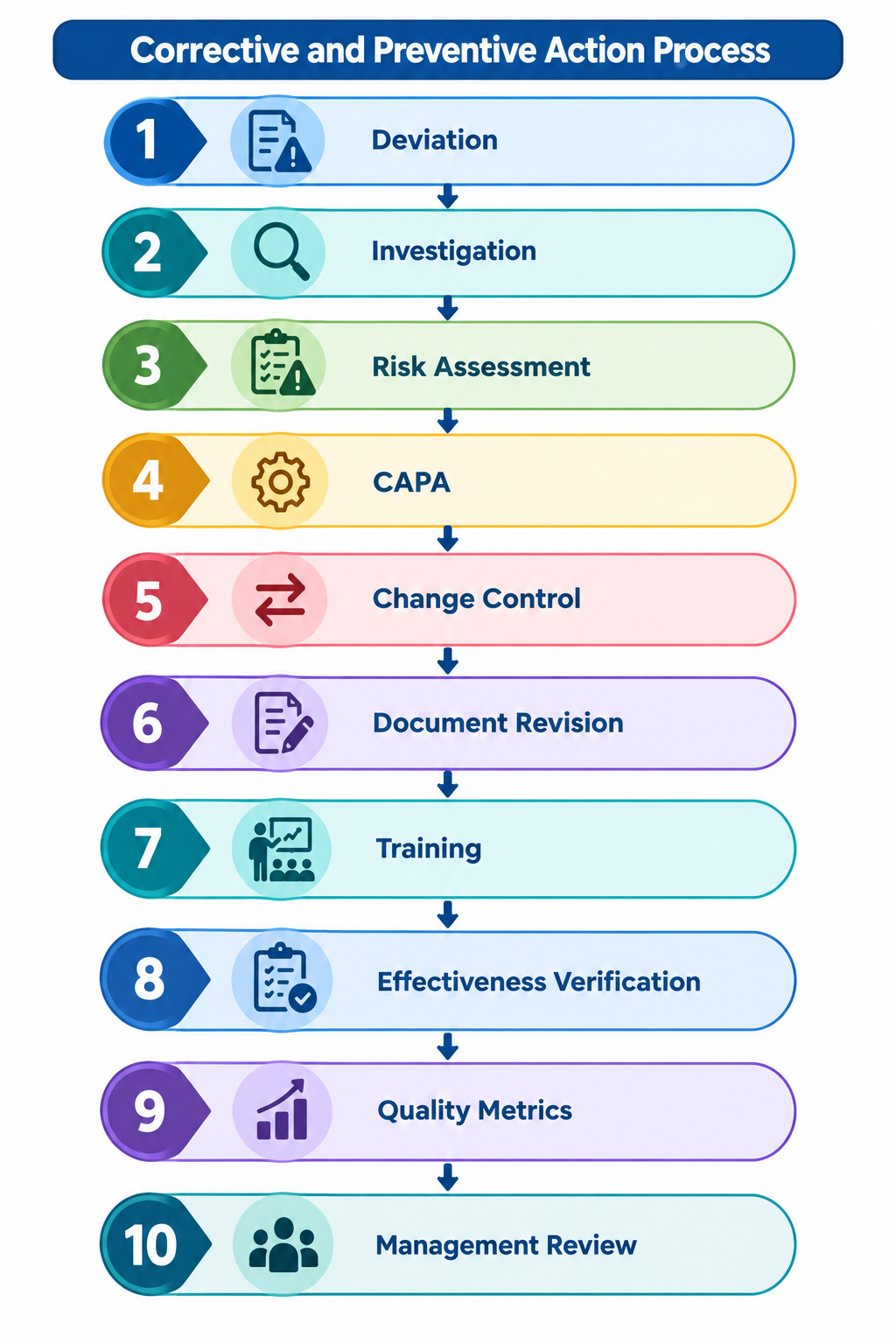
A successful eQMS should not become a collection of disconnected modules. Consider the following relationship:
What Is an Electronic Quality Management System (eQMS)?
An eQMS is a controlled electronic platform used to manage and integrate pharmaceutical quality processes.
Depending on the organization’s needs, an eQMS may include modules for:
- Deviation management
- CAPA
- Change control
- Complaint management
- Audit management
- Document management
- Training management
- Supplier quality
- Risk management
- Quality metrics
- Nonconformance
- Investigation management
- Management review
- Regulatory commitments
- Effectiveness monitoring
The major advantage of an integrated eQMS is that quality information can be connected across processes.
For example: Deviation → Investigation → Root Cause → CAPA → Change Control → Training → Effectiveness Check → Quality Metric
This creates a more complete quality lifecycle than managing each activity independently through paper records and spreadsheets.
Why Pharmaceutical Companies Are Moving Toward eQMS
Pharmaceutical quality organizations are increasingly dealing with:
- Large volumes of quality data
- Multiple manufacturing sites
- Global suppliers
- Increasing regulatory expectations
- Electronic records
- Remote collaboration
- Complex change-management requirements
- Data-integrity risks
- Increasing audit requirements
- Shorter response times
Paper-based systems can make it difficult to obtain a real-time view of quality performance.
For example, management may need to determine:
- How many critical deviations are currently open?
- Which CAPAs are overdue?
- Which CAPAs repeatedly fail effectiveness checks?
- How many change controls are awaiting approval?
- Which SOPs require revision?
- Which employees have overdue GMP training?
- Which suppliers have recurring quality issues?
- What are the major complaint trends?
An appropriately designed eQMS can provide centralized visibility into these activities.
FDA Considerations for Pharmaceutical eQMS
For companies operating under U.S. FDA requirements, electronic quality systems should be designed with applicable regulatory expectations in mind.
Important areas include:
- Current Good Manufacturing Practice (CGMP)
- Electronic records
- Electronic signatures
- Data integrity
- Computerized systems
- System access controls
- Audit trails
- Data retention
- Backup and recovery
- System security
- Validation or appropriate assurance activities
- Change management
FDA’s 21 CFR Part 11 establishes criteria under which FDA considers electronic records and electronic signatures to be trustworthy, reliable, and generally equivalent to paper records and handwritten signatures under specified circumstances.
Therefore, simply converting a paper form into an electronic form does not automatically create a compliant electronic quality system.
The organization must understand the intended use, risks, controls, and regulatory requirements associated with the system.
eQMS and 21 CFR Part 11
One of the most important considerations for an FDA-regulated electronic quality system is 21 CFR Part 11.
Depending on system use and applicability, controls may include:
- Unique user identification
- Secure passwords
- Electronic signatures
- Signature manifestation
- Audit trails
- Access controls
- Authority checks
- Operational system checks
- Record protection
- System documentation
- Appropriate validation
An eQMS implementation team should conduct a documented assessment to determine which Part 11 controls apply to the intended use of the system.
Data Integrity and eQMS
Digitalization creates significant opportunities for improving data integrity, but poorly designed electronic systems can also introduce new risks.
A pharmaceutical eQMS should support data that is:
- Attributable
- Legible
- Contemporaneous
- Original
- Accurate
and, where applicable, complete, consistent, enduring and available.
The system should provide appropriate controls for:
- User access
- Role-based permissions
- Audit trails
- Electronic signatures
- Data modification
- Record retention
- Backup
- Restoration
- Data export
- System administration
Data integrity should be considered throughout the entire system lifecycle.
The Core eQMS Modules for Pharmaceutical Companies
A mature eQMS can integrate multiple quality processes.
1. Deviation Management
Deviation management is one of the most important eQMS modules. A digital deviation system can standardize:
Event Reporting → Initial Assessment → Classification → Investigation → Root Cause → Risk Assessment → CAPA → Approval → Effectiveness → Closure
Important features may include:
- Unique deviation number
- Automated workflow
- Classification
- Product/process association
- Immediate action
- Impact assessment
- Investigation
- Root-cause analysis
- Quality risk assessment
- CAPA linkage
- QA review
- Approval workflow
- Due-date monitoring
- Escalation
- Effectiveness verification
eQMS advantage
Management can quickly identify:
- Open critical deviations
- Overdue investigations
- Recurring deviations
- Department trends
- Product-related trends
- Root-cause trends
This transforms deviation management from document storage into a source of quality intelligence.
2. CAPA Management
CAPA should be directly connected to deviations, audits, complaints, OOS/OOT investigations, and other quality events. A digital CAPA workflow can include:
Problem → Investigation → Root Cause → Action Plan → Implementation → Effectiveness Verification → Closure
Important controls include:
- CAPA owner
- Due date
- Priority
- Risk classification
- Action tracking
- Escalation
- Effectiveness criteria
- QA approval
The eQMS should make it difficult to close a CAPA without appropriate evidence.
3. Change Control Management
Change control is essential for maintaining a controlled pharmaceutical operation. An eQMS can manage changes involving:
- Equipment
- Facilities
- Utilities
- Manufacturing processes
- Analytical methods
- Specifications
- Raw materials
- Packaging materials
- Suppliers
- Computerized systems
- SOPs
- Validation
- Regulatory commitments
A digital change-control workflow may include: Change Request → Initial Assessment → Impact Assessment → Risk Assessment → Approval → Implementation → Verification → Closure
The system should provide visibility of dependencies. For example, a change to a manufacturing process may require:
- SOP revision
- Validation
- Training
- Regulatory assessment
- Batch-record revision
- Specification review
An integrated eQMS can link these activities.
4. Complaint Management
Product complaints are an important source of product-quality information. An electronic complaint-management system can capture:
- Complaint number
- Product
- Batch/lot
- Market
- Customer information
- Complaint category
- Product defect
- Investigation
- Sample availability
- Root cause
- CAPA
- Regulatory assessment
- Response
- Closure
Complaint data should also feed into quality trending. For example:
Complaint Trend → Product Quality Review → Risk Assessment → CAPA → Management Review
This creates a feedback loop between market experience and the PQS.
5. Audit Management
Internal audits, supplier audits, and regulatory inspections generate significant quality information.
An eQMS can manage:
- Audit schedules
- Audit plans
- Auditor assignments
- Findings
- Classification
- Responses
- CAPA
- Due dates
- Effectiveness
- Closure
A centralized audit system can help management identify recurring findings across departments and sites.
6. Training Management
Training is another critical component of pharmaceutical quality systems. An eQMS/LMS integration can connect:
SOP Revision → Training Assignment → Employee Completion → Effectiveness → Training Record
The system can automatically identify:
- Overdue training
- Employees requiring training
- Training by department
- Training related to a specific SOP
- Training associated with a CAPA
- Training associated with a change control
This reduces dependence on manually maintained training matrices.
7. Document Management
Controlled document management is a fundamental requirement of pharmaceutical quality operations.
A document-management module may control:
- SOPs
- Policies
- Specifications
- Forms
- Protocols
- Work instructions
- Manuals
- Quality agreements
- Validation documents
- Records
Important functionality may include:
- Version control
- Document approval
- Electronic signatures
- Effective dates
- Controlled distribution
- Revision history
- Periodic review
- Obsolete-document control
- Access permissions
A major objective is to ensure that employees access the current approved version of a controlled document.
8. Quality Risk Management
An eQMS can also integrate quality risk management. Risk assessments may be associated with:
- Deviations
- CAPA
- Changes
- Validation
- Equipment
- Facilities
- Utilities
- Suppliers
- Data integrity
- Computerized systems
Typical tools include:
- FMEA
- HACCP
- Risk matrices
- Fault Tree Analysis
- Risk ranking
Integration allows risk information to be connected to actual quality events.
9. Quality Metrics and Dashboards
One of the biggest advantages of eQMS digitalization is the ability to transform quality data into management information. A pharmaceutical quality dashboard may include:
Deviation Metrics
- Open deviations
- Critical deviations
- Recurrence
- Closure time
- Overdue investigations
CAPA Metrics
- Open CAPAs
- Overdue CAPAs
- CAPA recurrence
- Effectiveness failures
Change Control Metrics
- Open changes
- Overdue changes
- Average implementation time
- Changes by category
Complaint Metrics
- Complaint rate
- Product trends
- Recurring complaints
- Investigation status
Training Metrics
- Training completion
- Overdue training
- Training effectiveness
Audit Metrics
- Open findings
- Critical findings
- Recurring findings
- Overdue responses
The objective should be to convert data into actionable quality intelligence.
GAMP 5 Compliance Guide: What is It and How Modern Requirements Helps
eQMS Implementation: A Step-by-Step Approach
Implementing an eQMS should be treated as a major quality-system transformation project.
Step 1: Define the Business and Quality Objectives
First identify:
- Why is the organization implementing an eQMS?
- Which problems need to be solved?
- Which processes should be digitalized?
- What regulatory requirements apply?
- What are the expected benefits?
Avoid starting with software features alone.
Step 2: Map Existing Processes
Document the current state. For each process, evaluate:
- Current workflow
- Forms
- Approvals
- Responsibilities
- Manual activities
- Existing systems
- Interfaces
- Problems
- Bottlenecks
- Compliance risks
This is commonly called AS-IS process mapping.
Step 3: Design the Future State
Define how the process should work after digitalization. For example:
Current State
Deviation reported on paper → email investigation → spreadsheet CAPA tracker → manual approval → paper closure
Future State
Electronic deviation → automated workflow → investigation → risk assessment → CAPA linkage → electronic approval → effectiveness verification → dashboard
The objective should be process improvement, not merely paper-to-screen conversion.
Step 4: Develop the URS
The User Requirements Specification (URS) should describe what the system needs to accomplish.
Requirements may include:
- Workflow
- User roles
- Access control
- Electronic signatures
- Audit trail
- Reporting
- Notifications
- Escalation
- Document control
- Data retention
- Search
- Interfaces
- Security
- Backup
- Business continuity
Requirements should be clear, testable, and risk-based.
Step 5: Conduct Supplier Evaluation
eQMS vendors should be evaluated against documented requirements. Consider:
Functional Capability
- Deviation
- CAPA
- Change control
- Complaints
- Audits
- Training
- Documents
- Risk management
- Reporting
Compliance
- 21 CFR Part 11
- Data integrity
- Audit trail
- Electronic signatures
- Validation/assurance support
Technical
- Cloud architecture
- Integration
- Security
- Backup
- Disaster recovery
- Availability
- Scalability
Vendor Quality
- Quality system
- Supplier qualification
- Change management
- Release management
- Incident management
- Support
- Service-level agreements
Step 6: Perform Quality Risk Assessment
Not every system function presents the same level of risk. Risk assessment should consider:
- Product quality
- Patient safety
- Data integrity
- Regulatory compliance
- Business continuity
High-risk functions should receive appropriate controls and testing.
Step 7: Configure the System
Configuration should follow approved requirements. Important areas include:
- Workflows
- User roles
- Permissions
- Notifications
- Approval routes
- Electronic signatures
- Forms
- Reports
- Dashboards
- Master data
Avoid unnecessary customization where standard validated functionality meets requirements.
Step 8: Validate or Apply a Risk-Based Computerized-System Assurance Approach
The system must be appropriately assessed and controlled based on its intended use and risk.
Activities may include:
- Validation planning
- Requirements review
- Risk assessment
- Configuration verification
- Functional testing
- User acceptance testing
- Security testing
- Data migration testing
- Interface testing
- Backup/recovery testing
- Audit-trail verification
- Electronic-signature verification
The level of testing should be commensurate with risk.
For FDA-regulated organizations, the approach should also consider applicable FDA expectations for software used in regulated processes.
Step 9: Data Migration
Data migration can become one of the most overlooked risks during eQMS implementation. Examples include migration of:
- Open deviations
- CAPAs
- Change controls
- Training records
- Controlled documents
- Audit findings
- Complaints
- Supplier records
A migration plan should address:
- Data mapping
- Data cleansing
- Data transformation
- Data verification
- Migration testing
- Reconciliation
- Record retention
- Legacy-system access
The organization should be able to demonstrate that migrated records remain complete, accurate, and reliable.
Step 10: Training and Change Management
Technology implementation will fail if users do not understand the new processes. Training should cover:
- System functionality
- GMP responsibilities
- Data integrity
- Electronic signatures
- Workflow requirements
- New procedures
- User responsibilities
- Quality expectations
Different roles may require different training. For example:
QA Administrator ≠ QA Approver ≠ Investigator ≠ Department User ≠ System Administrator
Role-based training is therefore important.
Step 11: Go-Live
Before go-live, confirm:
- System approved
- Validation/assurance completed
- SOPs effective
- Users trained
- Data migrated
- Roles assigned
- Interfaces tested
- Backup confirmed
- Support process established
- Business continuity plan available
A controlled go-live reduces disruption to quality operations.
Step 12: Post-Go-Live Optimization
Implementation is not the end of digital transformation. After go-live, monitor:
- User adoption
- Workflow performance
- System incidents
- Data-quality issues
- Overdue actions
- User feedback
- Reporting accuracy
- System performance
- Process efficiency
Then use the information to improve the system.
Common eQMS Implementation Mistakes
1. Automating a Bad Process
If the existing process is inefficient, simply putting it into software may make the inefficiency faster—not better. Improve the process before automating it.
2. Over-Customization
Excessive customization can:
- Increase complexity
- Increase validation effort
- Increase maintenance
- Complicate upgrades
- Increase cost
Use standard functionality where appropriate.
3. Poor User-Requirement Definition
If requirements are unclear, the organization may select a system that does not adequately support its processes.
4. Weak Data Migration
Incomplete or inaccurate migration can compromise quality records and historical traceability.
5. Treating Validation as a Final Step
Validation should be integrated into the project lifecycle rather than performed only immediately before go-live.
6. Ignoring Change Management
Users may resist new workflows if they do not understand why the organization is changing.
7. Excessive Notifications
Too many alerts can result in notification fatigue. Notifications should be meaningful and risk-based.
eQMS and Data Integrity: Important Controls
An eQMS should be designed around the complete data lifecycle. Consider:
Data Creation → Review → Approval → Modification → Storage → Retrieval → Retention → Archiving/Disposition
Controls may include:
- Unique user accounts
- Role-based access
- Segregation of duties
- Audit trails
- Electronic signatures
- Periodic access review
- Backup
- Recovery
- Data retention
- System monitoring
Administrative access should receive particular attention.
System administrators should not automatically have unrestricted ability to create, modify, or delete regulated records without appropriate controls.
Cybersecurity and Pharmaceutical eQMS
Digitalization also increases dependence on information technology. An eQMS cybersecurity strategy should consider:
- Authentication
- Authorization
- Encryption
- Network security
- Vulnerability management
- Security monitoring
- Incident response
- Backup
- Disaster recovery
- Business continuity
- Vendor security
- Third-party access
Cybersecurity should be considered part of the overall computerized-system risk assessment.
Cloud-Based eQMS: What Should Pharmaceutical Companies Consider?
Cloud deployment can offer:
- Scalability
- Centralized access
- Reduced infrastructure burden
- Faster deployment
- Automated updates
- Remote accessibility
However, pharmaceutical organizations should carefully evaluate:
- Vendor qualification
- Data ownership
- Data location
- Security
- Backup
- Disaster recovery
- Service availability
- Change management
- Incident management
- Subcontractors
- Business continuity
- Data export
- Contractual responsibilities
Cloud deployment does not eliminate the regulated company’s responsibility for appropriate oversight of the system.
Quality Metrics: Moving from Reporting to Predictive Quality Management
A mature eQMS should eventually move beyond basic reporting.
Level 1 — Descriptive
“What happened?”
Example: 25 deviations were opened this month.
Level 2 — Diagnostic
“Why did it happen?”
Example: 40% were associated with equipment setup.
Level 3 — Predictive
“What could happen next?”
Example: A recurring failure pattern indicates increased risk around a specific equipment component.
Level 4 — Prescriptive
“What action should be considered?”
Example: Review preventive-maintenance frequency and component replacement strategy. The objective is to progressively transform quality data into quality intelligence.
Integrating eQMS with Other Pharmaceutical Systems
An eQMS may need interfaces with:
- ERP
- LIMS
- MES
- DMS
- LMS
- HR systems
- Environmental monitoring systems
- Stability systems
- Laboratory instruments
- Supplier-management platforms
Integration can reduce duplicate data entry and improve traceability. However, interfaces also introduce additional risks. Each interface should be appropriately assessed for:
- Data mapping
- Data transfer
- Error handling
- Security
- Reconciliation
- Audit trail
- Availability
- Change management
How eQMS Supports Management Review
An eQMS can provide management with near-real-time quality information. A management dashboard might display:
Quality Health
- Open critical deviations
- Overdue CAPA
- Critical audit findings
- Complaint trends
- Change control backlog
- Training compliance
- Supplier quality performance
- Recurring quality events
This allows management to focus on significant risks rather than manually collecting information from multiple spreadsheets and departments.
eQMS and Continual Improvement
Digitalization should ultimately support continual improvement.
The closed-loop model is:
Quality Data
↓
Trend Analysis
↓
Risk Assessment
↓
Management Review
↓
CAPA / Change / Improvement
↓
Implementation
↓
Effectiveness Verification
↓
Re-Trending
↓
Continual Improvement
This connects eQMS implementation with the broader Pharmaceutical Quality System.
Practical eQMS Implementation Checklist
Before implementation, ask:
Governance
- Is there an executive sponsor?
- Is QA involved?
- Is IT involved?
- Are business-process owners identified?
- Is a project governance structure established?
Requirements
- Is the URS approved?
- Are critical requirements identified?
- Are regulatory requirements documented?
- Are data-integrity requirements included?
Supplier
- Has the vendor been appropriately assessed?
- Is supplier quality information available?
- Are service-level requirements defined?
- Are security controls evaluated?
Validation / Assurance
- Is a risk assessment completed?
- Is the intended use documented?
- Are test requirements defined?
- Is validation or assurance appropriately planned?
Data
- Is data migration required?
- Is data cleansing completed?
- Is migration verified?
- Is historical data accessible?
Security
- Are user roles defined?
- Is access controlled?
- Are audit trails enabled?
- Are electronic signatures appropriately configured?
Training
- Are users trained?
- Is role-based training implemented?
- Are system administrators appropriately trained?
Go-Live
- Are SOPs effective?
- Are workflows approved?
- Is testing complete?
- Is business continuity established?
Post-Go-Live
- Are system metrics monitored?
- Is user feedback collected?
- Are incidents tracked?
- Is system performance reviewed?
- Is continual improvement implemented?
The Future of Pharmaceutical Quality Digitalization
The next phase of pharmaceutical digitalization is likely to move beyond basic workflow automation.
Emerging capabilities may include:
- Advanced analytics
- Artificial intelligence-assisted investigations
- Automated trend detection
- Predictive quality analytics
- Intelligent document search
- Automated regulatory intelligence
- Integrated risk analytics
- Real-time quality dashboards
- Digital batch records
- Digital validation
- Greater system interoperability
However, emerging technology should be introduced using a risk-based and scientifically justified approach.
AI or automation should not replace qualified personnel responsible for pharmaceutical quality decisions.
Instead, technology should help quality professionals identify information faster, improve consistency, and focus their attention on higher-value activities.
Conclusion
Pharmaceutical digitalization is much more than replacing paper forms with electronic workflows.
A successful eQMS transformation should create an integrated, controlled, and data-driven Pharmaceutical Quality System.
The most important elements include:
Deviations + CAPA + Change Control + Complaints + Audits + Training + Document Management + Risk Management + Quality Metrics
When these systems are properly integrated, an organization can create a continuous flow of quality information:
Event → Investigation → Risk → Action → Verification → Learning → Improvement
For companies operating in the U.S. pharmaceutical market, the digital transformation strategy should be aligned with applicable FDA requirements and expectations concerning CGMP, electronic records, electronic signatures, data integrity, and computerized systems.
The ultimate objective is not simply to have an eQMS.
The objective is to create a more reliable, transparent, efficient, and continuously improving Pharmaceutical Quality System that supports product quality and patient protection.
Digitalize the process, control the data, manage the risk, measure the performance, and continuously improve the Pharmaceutical Quality System.
A successful eQMS should make the right quality action easier to perform, easier to document, easier to review, and easier to measure.
Continual Improvement of the Pharmaceutical Quality System: A Practical FDA, ICH & PIC/S Framework