FDA Warning Letter: Major CGMP Violations and Required Remediation
The FDA warning letter identifies significant violations of Current Good Manufacturing Practice (CGMP) requirements for finished pharmaceuticals. The FDA determined that the firm’s methods, facilities, and controls for manufacturing, processing, packing, or holding drugs did not conform to CGMP requirements under 21 CFR Parts 210 and 211.
The FDA warning letter states that the company’s drug products were considered adulterated under Section 501(a)(2)(B) of the Federal Food, Drug, and Cosmetic Act because of deficiencies in manufacturing controls and CGMP compliance. The FDA also reviewed the company’s April 2, 2026 response to the Form FDA 483 and concluded that the response did not provide sufficient supporting documentation or adequate evidence demonstrating effective corrective actions.
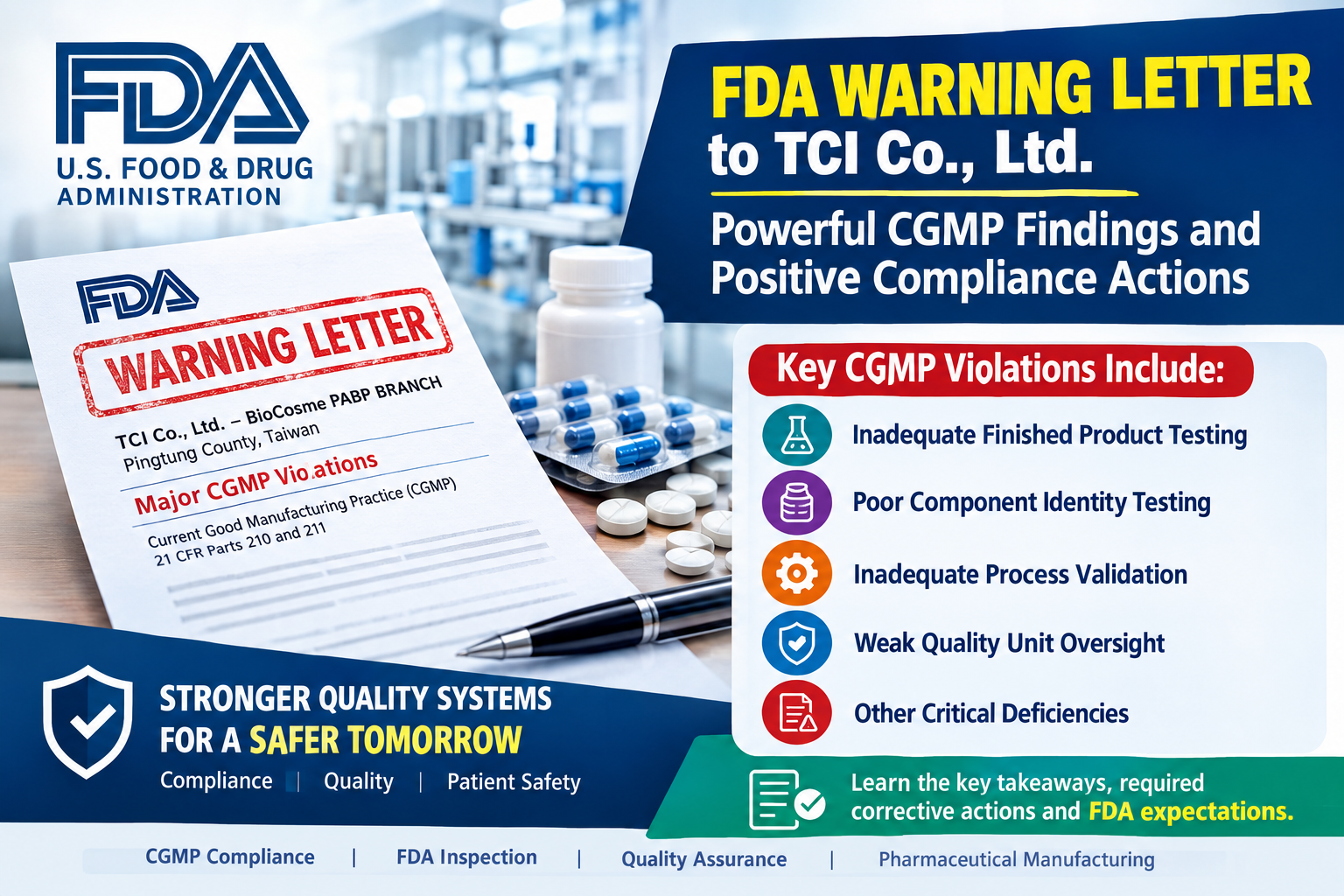
Key Findings in the FDA Warning Letter
The FDA warning letter identifies four major areas of concern involving laboratory testing, component testing, process validation, and quality unit oversight.
1. Inadequate Finished Product Testing Before Release
According to the FDA warning letter, the firm failed to perform appropriate laboratory testing for each batch before release, including testing for the identity and strength of active ingredients, as required by 21 CFR 211.165(a).
The FDA found that certain OTC drug product batches were released and distributed in the U.S. market without appropriate assay testing of the API as part of finished-product release testing.
The FDA emphasized that without adequate testing, the company lacked sufficient scientific evidence to demonstrate that its drug batches met established specifications before release.
The FDA required the company to provide a comprehensive quality agreement defining responsibilities between the contract manufacturing organization and the product owner. The agreement should address testing, specifications, investigations, batch disposition, manufacturing responsibilities, and quality-related communication. The company must also provide applicable chemical and microbiological test methods and specifications used before lot disposition.
2. Inadequate Identity Testing of Incoming Components
A major issue highlighted in the FDA warning letter was inadequate testing of incoming APIs and raw materials.
The firm did not perform all required identity testing and relied on supplier Certificates of Analysis (COAs) without adequately establishing the reliability of supplier test results at appropriate intervals. These deficiencies were cited under 21 CFR 211.84(d)(1) and 211.84(d)(2).
The FDA also identified instances where components were not tested in accordance with applicable USP monograph requirements. The supplier COAs lacked several required tests, including certain identity, impurities, heavy metals, residue-on-ignition, and other specification tests.
The company acknowledged limitations in its laboratory instrumentation and proposed outsourcing some testing. However, the FDA emphasized that the manufacturer remains responsible for adequately sampling, testing, and examining components before their use in production.
The FDA requested additional CAPA measures, stronger supplier qualification controls, and a clear description of how every component lot would be tested for identity, strength, quality, and purity. If supplier COAs are used in place of certain testing, the firm must establish supplier reliability through appropriate qualification and periodic requalification.
3. Inadequate Process Validation and System Qualification
The FDA warning letter also identified deficiencies in the firm’s written production and process-control procedures under 21 CFR 211.100(a).
The FDA determined that the firm’s manufacturing processes were not adequately validated to demonstrate that they were reproducible, controlled, and capable of consistently producing drugs of appropriate quality. In one example, the process-validation documentation contained a manufacturing step that was absent from the relevant batch record.
The FDA further identified inadequate qualification of a system used in manufacturing. The qualification documentation did not include sufficient testing such as total organic carbon (TOC), conductivity, and microbial content to demonstrate that the system was suitable for its intended use.
The FDA required the company to provide a comprehensive validation program covering process performance qualification, ongoing monitoring, equipment qualification, facility qualification, and continuing process control.
The firm was also required to establish appropriate microbial monitoring procedures and define current action and alert limits for total microbial counts and objectionable organisms.
4. Inadequate Quality Unit Oversight
Another significant finding in the FDA warning letter concerned the responsibilities of the firm’s Quality Unit (QU) under 21 CFR 211.22.
The FDA found that manufacturing process parameters had been changed without documented justification and without following the firm’s established change-management procedure. The company later determined that members of its research and development team had made on-site process adjustments without following the required procedure.
The FDA concluded that the retrospective review was not sufficiently comprehensive to determine whether other similar incidents had occurred.
The inspection also identified deficiencies in batch production and control records and the absence of a written stability testing program. These findings further demonstrated weaknesses in Quality Unit oversight.
The FDA required the company to strengthen Quality Unit authority, procedures, batch review, investigation oversight, change control, and personnel training. The company must ensure that manufacturing process changes receive appropriate Quality Unit approval before commercial manufacturing.
Drug Production Suspended
The FDA warning letter also states that the company had communicated its decision to allow its FDA drug registration to expire. The company indicated that it would renew the registration if a U.S. order was received.
The FDA stated that if the firm intends to resume manufacturing operations regulated under the FD&C Act, it must notify the FDA before resuming operations and resolve the identified deficiencies and systemic CGMP weaknesses.
Because of the nature of the violations, FDA recommended that the firm engage a qualified consultant in accordance with 21 CFR 211.34. The consultant should conduct a comprehensive six-system CGMP audit and evaluate the completion and effectiveness of CAPA before the company seeks resolution of its compliance status.
FDA-Required Corrective Actions
The FDA warning letter requires the company to address several critical remediation areas, including:
- Comprehensive quality agreements and clearly defined responsibilities.
- Complete finished-product testing before batch release.
- Adequate identity testing of APIs and raw materials.
- Stronger supplier qualification and COA verification.
- Appropriate process validation and continued process verification.
- Equipment and facility qualification.
- Microbial monitoring and scientifically justified alert/action limits.
- Strengthened Quality Unit oversight.
- Effective change-control procedures.
- Complete batch documentation and review.
- A written stability testing program.
- Personnel training on change management and CGMP requirements.
- Comprehensive CAPA implementation and effectiveness assessment.
- Independent consultant support and a six-system CGMP audit.
FDA Compliance Expectations
The FDA warning letter makes clear that the responsibility for drug quality remains with the manufacturer. Use of a contract manufacturing arrangement or supplier COA does not remove the firm’s responsibility for ensuring the identity, strength, quality, purity, and safety of its drug products.
The company must identify root causes, implement effective corrective and preventive actions, and demonstrate sustained CGMP compliance. FDA also stated that executive management remains responsible for resolving deficiencies and systemic flaws.
Failure to address the violations could result in FDA refusing admission of articles manufactured at the Taiwan facility into the United States under Section 801(a)(3) of the FD&C Act.
The FDA requested a written response within 15 business days of receipt of the letter.
Conclusion
This FDA warning letter highlights the importance of a robust pharmaceutical quality system covering laboratory controls, raw-material testing, supplier qualification, process validation, equipment qualification, change control, stability testing, batch documentation, and Quality Unit oversight.
For pharmaceutical manufacturers supplying products to the U.S. market, the FDA warning letter serves as an important reminder that documented procedures alone are not sufficient. Companies must demonstrate that their controls are implemented effectively, scientifically justified, appropriately documented, and continuously monitored.
The FDA warning letter also demonstrates the importance of effective CAPA. Corrective actions should address the root causes of deficiencies rather than simply correcting individual observations. Companies should verify CAPA effectiveness and demonstrate sustained compliance before considering remediation complete.
Overall, this FDA warning letter provides a valuable compliance lesson for pharmaceutical and OTC drug manufacturers: strong quality systems, complete testing, validated processes, effective Quality Unit oversight, and documented evidence of control are essential for maintaining CGMP compliance.
Key Regulatory References
- 21 CFR Parts 210 and 211 – Current Good Manufacturing Practice
- 21 CFR 211.22 – Responsibilities of the Quality Control Unit
- 21 CFR 211.84 – Testing and approval/rejection of components
- 21 CFR 211.100 – Written procedures and process controls
- 21 CFR 211.165 – Testing and release of drug products
- 21 CFR 211.166 – Stability testing
- 21 CFR 211.188 – Batch production and control records
- 21 CFR 211.34 – Consultants
- Section 501(a)(2)(B) of the FD&C Act
- Section 801(a)(3) of the FD&C Act
Source: FDA warning letter concerning TCI Co., Ltd. – BioCosme PABP BRANCH, Pingtung County, Taiwan. Issued on 09/02/2026
Disclaimer
Educational & Awareness Purpose Only:
This article has been prepared for learning, training, educational, and pharmaceutical industry awareness purposes only. The information presented in this article is based on and/or summarized from publicly available information published on the official U.S. Food and Drug Administration (FDA) website, including FDA Warning Letters.
For the original and most up-to-date information, readers should refer directly to the official FDA Warning Letters database and related FDA publications.
This article is not an official FDA publication, communication, guidance, regulatory decision, or statement of the U.S. Food and Drug Administration. PharmGuidances is not affiliated with, endorsed by, or representing the FDA.
The information provided should not be used as a substitute for official FDA documents, applicable laws and regulations, regulatory guidance, legal advice, compliance advice, or professional consultation. It should not be relied upon for making regulatory, legal, manufacturing, quality, or business decisions.
Official Reference:
FDA Warning Letters – U.S. Food and Drug Administration
© PharmGuidances – For Educational, Training & Awareness Purposes Only.