FDA Warning Letter: Major Sterility, CAPA, Environmental Monitoring and CGMP Violations
The FDA Warning Letter reviewed in this article identifies significant Current Good Manufacturing Practice (CGMP) deficiencies at a pharmaceutical facility involved in the manufacture of sterile injectable drug products.
The inspection was conducted under the authority of the U.S. Food and Drug Administration (FDA) to protect patients from unsafe, ineffective, adulterated, or poor-quality medicines. FDA identified serious deficiencies involving:
- Sterility failure investigations
- Repeated fungal contamination
- Environmental monitoring (EM)
- Deviation and failure investigations
- CAPA effectiveness
- Quality Unit oversight
- Aseptic processing
- Airflow visualization studies
- Restricted Access Barrier System (RABS) controls
- Cleanroom maintenance
- Disinfection effectiveness
- Process validation
- Cleaning validation
- Batch documentation
- Facility and equipment qualification
- Pharmaceutical quality systems
The findings fall primarily under 21 CFR Parts 210 and 211, including 21 CFR 211.192, 211.22(d), 211.113(b), and 211.58.
The FDA Warning Letter demonstrates that sterile manufacturing facilities must maintain a robust contamination control strategy supported by scientifically sound investigations, effective CAPA, reliable environmental monitoring, qualified facilities, validated processes, and strong Quality Unit oversight.
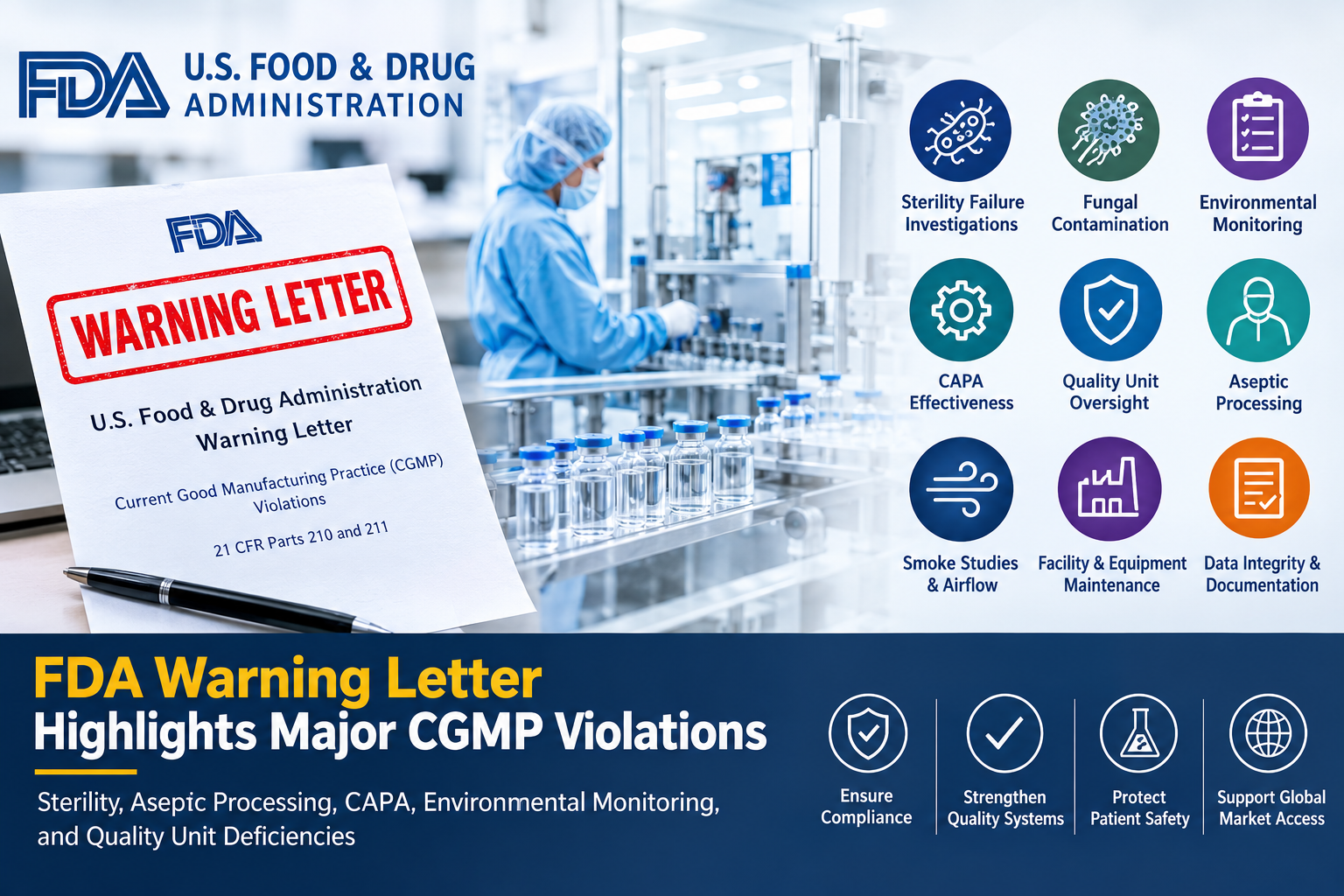
Major Findings in the FDA Warning Letter
The inspection identified three major areas of concern:
- Inadequate investigation of sterility failures and recurring fungal contamination.
- Inadequate Quality Unit responsibilities and oversight.
- Deficiencies in aseptic processing, environmental monitoring, airflow visualization, and facility maintenance.
These deficiencies were considered systemic and required comprehensive remediation rather than isolated procedural corrections.
1. Inadequate Investigation of Sterility Failures
Under 21 CFR 211.192, pharmaceutical manufacturers are required to thoroughly investigate unexplained discrepancies, batch failures, and failures of components to meet established specifications.
The facility was operating as a contract manufacturer of sterile injectable products and failed to adequately investigate a sterility test failure.
A fungal organism, Ustilago spermophora, was identified during testing.
Although the affected batch was rejected, FDA determined that the investigation was inadequate because the root cause was classified as “undetermined” without sufficiently investigating potential contamination pathways. Potential sources that should have been evaluated included:
- Personnel movement
- Material movement
- HVAC systems
- Airflow patterns
- Facility design
- Cleaning and disinfection
- Equipment surfaces
- Aseptic interventions
- Environmental monitoring
- Personnel practices
- Potential fungal migration through classified areas
The FDA Warning Letter emphasized that rejecting a contaminated batch alone does not constitute an adequate investigation. The investigation must determine the probable root cause and establish effective CAPA to prevent recurrence.
2. Recurring Fungal Contamination in Aseptic Areas
One of the most significant issues identified in the FDA Warning Letter was repeated recovery of fungi from areas associated with sterile manufacturing.
FDA identified multiple environmental monitoring excursions involving fungal organisms. Examples described in the inspection included recoveries of organisms such as:
- Chaetomium globosum
- Didymella glomerata
- Mycosphaerella africana
- Chaetomium cruentum/globosum
The observations occurred at different locations and dates associated with aseptic filling operations. The repeated recovery of fungi raised concerns about the facility’s contamination control strategy.
3. Failure to Identify the Root Cause of Environmental Monitoring Excursions
FDA found that several investigations did not adequately identify the source of fungal contamination. In some cases, the company attributed contamination to events such as power failures.
However, FDA determined that the investigations did not sufficiently evaluate other possible contamination pathways. For sterile manufacturing, an investigation of an environmental monitoring excursion should consider:
Personnel Factors
- Gowning practices
- Personnel movement
- Operator interventions
- Personnel qualification
- Aseptic technique
Facility Factors
- HVAC performance
- Air pressure differentials
- Airflow patterns
- Building condition
- Room interfaces
- Material transfer routes
Equipment Factors
- Equipment design
- Equipment cleaning
- Equipment disinfection
- Equipment maintenance
- Difficult-to-clean areas
Process Factors
- Manual interventions
- Line stoppages
- Equipment adjustments
- Product exposure
- Material transfers
The FDA Warning Letter makes clear that simply identifying an event that occurred around the same time as an environmental monitoring excursion is not sufficient to establish a scientifically justified root cause.
4. Increasing Fungal Trends Were Not Adequately Addressed
FDA noted an increasing trend of fungal recoveries in aseptic production areas and supporting cleanrooms. The concern was not limited to individual environmental monitoring excursions.
FDA was concerned about the overall trend and the fact that investigations were closed without sufficiently robust CAPA. A proper environmental monitoring trend program should evaluate:
- Organism identification
- Location
- Frequency
- Recurrence
- Severity
- Personnel association
- Equipment association
- Room association
- Seasonal trends
- Alert/action-level excursions
- Repeated recoveries
- Microbial species distribution
Trending should be performed proactively rather than waiting for a sterility failure.
5. Inadequate CAPA Program
The FDA Warning Letter found that the firm’s investigations frequently did not lead to sufficiently effective corrective and preventive actions. A strong CAPA program should include:
- Problem definition
- Immediate correction
- Investigation
- Root-cause analysis
- Risk assessment
- Corrective action
- Preventive action
- Implementation
- Effectiveness verification
- Management review
- Quality Unit approval
CAPA should address systemic causes rather than simply updating an SOP or retraining employees.
For example, if recurring fungal contamination is associated with facility design, HVAC performance, personnel movement, equipment condition, or cleaning practices, retraining alone would not adequately address the problem.
6. Independent Assessment of the Investigation System
FDA requested a comprehensive independent assessment of the firm’s systems for investigating:
- Deviations
- Discrepancies
- Complaints
- OOS results
- Batch failures
- Sterility failures
- Environmental monitoring excursions
The assessment should evaluate:
- Investigation competency
- Investigation scope
- Root-cause methodology
- Evidence evaluation
- Risk assessment
- CAPA selection
- CAPA effectiveness
- Quality Unit oversight
- Investigation timelines
- Documentation practices
- Trend analysis
This requirement demonstrates the importance of having a scientifically robust investigation process.
7. Comprehensive Contamination Risk Assessment
FDA requested an independent risk assessment covering contamination hazards associated with aseptic manufacturing. The assessment should include:
- ISO 5 operations
- Human interventions
- Equipment suitability
- Equipment ergonomics
- Air quality
- Air volume
- Airflow
- Facility layout
- Personnel flow
- Material flow
- Material transfer
- Cleanroom design
- Aseptic processing lines
The assessment should lead to specific CAPA recommendations and defined implementation timelines.
8. Environmental Monitoring Program Deficiencies
Environmental monitoring was another major concern identified in the FDA Warning Letter.
FDA determined that the facility’s environmental monitoring system had deficiencies involving sampling techniques and sampling locations.
For example, investigators observed that certain surfaces were not adequately sampled and that analysts did not sample the maximum accessible areas.
This is important because environmental monitoring data are only meaningful when samples are collected using scientifically appropriate methods.
9. Effective Environmental Monitoring Requires a Risk-Based Strategy
An effective EM program should define:
Sampling Locations
Locations should be selected based on contamination risk, including:
- Critical processing areas
- Product-contact surfaces
- Equipment
- Operator interaction points
- Difficult-to-clean areas
- Material transfer points
- Airflow-sensitive areas
Sampling Frequency
The frequency should be scientifically justified based on:
- Process risk
- Historical data
- Facility classification
- Product exposure
- Intervention frequency
- Environmental trends
Sampling Methods
Methods should be appropriately qualified and performed consistently.
Trending
Data should be evaluated for:
- Recurring organisms
- Increasing microbial counts
- Repeated locations
- Repeated personnel association
- Fungal trends
- Seasonal patterns
- Action-level excursions
The FDA Warning Letter emphasizes that an apparently acceptable historical trend cannot compensate for poor sampling techniques or inadequate sampling locations.
10. Quality Unit Oversight Deficiencies
The second major violation cited in the FDA Warning Letter involved the Quality Control Unit under 21 CFR 211.22(d).
FDA found that the Quality Unit did not provide adequate oversight of sterile manufacturing operations. Specific deficiencies included:
- Inadequate documentation of aseptic interventions
- Inadequate disinfectant efficacy studies
- Lack of appropriate process validation
- Insufficient review of manufacturing records
- Inadequate oversight of manufacturing activities
The Quality Unit must have sufficient authority and resources to ensure that manufacturing and laboratory activities comply with approved procedures and CGMP requirements.
11. Incomplete Documentation of Aseptic Interventions
FDA investigators observed significant discrepancies between the number of interventions actually performed and the number documented in batch records.
One batch record reportedly documented only 12 interventions, while approximately 200 interventions were indicated to have occurred. Critical interventions were also not adequately documented.
These included activities such as:
- Removing vials from filling areas
- Handling fallen vials
- Other interventions within critical processing areas
Accurate documentation of aseptic interventions is essential because interventions can potentially affect sterility assurance.
12. Why Aseptic Intervention Documentation Matters
Aseptic interventions should be:
- Clearly defined
- Minimized where possible
- Documented contemporaneously
- Scientifically assessed
- Included in aseptic process simulations where appropriate
- Evaluated for contamination risk
- Reviewed by the Quality Unit
Incomplete documentation compromises the ability to determine whether a batch was manufactured under validated and controlled conditions.
13. Disinfectant Efficacy Study Deficiencies
FDA also identified deficiencies in disinfectant efficacy studies. The firm’s studies did not adequately represent the full range of microorganisms recovered from the facility.
A scientifically robust disinfectant efficacy program should consider relevant environmental isolates and demonstrate that the selected disinfectant system is effective under defined conditions. Important factors include:
- Organism selection
- Contact time
- Concentration
- Surface type
- Temperature
- Organic load
- Application method
- Recovery methodology
- Neutralization
- Environmental conditions
The FDA Warning Letter therefore highlights the importance of connecting environmental monitoring data with disinfectant efficacy studies.
14. Process Validation Deficiencies
FDA also identified concerns regarding process validation. The firm had implemented a new production step but had not adequately demonstrated process validation for the revised manufacturing process.
For sterile drug products, process validation should provide evidence that the process can consistently produce a product meeting predetermined quality requirements. Important elements include:
- Process design
- Process qualification
- Process Performance Qualification (PPQ)
- Critical process parameters
- Critical quality attributes
- Intra-batch variation
- Inter-batch variation
- Continued process verification
- Ongoing monitoring
15. Cleaning Validation Deficiencies
The FDA Warning Letter also required improvements to the cleaning validation program. A comprehensive cleaning validation program should consider worst-case conditions. FDA specifically highlighted the importance of evaluating:
- Higher toxicity products
- Higher potency products
- Poorly soluble products
- Difficult-to-clean products
- Difficult-to-clean equipment locations
- Worst-case swab locations
- Maximum dirty hold time
- Cleaning-agent effectiveness
- Maximum clean hold time where applicable
Cleaning validation should demonstrate that residues and contaminants are consistently controlled to scientifically justified acceptance criteria.
16. Change Management and Validation
The warning letter also emphasized the importance of change control. Before introducing:
- New equipment
- New manufacturing steps
- New products
- Process modifications
- Facility modifications
- HVAC changes
- Critical equipment modifications
the firm should perform appropriate:
- Change control
- Impact assessment
- Quality risk assessment
- Validation impact assessment
- Qualification assessment
- Regulatory assessment
- Implementation
- Post-implementation verification
A change should not be assumed to have no validation impact merely because it appears minor.
17. Airflow Visualization Smoke Study Deficiencies
Another significant finding in the FDA Warning Letter involved airflow visualization (AFV) smoke studies.
FDA found that smoke studies were not adequately performed following modifications to a Restricted Access Barrier System (RABS).
The validation group reportedly determined that smoke studies were unnecessary after a modification, even though engineering personnel had proposed performing them.
FDA considered this inadequate because modifications to critical airflow systems must be evaluated to determine their potential effect on airflow and first-air protection.
18. Dynamic Smoke Studies Are Critical for Sterile Manufacturing
Airflow visualization studies should demonstrate that unidirectional airflow provides appropriate protection during both normal operations and interventions. Studies should consider:
- Normal operation
- Operator interventions
- Equipment adjustments
- Product spillage response
- Line stoppages
- Material movement
- Cleaning interventions
- Worst-case conditions
The purpose is to demonstrate that interventions do not compromise first-air protection. The FDA Warning Letter also highlighted the importance of performing studies under dynamic conditions using appropriate visualization techniques.
19. RABS Design and Operation Concerns
FDA also questioned whether the facility’s processing lines met the expected characteristics of a Restricted Access Barrier System. The agency noted concerns regarding the number of interventions and the actual design and operation of the system.
A barrier system should reduce the possibility of direct human intervention and minimize contamination risks. Sterile manufacturing facilities should therefore assess:
- Barrier integrity
- Glove systems
- Material transfer
- Intervention frequency
- Operator access
- Airflow
- Cleaning
- Disinfection
- Equipment ergonomics
- Line design
20. Facility Maintenance Deficiencies
The inspection identified deterioration in classified areas. Examples included:
- Peeling paint
- Bubbling surfaces
- Plastic debris
- Deteriorating surfaces
- Cleanroom maintenance deficiencies
Deteriorating surfaces can become sources of:
- Particulate contamination
- Microbial contamination
- Fungal growth
- Cleaning difficulties
The FDA Warning Letter therefore reinforces the importance of maintaining cleanrooms in an appropriate state of repair.
21. Contamination Control Strategy
A modern sterile manufacturing operation should maintain an integrated contamination control strategy. The strategy should consider:
Personnel
- Gowning
- Training
- Qualification
- Aseptic behavior
- Personnel flow
Facility
- Cleanroom classification
- HVAC
- Airflow
- Pressure differentials
- Surfaces
- Maintenance
Equipment
- Design
- Cleanability
- Sterilizability
- Maintenance
- Preventive maintenance
Materials
- Material transfer
- Disinfection
- Storage
- Movement
Process
- Interventions
- Aseptic operations
- Sterilization
- Filling
- Hold times
Monitoring
- Environmental monitoring
- Personnel monitoring
- Trending
- Microbial identification
22. Pharmaceutical Quality System Was Considered Ineffective
The FDA Warning Letter concluded that significant findings demonstrated deficiencies in the overall pharmaceutical quality system. The concerns included:
- Inadequate management oversight
- Insufficient Quality Unit authority
- Weak investigations
- Inadequate CAPA
- Environmental monitoring deficiencies
- Poor aseptic practices
- Validation deficiencies
- Facility maintenance problems
- Inadequate contamination control
FDA therefore expected executive management to conduct a comprehensive assessment of global manufacturing operations.
23. Independent GMP Consultant Recommended
Because of the nature and scope of the deficiencies, FDA recommended that the firm engage a qualified consultant in accordance with 21 CFR 211.34. The consultant should assist with:
- CGMP compliance
- Investigation remediation
- CAPA
- Contamination control
- Quality systems
- Validation
- Facility assessment
- Manufacturing systems
- Laboratory systems
FDA also recommended a comprehensive six-system GMP audit and evaluation of CAPA completion and effectiveness. Importantly, hiring a consultant does not transfer regulatory responsibility away from company management. Executive management remains responsible for CGMP compliance.
24. What Pharmaceutical Companies Can Learn from This FDA Warning Letter
This FDA Warning Letter provides several important lessons for sterile pharmaceutical manufacturers.
Lesson 1: Sterility Failures Require Deep Investigations
A failed sterility test should never automatically be classified as an isolated event or assigned an “undetermined” root cause without comprehensive evaluation.
Lesson 2: Recurring Fungal Recoveries Require Systemic Investigation
Repeated fungal contamination should trigger a comprehensive assessment of facility, HVAC, personnel, equipment, cleaning, disinfection, and material flow.
Lesson 3: CAPA Must Address Root Causes
Retraining and SOP revisions may be necessary but are not always sufficient.
Lesson 4: Environmental Monitoring Must Be Scientifically Designed
Sampling location, frequency, technique, organism identification, and trending are all critical.
Lesson 5: Smoke Studies Must Reflect Actual Operations
Dynamic interventions should be evaluated during airflow visualization studies.
Lesson 6: Quality Units Must Have Authority
The Quality Unit must be capable of independently reviewing, approving, and controlling critical GMP activities.
Lesson 7: Batch Records Must Reflect Actual Operations
Every significant aseptic intervention should be appropriately documented.
Lesson 8: Facility Condition Is Part of Contamination Control
Peeling paint, damaged surfaces, debris, and poor maintenance can contribute to contamination risk.
Lesson 9: Validation Must Follow Process Changes
New equipment, process steps, or facility modifications should undergo appropriate change control and validation-impact assessment.
Lesson 10: Management Oversight Is Essential
Systemic GMP failures generally require executive-management involvement and adequate allocation of technical and financial resources.
FDA Warning Letter: QA and GMP Audit Checklist
Pharmaceutical manufacturers can use the following questions for internal self-assessment:
Investigations
- Are sterility failures thoroughly investigated?
- Are environmental monitoring excursions scientifically investigated?
- Is root cause supported by objective evidence?
- Are recurring trends evaluated?
- Is CAPA effectiveness verified?
Environmental Monitoring
- Are sampling locations risk-based?
- Are sampling techniques validated or appropriately qualified?
- Are all critical surfaces adequately monitored?
- Are fungal trends evaluated?
- Are microorganisms identified appropriately?
- Are adverse trends investigated?
Aseptic Processing
- Are interventions minimized?
- Are interventions documented?
- Are operators properly qualified?
- Is first-air protection maintained?
- Are dynamic smoke studies performed?
- Are worst-case interventions included?
Quality Unit
- Does the QU have adequate authority?
- Does the QU review every batch appropriately?
- Does the QU approve investigations and CAPA?
- Is management providing sufficient resources?
Validation
- Is process performance qualification completed?
- Is continued process verification established?
- Are equipment and facilities qualified?
- Are changes assessed for validation impact?
- Are cleaning validation worst cases scientifically justified?
Facility
- Are cleanroom surfaces intact?
- Is preventive maintenance effective?
- Are HVAC systems appropriately controlled?
- Are personnel and material flows appropriate?
- Are contamination hazards periodically reassessed?
Conclusion
This FDA Warning Letter highlights serious weaknesses in sterile pharmaceutical manufacturing involving sterility failure investigations, fungal contamination, environmental monitoring, CAPA, Quality Unit oversight, aseptic interventions, airflow visualization, RABS operation, process validation, cleaning validation, facility maintenance, and contamination control.
The central regulatory lesson is that sterile manufacturing requires an integrated and scientifically justified quality system.
A pharmaceutical manufacturer cannot rely solely on final sterility testing to demonstrate product quality. Sterility assurance must be built into the entire manufacturing process through facility design, qualified equipment, validated processes, effective cleaning and disinfection, environmental monitoring, trained personnel, robust investigations, effective CAPA, and strong Quality Unit oversight.
For companies supplying the U.S., UK, European Union, and other regulated markets, the FDA Warning Letter is an important reminder to conduct proactive GMP gap assessments before regulatory inspections identify systemic deficiencies.
The most effective approach is to establish a continuous state of control supported by Quality Risk Management (QRM), contamination control strategy, process validation, environmental monitoring, data integrity, CAPA effectiveness, and management review.
Reference Warning Letter Date – 08/27/2026 Issued to Jabil Inc. for CGMP/Finished Pharmaceuticals/Adulterated by the Center for Drug Evaluation and Research (CDER)
Disclaimer
Educational & Awareness Purpose Only:
This article has been prepared for learning, training, educational, and pharmaceutical industry awareness purposes only. The information presented in this article is based on and/or summarized from publicly available information published on the official U.S. Food and Drug Administration (FDA) website, including FDA Warning Letters.
For the original and most up-to-date information, readers should refer directly to the official FDA Warning Letters database and related FDA publications.
This article is not an official FDA publication, communication, guidance, regulatory decision, or statement of the U.S. Food and Drug Administration. PharmGuidances is not affiliated with, endorsed by, or representing the FDA.
The information provided should not be used as a substitute for official FDA documents, applicable laws and regulations, regulatory guidance, legal advice, compliance advice, or professional consultation. It should not be relied upon for making regulatory, legal, manufacturing, quality, or business decisions.
Official Reference:
FDA Warning Letters – U.S. Food and Drug Administration
© PharmGuidances – For Educational, Training & Awareness Purposes Only.