FDA Warning Letter: Major Data Integrity, Aseptic Processing and CGMP Violations at Reliance Life Sciences
The FDA Warning Letter concerning Reliance Life Sciences Private Limited, Navi Mumbai, India, highlights serious deficiencies in Current Good Manufacturing Practice (CGMP) compliance, laboratory data integrity, microbiological testing, aseptic processing, cleaning and maintenance, quality-unit oversight, and contamination control.
The inspection was conducted under the U.S. Food and Drug Administration’s statutory authority to protect patients from unsafe, ineffective, adulterated, or poor-quality drug products. FDA concluded that the firm’s manufacturing methods, facilities, processes, and controls did not conform to CGMP requirements established under 21 CFR Parts 210 and 211.
The FDA Warning Letter states that the identified deficiencies could affect the quality, safety, sterility, and reliability of drug products manufactured at the facility.
FDA also reviewed the firm’s response to the Form FDA 483 dated March 20, 2026, but determined that several proposed corrective actions were insufficient to adequately address the systemic nature and potential impact of the observations.
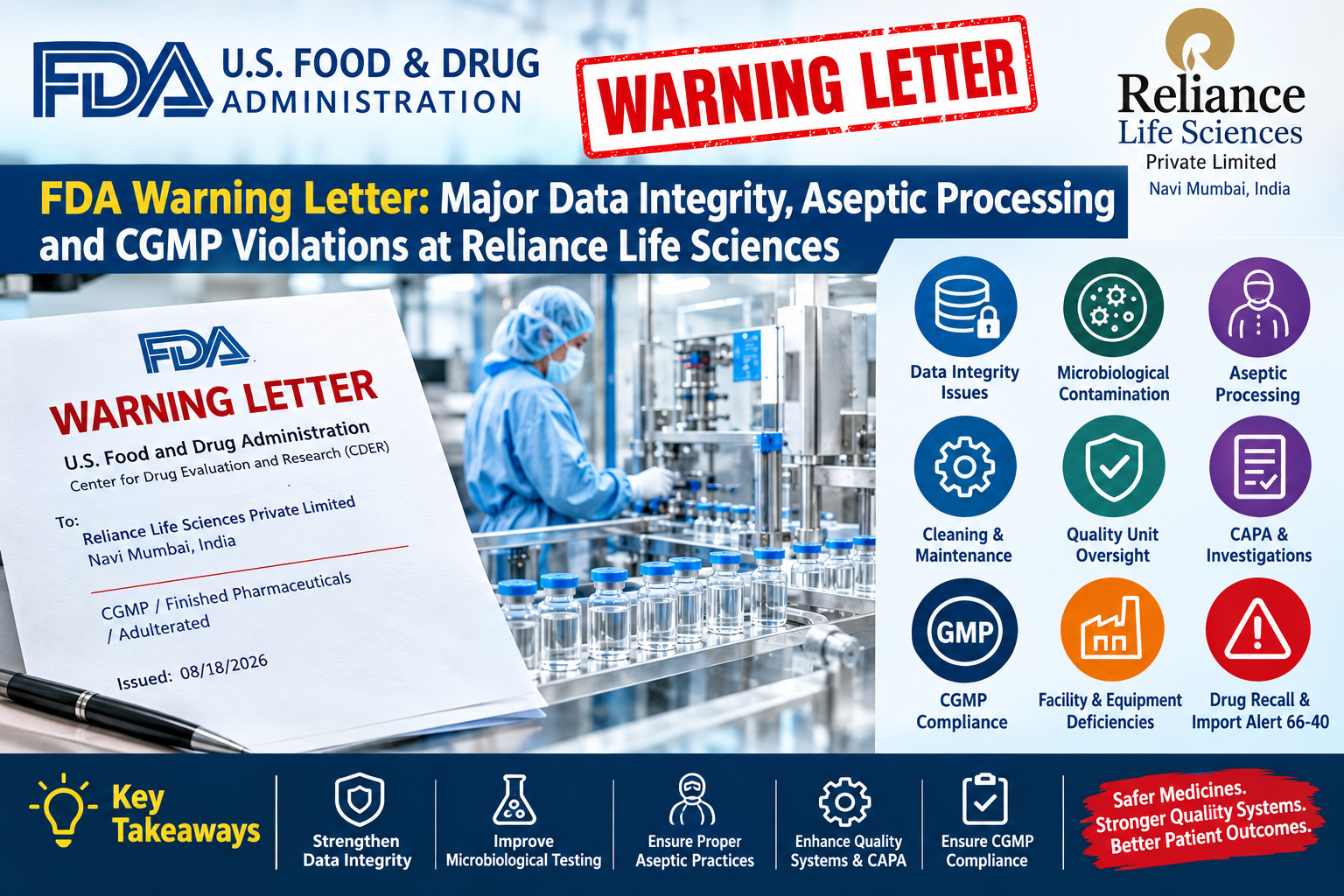
Key Findings in the FDA Warning Letter
The FDA Warning Letter identified two major categories of CGMP violations:
- Failure to maintain complete and accurate laboratory records and adequate data-integrity controls.
- Failure to establish and follow appropriate procedures to prevent microbiological contamination of sterile drug products and to adequately validate aseptic and sterilization processes.
These observations were considered significant because they potentially affected the reliability of laboratory results and the sterility assurance of drug products.
1. Inadequate Laboratory Records and Data Integrity
One of the most significant findings in the FDA Warning Letter involved laboratory documentation and data integrity.
Under 21 CFR 211.194(a), laboratory records must contain complete data derived from all tests necessary to demonstrate compliance with established specifications and standards.
FDA identified several deficiencies that raised concerns about the reliability and authenticity of microbiological testing data.
Inaccurate Microbiology Laboratory Records
FDA investigators found that multiple environmental monitoring and other microbiological samples were recorded in laboratory logbooks as having been collected and incubated.
However, the corresponding plates could not be located in the incubators during the inspection. More seriously, interviews with analysts indicated that some of these samples had not actually been collected.
This created a significant concern regarding the accuracy of laboratory records and the reliability of reported microbiological results.
The FDA Warning Letter emphasizes that inaccurate or incomplete laboratory records can undermine the ability of the Quality Unit to determine whether drug products meet established specifications.
Why This Is a Serious GMP Concern
Microbiological testing is an important component of quality control for pharmaceutical products, particularly sterile and microbiologically sensitive products.
If samples are incorrectly recorded as collected or tested, the resulting batch-release decision may not be supported by reliable scientific evidence. Potential consequences include:
- Incorrect batch release decisions
- Failure to detect microbial contamination
- Inaccurate environmental monitoring records
- Inadequate deviation investigations
- Inability to establish reliable product quality
- Potential patient-safety risks
- Loss of confidence in the pharmaceutical quality system
2. Incorrect Use of Microbial Limit Test Results
The inspection also identified deficiencies in the firm’s Laboratory Information Management System (LIMS). The system did not appropriately incorporate the required dilution factor for calculating colony-forming units (CFU) per gram or milliliter. As a result, drug products were reportedly released using raw plate-count averages without applying the required dilution factor.
This raised concerns about whether the microbial limit test results accurately represented the actual microbial burden of the tested products. The FDA Warning Letter therefore highlights the importance of ensuring that computerized laboratory systems correctly implement approved analytical procedures and compendial requirements.
Key Lesson for Pharmaceutical Laboratories
Laboratory software should not simply capture analytical results. It must also be appropriately configured, validated, controlled, and periodically reviewed to ensure that calculations and reporting accurately reflect approved procedures.
3. Electronic Records and Data Integrity Controls
Another major concern identified in the FDA Warning Letter involved electronic records.
FDA found that controls were inadequate to prevent deletion or overwriting of certain electronic integrity-testing data. Reports were reportedly not saved using unique file names, which allowed data to be overwritten after subsequent tests.
Furthermore, certain integrity testing was not performed for one of the plant systems. This meant that the firm could not reliably track or retrieve historical failed tests.
Why Electronic Data Integrity Matters
Electronic GMP records must be:
- Complete
- Accurate
- Reliable
- Traceable
- Secure
- Retrievable
- Contemporaneous
- Protected against unauthorized deletion or alteration
A failure to control electronic records can prevent a Quality Unit from determining whether equipment and processes remained within validated and qualified conditions.
The FDA Warning Letter therefore demonstrates that data integrity is not limited to paper laboratory notebooks. It also applies to LIMS, electronic reports, spreadsheets, instrument software, computerized systems, and other electronic GMP records.
4. Data Integrity Investigation Was Considered Inadequate
The company stated that some unaccounted-for samples may have been misplaced. However, FDA considered this explanation inadequate because analysts had reportedly confirmed that certain microbiological samples had never been collected.
FDA also noted that the firm’s response did not adequately address the broader pattern of inaccurate recordkeeping identified during the inspection. The company proposed using third-party consultants for:
- Data integrity remediation
- Risk assessment
- Product impact assessment
However, FDA requested substantially more detail regarding the scope, methodology, timelines, deliverables, responsibilities, and accountability associated with these activities.
5. Retrospective Data Integrity Review
The FDA Warning Letter requested a comprehensive investigation into the extent of data inaccuracies. The investigation should include:
- Detailed investigation protocols
- Defined methodology
- Assessment of laboratories
- Manufacturing operations
- Computerized systems
- Interviews with current and former employees
- Identification of data integrity lapses
- Assessment of deleted or altered records
- Evaluation of non-contemporaneous documentation
- Assessment of record destruction
- Retrospective evaluation of laboratory data
- Identification of root causes
- Evaluation of potential product impact
FDA recommended that qualified third parties with appropriate data-integrity expertise be involved where necessary.
6. Review of Microbial Limit Test Results
FDA also requested a retrospective review of microbial limit test results for products currently distributed in the United States and still within their expiry period.
The review should properly apply the required dilution factor when calculating CFU per gram or milliliter. The firm was also expected to evaluate whether any product quality or patient-safety risks existed. Depending on the findings, potential actions could include:
- Customer notifications
- Additional testing
- Product recall
- Enhanced complaint monitoring
- Additional stability monitoring
- Other appropriate regulatory actions
This aspect of the FDA Warning Letter demonstrates the importance of conducting a scientifically justified product-impact assessment when laboratory data integrity is compromised.
7. ALCOA Data Integrity Principles
The warning letter also emphasizes the importance of appropriate documentation practices. Pharmaceutical companies should maintain records that are:
A – Attributable
L – Legible
C – Contemporaneous
O – Original
A – Accurate
These ALCOA principles are fundamental to pharmaceutical data integrity. A robust data-integrity program should also incorporate additional expectations commonly referred to as ALCOA+, including complete, consistent, enduring, and available records.
8. Inadequate Quality Unit Oversight
Another major concern was the effectiveness and authority of the Quality Unit (QU).
FDA concluded that the firm’s quality system did not adequately ensure the accuracy and integrity of data needed to support the safety, effectiveness, and quality of manufactured drugs.
The FDA Warning Letter called for a comprehensive assessment and remediation plan to ensure that the Quality Unit has sufficient authority, resources, independence, and oversight capability. The Quality Unit should be able to:
- Review and approve investigations
- Review batch documentation
- Evaluate deviations
- Approve CAPA
- Assess laboratory data
- Review manufacturing records
- Ensure compliance with approved procedures
- Make appropriate batch disposition decisions
- Verify product identity, strength, quality, and purity
9. Poor Aseptic Practices
The second major violation under the FDA Warning Letter involved sterile drug manufacturing.
FDA cited failures under 21 CFR 211.113(b) concerning procedures designed to prevent microbiological contamination of sterile drug products. During mock filling activities and review of smoke studies, investigators observed inappropriate aseptic practices that could compromise first-air protection. Examples included:
- Blocking unidirectional airflow
- Inappropriate operator interventions
- Improper handling of components
- Movement of tools or materials through critical airflow
- Manual activities that could compromise sterile product protection
- Handling of potentially affected vials without appropriate rejection or corrective actions
10. First-Air Protection and Aseptic Processing
Maintaining first-air protection is fundamental to sterile manufacturing. Operators must perform interventions in a manner that minimizes the possibility of contamination of exposed sterile product, components, containers, and closures.
The observations described in the FDA Warning Letter demonstrate how operator behavior, equipment design, intervention techniques, and airflow patterns can interact to create contamination risks. Aseptic operators should therefore receive appropriate training and qualification covering:
- First-air principles
- Proper hand positioning
- Intervention techniques
- Movement restrictions
- Material handling
- Equipment ergonomics
- Response to dropped units
- Response to airflow interruption
- Appropriate rejection criteria
11. Cleaning, Decontamination and Maintenance Deficiencies
FDA also identified problems involving equipment condition, cleaning, decontamination, and maintenance. The inspection identified deterioration and damage in areas used for sterile drug manufacturing. Examples included:
- Deteriorated equipment-support components
- Excess sealant near HEPA filters
- Inappropriate cleaning materials
- Standing water
- Unknown staining
- Maintenance deficiencies
- Equipment surfaces requiring improvement
These conditions can create potential contamination hazards if they are not identified and corrected through a robust preventive maintenance and contamination-control program.
12. Cleaning and Disinfection Program
The FDA Warning Letter called for a retrospective assessment of the cleaning and disinfection program. A robust cleaning and disinfection program should include:
- Defined cleaning procedures
- Validated cleaning processes where applicable
- Appropriate disinfectant selection
- Disinfectant effectiveness
- Defined contact times
- Appropriate sterile cleaning materials
- Routine verification
- Equipment lifecycle management
- Preventive maintenance
- Environmental monitoring
- Personnel training
- Documentation and review
The firm was expected to identify vulnerabilities and implement CAPA with defined timelines.
13. Comprehensive Contamination Risk Assessment
FDA requested an independent assessment of contamination hazards associated with:
- Aseptic processing
- Equipment
- Facilities
- Personnel
- Material flow
- Personnel flow
- ISO 5 areas
- Manual interventions
- Equipment ergonomics
- Cleanroom design
- Manufacturing processes
The assessment should identify specific contamination hazards and establish scientifically justified corrective and preventive actions.
This is particularly important for sterile manufacturing because contamination control must be designed into the process rather than relying solely on end-product testing.
14. Equipment Design and Cleanroom Improvements
The FDA Warning Letter also requested a remediation strategy addressing equipment and facility design. Potential areas for improvement include:
- Aseptic line design
- Cleanroom layout
- Barrier technology
- Restricted Access Barrier Systems
- Equipment placement
- Personnel movement
- Material transfer
- Intervention reduction
- Cleaning accessibility
- Equipment maintainability
- Qualification and validation
The company was expected to provide timelines and specific deliverables for the remediation program.
15. Ineffective Pharmaceutical Quality System
FDA concluded that the findings demonstrated deficiencies in the firm’s overall pharmaceutical quality system. The concerns extended beyond individual laboratory or production observations. They included:
- Insufficient management oversight
- Weak Quality Unit authority
- Inadequate data governance
- Weak contamination controls
- Inadequate laboratory controls
- Insufficient CAPA
- Equipment and facility deficiencies
- Inadequate oversight of sterile manufacturing
The FDA Warning Letter therefore characterizes the issues as systemic rather than isolated procedural failures.
16. CAPA and Management Oversight
FDA requested a comprehensive global CAPA strategy. The CAPA program should address:
Immediate Corrective Actions
- Protect patients
- Assess distributed products
- Conduct additional testing where necessary
- Notify customers where appropriate
- Consider recalls
- Enhance complaint monitoring
- Assess stability risks
Long-Term Preventive Actions
- Improve procedures
- Strengthen computerized systems
- Improve documentation
- Improve training
- Strengthen staffing
- Improve Quality Unit oversight
- Upgrade facilities and equipment
- Improve data governance
- Strengthen management review
The company was also expected to consider independent annual audits for at least two years to evaluate CAPA effectiveness.
17. Independent Consultant and Six-System Audit
Due to the nature of the deficiencies, FDA recommended that the firm engage a qualified consultant consistent with 21 CFR 211.34.
The consultant was expected to conduct a comprehensive assessment of the operation and evaluate the effectiveness of completed CAPA.
A comprehensive six-system GMP audit is particularly important because deficiencies can exist across interconnected systems, including:
- Quality System
- Production System
- Laboratory Control System
- Materials System
- Facilities and Equipment System
- Packaging and Labeling System
The objective should be to determine whether remediation is sustainable across the entire pharmaceutical quality system.
18. Drug Recall and Suspension of Production
According to the warning letter, FDA held a teleconference with the company on June 18, 2026, recommending consideration of removing sterile drug batches from the U.S. market.
On June 19, 2026, the company agreed to recall all sterile drug products. The company also committed to suspending production of drugs at the facility for the U.S. market. This action demonstrates the seriousness of the identified sterility, data integrity, and quality-system concerns.
19. FDA Import Alert 66-40
The conclusion of the FDA Warning Letter states that FDA placed drugs and drug products offered for import into the United States from the firm on Import Alert 66-40 on July 9, 2026.
FDA may refuse admission of products when it determines that the manufacturing methods and controls do not appear to conform to applicable CGMP requirements.
This can have significant consequences for pharmaceutical manufacturers supplying the U.S. market. Potential consequences can include:
- Import detention or refusal
- Regulatory delays
- Increased inspection scrutiny
- Customer concerns
- Supply-chain disruption
- Additional testing requirements
- Increased remediation costs
- Delays involving regulatory applications
20. Potential Impact on Drug Applications
FDA stated that it may withhold approval of new applications or supplements listing the firm as a drug manufacturer until the identified violations are adequately addressed and compliance with CGMP is confirmed.
This illustrates the importance of maintaining continuous CGMP compliance rather than treating regulatory compliance as a one-time inspection exercise.
Major GMP Lessons from the FDA Warning Letter
The FDA Warning Letter provides several important lessons for pharmaceutical manufacturers, especially companies involved in sterile drug production.
1. Data Integrity Must Be a Management Priority
Laboratory data must be complete, accurate, reliable, attributable, and retrievable.
2. Laboratory Systems Must Be Scientifically Controlled
LIMS and analytical systems must correctly implement approved calculations, methods, specifications, and data-management controls.
3. Aseptic Behavior Must Protect First Air
Personnel interventions must not compromise critical airflow or expose sterile product to contamination hazards.
4. Equipment Must Remain Suitable for Intended Use
Equipment deterioration, damaged surfaces, inappropriate sealants, and poor maintainability can create contamination risks.
5. Cleaning and Disinfection Must Be Lifecycle-Based
Cleaning programs should be designed, validated or verified as appropriate, routinely monitored, and periodically reassessed.
6. Quality Units Must Have Real Authority
A Quality Unit must have adequate authority, independence, resources, and technical capability to perform its responsibilities effectively.
7. CAPA Must Address Root Causes
Simply correcting an observation is not sufficient. CAPA should address systemic root causes and demonstrate sustained effectiveness.
8. Product Impact Assessment Is Critical
When data integrity or sterility concerns are identified, manufacturers must determine whether distributed products may have been affected.
9. Management Oversight Is Essential
Senior management should ensure that quality systems remain effective and that resources are available to maintain CGMP compliance.
10. Regulatory Compliance Must Be Sustainable
The objective should not merely be to pass an FDA inspection. The objective is to establish a robust pharmaceutical quality system capable of maintaining compliance continuously.
FDA Warning Letter: Key Takeaways for QA Professionals
For pharmaceutical Quality Assurance and Quality Control professionals, the FDA Warning Letter provides several important areas for audit and self-assessment.
Data Integrity Checklist
- Are laboratory records complete and accurate?
- Are all raw data retained?
- Are electronic records protected from deletion or overwriting?
- Are audit trails appropriately reviewed?
- Are computerized systems validated?
- Are calculations scientifically justified?
- Can historical data be retrieved?
Microbiology Checklist
- Are all samples actually collected?
- Are incubation records accurate?
- Are microbial calculations correct?
- Are dilution factors appropriately applied?
- Are environmental monitoring records reliable?
- Are microbial limit tests scientifically justified?
- Are reserve samples appropriately controlled?
Aseptic Processing Checklist
- Is first-air protection maintained?
- Are operator interventions minimized?
- Are operators properly trained and qualified?
- Are smoke studies representative of routine and worst-case interventions?
- Are equipment ergonomics appropriate?
- Are contamination risks assessed?
Quality System Checklist
- Does the Quality Unit have sufficient authority?
- Are deviations thoroughly investigated?
- Are CAPA root causes properly established?
- Is CAPA effectiveness verified?
- Is management review effective?
- Are internal audits sufficiently comprehensive?
- Are supplier, laboratory, manufacturing, and computerized systems appropriately controlled?
Conclusion
The FDA Warning Letter issued in relation to Reliance Life Sciences Private Limited, Navi Mumbai, identifies significant concerns involving data integrity, laboratory controls, microbiological testing, aseptic processing, cleaning and maintenance, contamination control, Quality Unit oversight, CAPA, and overall CGMP compliance.
The most important lesson is that pharmaceutical quality cannot depend solely on final-product testing. Reliable quality requires an integrated system covering people, processes, facilities, equipment, computerized systems, laboratory controls, documentation, contamination control, management oversight, and an empowered Quality Unit.
For manufacturers supplying the U.S., UK, European, and other regulated markets, the FDA Warning Letter reinforces the importance of proactive GMP self-inspection, robust data-integrity controls, scientifically sound investigations, effective CAPA, contamination-control strategies, and continuous management oversight.
Companies should use similar FDA findings as an opportunity to conduct internal gap assessments before regulatory inspections identify systemic weaknesses.
Reference Warning Letter Date – 08/18/2026 Issued to Reliance Life Sciences Private Limited for CGMP/Finished Pharmaceuticals/Adulterated by the Center for Drug Evaluation and Research (CDER)
Disclaimer
Educational & Awareness Purpose Only:
This article has been prepared for learning, training, educational, and pharmaceutical industry awareness purposes only. The information presented in this article is based on and/or summarized from publicly available information published on the official U.S. Food and Drug Administration (FDA) website, including FDA Warning Letters.
For the original and most up-to-date information, readers should refer directly to the official FDA Warning Letters database and related FDA publications.
This article is not an official FDA publication, communication, guidance, regulatory decision, or statement of the U.S. Food and Drug Administration. PharmGuidances is not affiliated with, endorsed by, or representing the FDA.
The information provided should not be used as a substitute for official FDA documents, applicable laws and regulations, regulatory guidance, legal advice, compliance advice, or professional consultation. It should not be relied upon for making regulatory, legal, manufacturing, quality, or business decisions.
Official Reference:
FDA Warning Letters – U.S. Food and Drug Administration
© PharmGuidances – For Educational, Training & Awareness Purposes Only.