Quality Risk Management Methods and Tools: Powerful Guide for Effective and Risk Control
Quality Risk Management Methods and Tools provide structured approaches for identifying, evaluating, controlling, communicating, and monitoring risks that may affect pharmaceutical products, processes, facilities, and systems.
The purpose of Quality Risk Management Methods and Tools is not to require one specific technique for every situation. Different risks may require different levels of formality and different analytical approaches. Simple techniques may be sufficient for some situations, while more formal methods may be appropriate for complex or high-risk situations.
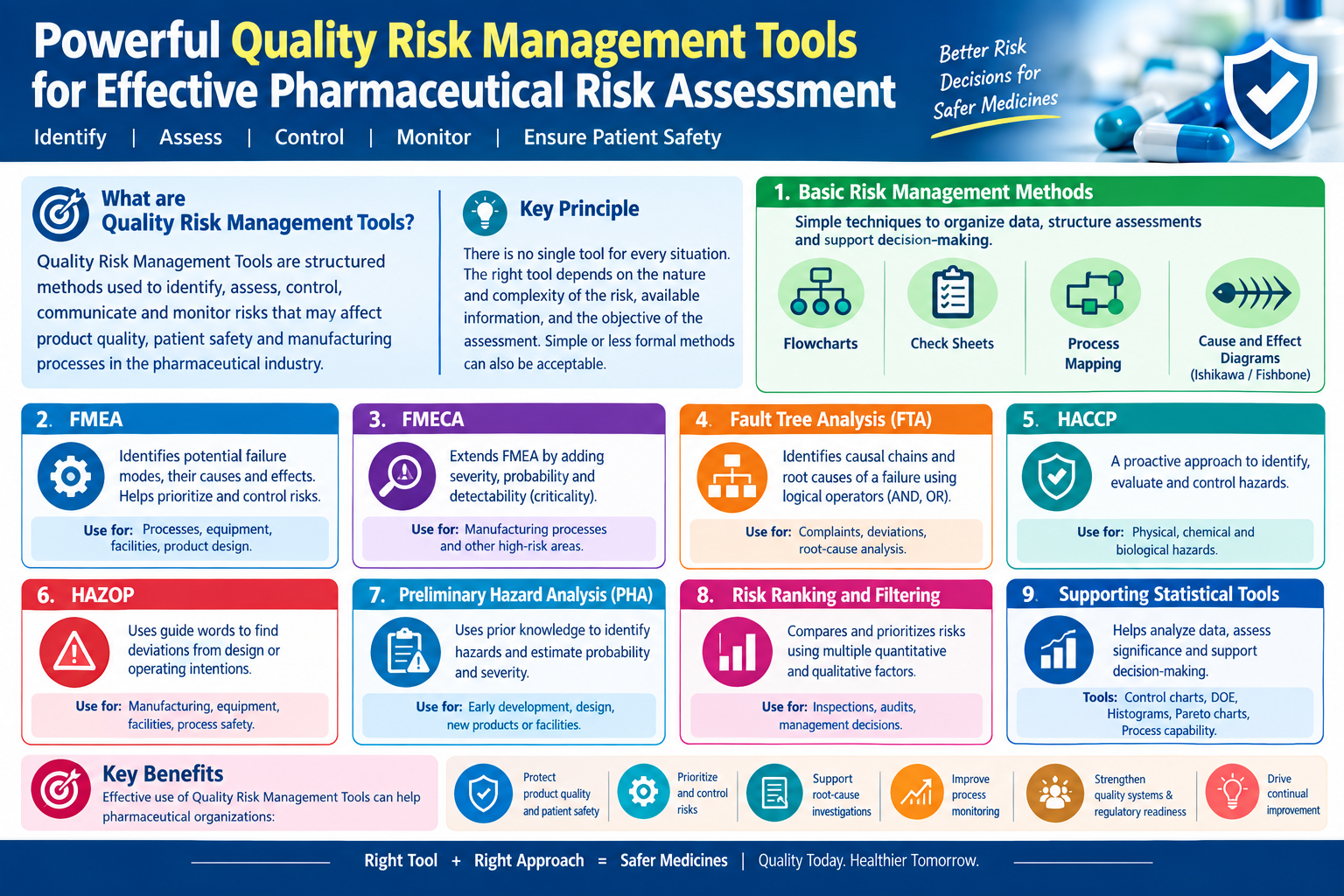
The selection of Quality Risk Management Methods and Tools should therefore be appropriate to the nature and complexity of the risk. The tools described below represent some of the primary approaches that may be used by industry and regulators, but the list is not exhaustive.
Why Quality Risk Management Methods and Tools Are Important
Effective Quality Risk Management Methods and Tools help organizations structure available information and support sound decision-making.
Depending on the situation, these tools can help organizations:
- Identify potential hazards and failure modes.
- Understand causes and effects.
- Evaluate severity, occurrence, and detectability.
- Prioritize risks.
- Identify appropriate preventive and corrective actions.
- Establish critical control points.
- Support process and facility design.
- Develop monitoring programs.
- Evaluate the effectiveness of risk controls.
- Support regulatory inspections and audits.
- Guide the allocation of resources.
The source emphasizes that highly formal methods are not always necessary. Less formal Quality Risk Management Methods and Tools can also be appropriate when they adequately address the risk.
1. Basic Risk Management Facilitation Methods
Some of the simplest Quality Risk Management Methods and Tools are used to organize information and facilitate decision-making.
Common techniques include:
Flowcharts
Flowcharts provide a visual representation of process steps and can help teams understand the sequence of activities and identify areas requiring further risk assessment.
Check Sheets
Check sheets provide a structured way of collecting and organizing information that can subsequently support risk evaluation.
Process Mapping
Process mapping helps teams visualize process activities and relationships and can facilitate identification of potential areas of risk.
Cause and Effect Diagrams
Cause and Effect Diagrams, also known as Ishikawa diagrams or fishbone diagrams, are used to organize potential causes contributing to a particular problem or outcome.
These basic techniques can provide a useful starting point before applying more detailed risk-analysis methods.
2. Failure Mode Effects Analysis (FMEA)
Failure Mode Effects Analysis (FMEA) is one of the important Quality Risk Management Methods and Tools for evaluating potential failure modes in processes and determining their likely effects on outcomes or product performance.
FMEA relies on product and process understanding. It systematically breaks a complex process into manageable steps and examines potential failures associated with those steps.
Once failure modes are identified, risk-reduction activities can be used to:
- Eliminate potential failures.
- Contain failures.
- Reduce the likelihood or impact of failures.
- Control potential failures.
Potential Uses of FMEA
FMEA can be used to:
- Prioritize risks.
- Monitor the effectiveness of risk-control activities.
- Analyze equipment and facilities.
- Evaluate manufacturing operations.
- Identify vulnerable elements or operations within a system.
- Support design activities.
- Guide resource deployment.
- Provide a basis for further analysis.
FMEA is particularly useful when a team needs a systematic understanding of potential failure modes, their causes, and their effects.
3. Failure Mode, Effects and Criticality Analysis (FMECA)
Failure Mode, Effects and Criticality Analysis (FMECA) extends FMEA by incorporating additional evaluation of the consequences of failures, including their severity, probability of occurrence, and detectability.
FMECA requires appropriate product or process specifications to support the analysis.
An important output of FMECA is a relative risk score for each failure mode. These scores can be used to rank failure modes on a relative risk basis.
Potential Uses of FMECA
FMECA can help identify areas where additional preventive actions may be appropriate to minimize risk.
In the pharmaceutical industry, FMECA is particularly applicable to failures and risks associated with manufacturing processes, although its application is not limited to manufacturing.
4. Fault Tree Analysis (FTA)
Fault Tree Analysis (FTA) is another important method among Quality Risk Management Methods and Tools. FTA begins by assuming failure of a product or process function and then works toward identifying the possible causal factors.
FTA can evaluate individual system or subsystem failures while also combining multiple causes through causal chains.
The results are represented visually as a fault tree, using logical operators such as:
- AND
- OR
FTA relies heavily on expert process understanding to identify causal factors.
Potential Uses of FTA
FTA can be used to:
- Establish pathways leading to root causes.
- Investigate complaints.
- Investigate deviations.
- Understand multiple contributing factors.
- Evaluate whether proposed improvements fully resolve an issue.
- Develop monitoring programs.
- Support risk assessment.
A major advantage of FTA is its visual representation of the relationships between failure modes and their contributing causes.
5. Hazard Analysis and Critical Control Points (HACCP)
Hazard Analysis and Critical Control Points (HACCP) is a systematic, proactive, and preventive approach for assuring product quality, reliability, and safety.
HACCP applies technical and scientific principles to identify, evaluate, prevent, and control hazards associated with the design, development, production, and use of products.
Seven Steps of HACCP
The source describes seven fundamental HACCP steps:
- Conduct a hazard analysis and identify preventive measures for each process step.
- Determine the critical control points.
- Establish critical limits.
- Establish a system for monitoring critical control points.
- Establish corrective actions when monitoring shows that a critical control point is not under control.
- Establish a verification system to confirm that HACCP is working effectively.
- Establish an appropriate record-keeping system.
Potential Uses of HACCP
HACCP can be used to identify and manage:
- Physical hazards.
- Chemical hazards.
- Biological hazards.
- Microbiological contamination risks.
HACCP is most useful when product and process understanding is sufficiently comprehensive to identify critical control points.
6. Hazard Operability Analysis (HAZOP)
Hazard Operability Analysis (HAZOP) is a systematic brainstorming technique used to identify hazards resulting from deviations from design or operating intentions.
HAZOP uses specific guide words applied to relevant parameters to identify potential deviations.
Examples of guide words include:
- No
- More
- Other Than
- Part of
Parameters may include factors such as contamination or temperature.
HAZOP generally involves a multidisciplinary team with appropriate expertise in the design, process, product, and application.
Potential Uses of HAZOP
HAZOP can be applied to:
- Pharmaceutical manufacturing processes.
- Outsourced production.
- Formulation operations.
- Upstream suppliers.
- Equipment.
- Facilities.
- Drug substances.
- Medicinal products.
- Process safety hazards.
The output of a HAZOP analysis is a list of critical operations that can be used to support risk management and regular monitoring.
7. Preliminary Hazard Analysis (PHA)
Preliminary Hazard Analysis (PHA) is a method based on previous experience or knowledge of hazards and failures to identify potential future hazards, hazardous situations, and events that could cause harm.
PHA generally involves:
- Identifying possible risk events.
- Qualitatively evaluating the potential extent of injury or health damage.
- Ranking hazards using severity and likelihood of occurrence.
- Identifying possible remedial measures.
Potential Uses of PHA
PHA can be useful when:
- Limited design information is available.
- A rapid initial assessment is required.
- Existing systems need to be evaluated.
- Hazards need to be prioritized.
- Product, process, or facility designs are being developed.
PHA is commonly used early in a project when detailed design and operating information may not yet be available.
The hazards identified during PHA may subsequently be evaluated using more detailed risk-management techniques.
8. Risk Ranking and Filtering
Risk Ranking and Filtering is one of the useful Quality Risk Management Methods and Tools for comparing and prioritizing different risks.
Complex systems may contain many different risks that cannot easily be compared using a single qualitative or quantitative factor.
Risk ranking breaks the overall risk question into relevant components. These factors are then combined into a relative risk score that can be used to rank risks.
Filters, such as weighting factors or score cut-offs, can then be applied to align the ranking with management or policy objectives.
Potential Uses of Risk Ranking and Filtering
Risk ranking and filtering can be useful for:
- Prioritizing manufacturing sites for inspections.
- Prioritizing audit activities.
- Comparing diverse risks.
- Supporting management decisions.
- Evaluating quantitative and qualitative risks within a common framework.
This method is particularly useful when an organization needs to prioritize a large and diverse portfolio of risks.
9. Supporting Statistical Tools
Statistical tools can support Quality Risk Management Methods and Tools by enabling effective data assessment, evaluating the significance of datasets, and supporting more reliable decision-making.
The source identifies several statistical tools commonly used in the pharmaceutical industry.
Control Charts
Control charts can be used to evaluate process behavior and monitor data over time.
Examples include:
- Acceptance Control Charts.
- Cumulative Sum (CUSUM) Charts.
- Shewhart Control Charts.
- Weighted Moving Average.
Design of Experiments (DOE)
Design of Experiments (DOE) is a statistical approach that can support systematic evaluation of process variables and their effects.
Histograms
Histograms provide a graphical representation of data distribution and can help teams understand the characteristics of a dataset.
Pareto Charts
Pareto Charts can help organize and prioritize contributing factors based on their relative importance.
Process Capability Analysis
Process Capability Analysis supports evaluation of the ability of a process to consistently meet specified requirements.
These statistical approaches can complement other Quality Risk Management Methods and Tools when sufficient data are available for meaningful analysis.
Comparison of Major Quality Risk Management Methods and Tools
| Method / Tool | Primary Purpose | Typical Output |
|---|---|---|
| Flowchart | Visualize process sequence | Process flow |
| Check Sheet | Organize data collection | Structured data |
| Process Mapping | Understand process activities | Process map |
| Cause & Effect Diagram | Identify potential causes | Cause-and-effect structure |
| FMEA | Identify and evaluate failure modes | Risk assessment/prioritization |
| FMECA | Evaluate failure criticality | Relative risk score |
| FTA | Analyze causal pathways | Fault tree |
| HACCP | Identify and control hazards | Critical control points |
| HAZOP | Identify process deviations | Critical operations/hazards |
| PHA | Identify early hazards | Preliminary hazard ranking |
| Risk Ranking & Filtering | Compare and prioritize risks | Relative risk ranking |
| Statistical Tools | Analyze process/data behavior | Statistical evidence and trends |
How to Select the Appropriate Risk Management Tool
There is no single tool that is appropriate for every quality-risk situation. Selection should consider the nature of the problem, the complexity of the process, the information available, and the objective of the assessment.
A simple process may be adequately evaluated using a flowchart, process map, check sheet, or cause-and-effect diagram.
More complex failure analysis may require FMEA, FMECA, or FTA.
Hazard-focused assessments may benefit from HACCP, HAZOP, or PHA.
Where multiple risks must be compared and prioritized, risk ranking and filtering may be appropriate.
Statistical tools can provide additional evidence when sufficient process or quality data are available.
Therefore, Quality Risk Management Methods and Tools should be selected based on the specific risk rather than applying a formal technique simply because it is available.
Key Takeaways
The major Quality Risk Management Methods and Tools described in the source include:
- Basic risk-management facilitation methods.
- FMEA.
- FMECA.
- Fault Tree Analysis.
- HACCP.
- HAZOP.
- PHA.
- Risk Ranking and Filtering.
- Supporting statistical tools.
The most important principle is that no single Quality Risk Management Methods and Tools approach is suitable for every situation. The appropriate level of formality should depend on the complexity and nature of the risk.
Simple techniques can be effective for straightforward assessments, while more structured methods can provide deeper analysis for complex processes and systems.
When appropriately selected and applied, Quality Risk Management Methods and Tools can help pharmaceutical organizations identify hazards, understand failure mechanisms, prioritize risks, establish controls, and support reliable quality-related decision-making.
Conclusion
Quality Risk Management Methods and Tools are important components of a systematic pharmaceutical quality-risk approach. FMEA, FMECA, FTA, HACCP, HAZOP, PHA, risk ranking and filtering, and statistical tools each provide different approaches to understanding and managing risk.
The objective should not be to use the most complicated tool available. Instead, the selected Quality Risk Management Methods and Tools should be appropriate to the risk, available information, process complexity, and intended decision.
A well-selected risk-management method can provide a powerful framework for identifying potential problems, prioritizing resources, strengthening controls, and supporting positive quality outcomes throughout pharmaceutical operations.
Source: QUALITY RISK MANAGEMENT Q9(R1)