FDA Warning Letter: Major CGMP, Aseptic Processing and Sterile Manufacturing Violations
This FDA warning letter identifies significant Current Good Manufacturing Practice (CGMP) deficiencies involving the manufacture of sterile injectable drug products. FDA determined that the firm’s methods, facilities, controls, and quality systems did not adequately conform to CGMP requirements under 21 CFR Parts 210 and 211. FDA therefore considered the affected drug products adulterated under Section 501(a)(2)(B) of the Federal Food, Drug, and Cosmetic Act.
The FDA warning letter highlights serious concerns involving inadequate investigations, endotoxin and bioburden control, failed media fills, poor aseptic practices, visible particulate contamination, facility and equipment design, environmental monitoring, process simulation, and overall pharmaceutical quality systems.
The FDA warning letter is particularly important for sterile pharmaceutical manufacturers because the observations demonstrate how weaknesses in contamination control, aseptic processing, investigation systems, and Quality Unit oversight can potentially affect product quality and patient safety.
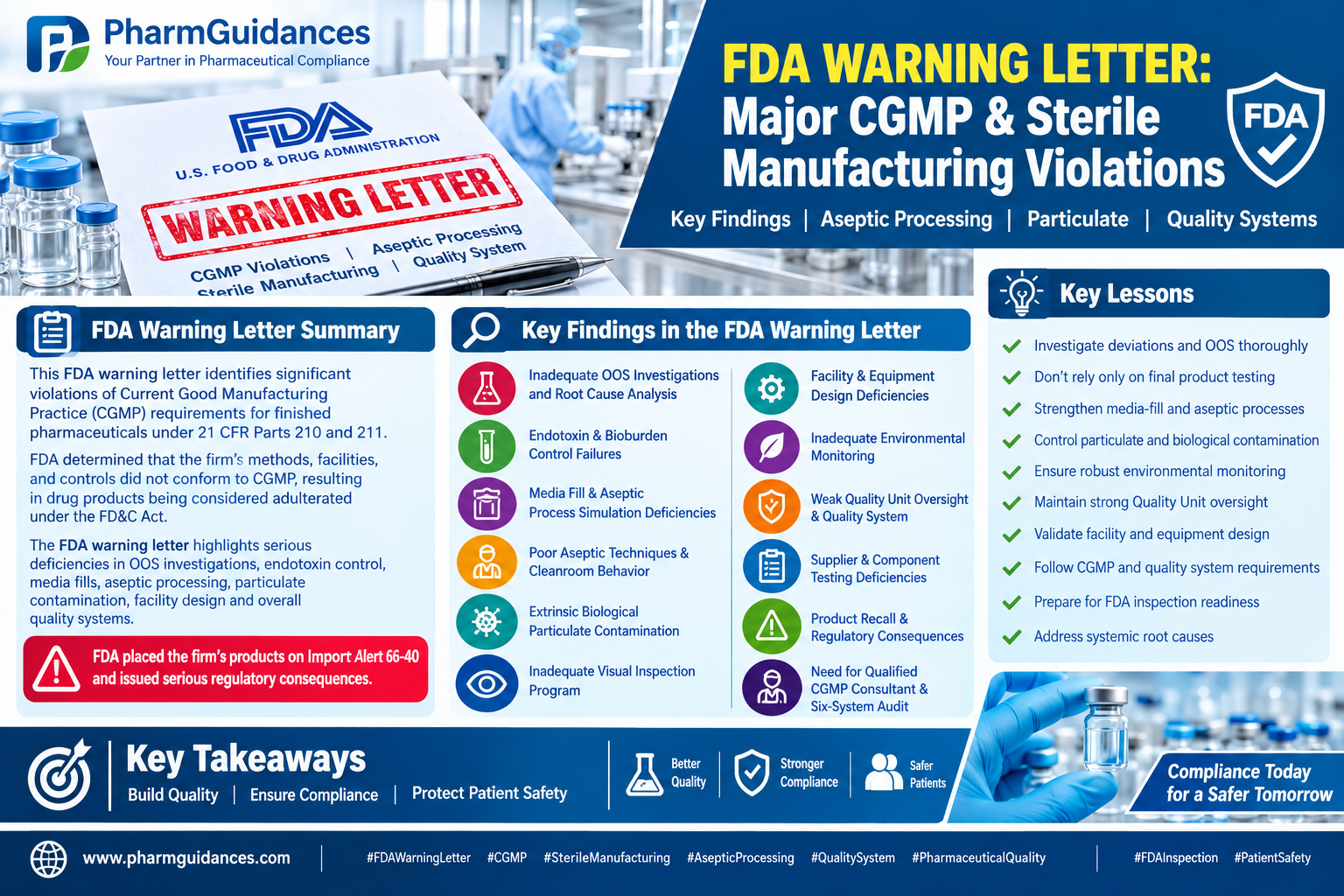
Key Findings in the FDA Warning Letter
The major observations described in this FDA warning letter include:
- Inadequate investigations of deviations, failures, and complaints
- Inadequate investigation of endotoxin failures
- Media-fill and aseptic process simulation deficiencies
- Poor aseptic technique and cleanroom behavior
- Extrinsic biological particulate contamination
- Inadequate visual inspection systems
- Deficiencies in facility and equipment design
- Inadequate environmental monitoring and contamination-control systems
- Inadequate Quality Unit and pharmaceutical quality-system oversight
- Repeat CGMP deficiencies and need for comprehensive remediation
- Product recalls and significant regulatory consequences
1. Inadequate Investigation and Root Cause Analysis
One of the most significant findings in this FDA warning letter concerns the firm’s investigation system.
FDA found that investigations did not consistently establish data-supported root causes, adequately document the investigation, expand the investigation to potentially affected products, or verify CAPA effectiveness.
FDA specifically identified concerns involving endotoxin test failures associated with famotidine injection. The firm had experienced bioburden action-limit failures, yet affected batches were released after passing finished-product testing. Subsequent testing of retained finished products identified an endotoxin failure, and three famotidine injection batches were ultimately recalled.
The FDA warning letter emphasizes that passing final product test results should not be used as the sole justification for dismissing significant manufacturing or microbiological signals.
Key lessons for pharmaceutical manufacturers
An effective investigation should include:
- Immediate containment where appropriate
- Scientific root-cause analysis
- Assessment of potential product impact
- Appropriate investigation scope
- Review of related batches and products
- Quality Unit oversight
- CAPA development
- CAPA effectiveness verification
- Investigation trending
- Retrospective review where systemic issues are suspected
FDA requested an independent retrospective review of critical investigations, including deviations, complaints, OOS/OOL results, and specification failures.
2. Endotoxin and Bioburden Control Deficiencies
The FDA warning letter places significant emphasis on endotoxin contamination risk in sterile injectable products.
FDA noted that the firm experienced bioburden action-limit failures and subsequently identified endotoxin failures in retained finished-product samples.
The warning letter emphasizes that atypical or excessive bioburden levels should be treated as important contamination signals requiring prompt investigation and appropriate risk assessment.
FDA requested a comprehensive evaluation of the firm’s endotoxin contamination prevention program covering areas such as:
- Containers and closures
- Ingredients
- Water or relevant manufacturing systems
- Process controls
- Equipment design
- Preventive maintenance
- Repairs
- Manufacturing environment
- Environmental monitoring
- CAPA
For sterile injectable products, inadequate control of endotoxin and pyrogen risks can have serious patient-safety implications.
3. Media Fill and Aseptic Process Simulation Failures
Another major observation in this FDA warning letter involves inadequate media-fill studies.
FDA reported media-fill failures on aseptic manufacturing lines in September and October 2024, as well as additional failures on a Restricted Access Barrier System line in April and October 2025. The investigations attributed the failures primarily to deficient aseptic techniques but did not adequately evaluate why the firm’s aseptic observer program failed to detect these practices during commercial manufacturing.
FDA also determined that the media fills did not adequately simulate the actual worst-case aseptic manufacturing conditions.
Problems included:
- Insufficient simulation of maximum interventions
- Inadequate documentation of inherent interventions
- Insufficient media-fill batch sizes
- Failure to adequately represent actual commercial operations
- Inadequate intervention tracking
- Insufficient worst-case evaluation
The FDA warning letter therefore demonstrates the importance of designing media fills to realistically challenge the actual aseptic process.
4. Poor Aseptic Technique and Cleanroom Behavior
The FDA warning letter also identifies serious concerns regarding aseptic practices and cleanroom behavior.
FDA observed practices that could increase contamination risks within critical ISO 5 processing areas.
Examples included:
- Improper operator movements
- Contact with barriers
- Inappropriate handling of sterile tubing
- Frequent high-risk interventions
- Inadequate material handling
- Deficiencies in operator practices
- Insufficient supervisory oversight
FDA concluded that the firm’s response did not adequately address fundamental design and operational weaknesses in its aseptic processing lines.
For sterile manufacturing, operator behavior is a critical component of contamination control. Even a technically qualified facility can remain vulnerable if personnel practices introduce contamination risks into critical processing areas.
5. Extrinsic Biological Particulate Contamination
A particularly serious observation in the FDA warning letter concerns extrinsic biological contamination, including hair.
FDA reported that beginning in May 2022, the firm documented at least nine incidents involving extrinsic contamination during visible particulate inspection. The contamination was described as free-floating and in direct contact with drug product.
FDA was concerned that the firm did not initiate timely investigations and did not adequately address why affected commercial batches were not rejected.
The FDA warning letter requested:
- Comprehensive investigation of biological particulate events
- Retrospective review of relevant investigations
- Evaluation of potentially affected products
- CAPA effectiveness assessment
- Assessment of incoming packaging components
- Review of stopper supplier quality
- Evaluation of retained samples where appropriate
This finding demonstrates the importance of treating biological particulate contamination as a potentially critical quality and sterility-assurance concern.
6. Inadequate Visual Inspection Program
The FDA warning letter identifies deficiencies in the firm’s visual inspection program for sterile injectable products.
FDA determined that the visual inspection system was not adequately capable of ensuring that sterile injectable products were essentially free from visible particulate and other defects.
FDA identified concerns involving:
- Inadequate probability of detection
- Inconsistent detection of visible particulates
- Insufficient defect classification
- Inadequate defect limits
- Inadequate qualification of inspection systems
- Insufficient evaluation of different particulate types and sizes
- Inadequate assessment of products already on the market
FDA emphasized that visual inspection is a probabilistic process and that inspection systems must be appropriately qualified and capable of reproducibly detecting relevant defects.
The FDA warning letter also recommended that inspection programs incorporate product-specific knowledge, process experience, deviation data, complaint information, recall data, and quality risk management.
7. Facility and Equipment Design Deficiencies
The FDA warning letter also identifies deficiencies in the design of aseptic processing lines and associated facility controls.
FDA observed processing lines requiring frequent interventions and activities that could compromise protection of the ISO 5 critical areas.
Concerns included:
- Inadequate barrier protection
- Frequent high-risk interventions
- Equipment and tubing configurations that increased contamination risks
- Inadequate separation of critical areas
- Facility-layout concerns
- Ergonomic deficiencies
- Insufficient protection of critical processing operations
FDA stated that the firm’s response did not provide sufficient corrective actions for the fundamental design weaknesses of the existing aseptic processing lines.
8. Environmental Monitoring and Contamination Control
The FDA warning letter requested an independent and comprehensive review of the firm’s environmental monitoring program.
The assessment was expected to address:
- Environmental monitoring limits
- Sampling methods
- Sampling locations
- Sampling frequencies
- Trend analysis
- Investigation of adverse trends
- Deviation management
- CAPA
- Detection of potential contamination hazards
An effective environmental monitoring program should provide meaningful information about the state of environmental control and help detect trends before they become significant product-quality problems.
9. Quality System Deficiencies
Another important part of this FDA warning letter is the finding that the firm’s overall pharmaceutical quality systems were inadequate.
FDA referred to the need for stronger implementation of quality-system and risk-management principles, including those described in FDA’s quality-system guidance.
The firm’s remediation program was expected to address:
- Root-cause analysis
- CAPA effectiveness
- Investigation quality
- Quality Unit oversight
- Management responsibility
- Quality risk management
- Environmental monitoring
- Contamination control
- Process simulation
- Supplier oversight
- Complaint and recall systems
The FDA warning letter therefore indicates that FDA viewed the observations as systemic rather than isolated manufacturing events.
10. CGMP Consultant and Comprehensive Audit
Due to the nature of the violations and repeat deficiencies, FDA recommended that the firm engage a qualified consultant under 21 CFR 211.34.
The consultant should conduct a comprehensive six-system CGMP audit and evaluate whether corrective and preventive actions have been completed and are effective.
FDA also made clear that hiring a consultant does not transfer regulatory responsibility away from the company.
Executive management remains responsible for resolving deficiencies and maintaining sustained CGMP compliance.
11. Product Recall and Regulatory Consequences
The FDA warning letter describes a significant recall-related development.
On July 9, 2026, FDA discussed voluntary recall actions with the firm after identifying concerns involving biological particulate contamination and CGMP deficiencies.
The firm subsequently committed to recalling six batches, with recalls initiated on July 16, 2026, involving products including:
- Glycopyrrolate Injection, USP
- Lidocaine HCl Injection, USP
- Ropivacaine Hydrochloride Injection, USP
- Lidocaine HCl Injection, USP
The FDA warning letter states that unresolved violations may result in additional regulatory consequences, including:
- Withholding of Export Certificates
- Withholding approval of new applications or supplements
- Continued regulatory scrutiny
- Follow-up inspection
- Potential refusal of affected products
- Additional regulatory action where appropriate
FDA also stated that products manufactured under conditions that do not conform to CGMP may be detained or refused admission into the United States.
Also read – FDA Warning Letter: Major CGMP, Quality System and OTC Drug Violations
Key Lessons from the FDA Warning Letter
This FDA warning letter provides several important lessons for sterile pharmaceutical manufacturers.
1. Investigate deviations thoroughly
Every significant deviation, complaint, OOS/OOL result, and process failure should be investigated scientifically and promptly.
2. Do not rely only on finished-product testing
Passing sterility, endotoxin, or other final-product tests does not necessarily eliminate the need to investigate upstream manufacturing failures or contamination signals.
3. Strengthen media-fill programs
Media fills should accurately represent commercial operations and include appropriate worst-case interventions.
4. Control aseptic behavior
Personnel practices, interventions, material movement, and cleanroom behavior must be continuously monitored and controlled.
5. Strengthen visual inspection
Visual inspection systems should be scientifically qualified and capable of detecting relevant particulate defects.
6. Treat biological contamination seriously
Extrinsic biological contamination should trigger appropriate investigation, risk assessment, product impact assessment, and CAPA.
7. Strengthen Quality Unit oversight
The Quality Unit must have sufficient authority, independence, resources, and expertise.
8. Address systemic causes
CAPA should address systemic root causes rather than simply correcting individual observations.
FDA Warning Letter – Inspection Readiness Checklist
Pharmaceutical companies can use the following areas when preparing for an FDA inspection:
- OOS/OOL investigations
- Deviation investigations
- Complaint investigations
- CAPA effectiveness
- Media-fill qualification
- Aseptic process simulation
- Environmental monitoring
- Contamination control strategy
- Visible particulate inspection
- Operator qualification
- Cleanroom behavior
- Facility and equipment design
- Sterility assurance
- Endotoxin control
- Supplier qualification
- Quality Unit oversight
- Batch-release procedures
- Recall readiness
- Quality risk management
- Internal CGMP audits
Conclusion
This FDA warning letter demonstrates the importance of an integrated pharmaceutical quality system for sterile drug manufacturing.
The observations involve interconnected areas including investigations, endotoxin control, media fills, aseptic processing, visible particulate inspection, contamination control, facility design, environmental monitoring, Quality Unit oversight, CAPA, and management responsibility.
The most important lesson from this FDA warning letter is that pharmaceutical manufacturers must build quality into the entire manufacturing process rather than relying primarily on final-product testing.
For companies manufacturing sterile injectable products for the U.S. market, the findings provide valuable lessons for improving CGMP compliance, contamination control, sterility assurance, aseptic processing, FDA inspection readiness, investigation systems, and pharmaceutical quality management.
A sustainable remediation program should identify systemic root causes, establish scientifically justified CAPA, verify CAPA effectiveness, strengthen management oversight, and provide objective evidence that the manufacturing process remains in a state of control.
Reference Warning Letter Date – 09/22/2026 Issued to Fresenius Kabi USA LLC for CGMP/Finished Pharmaceuticals/Adulterated by Center for Drug Evaluation and Research (CDER)
Disclaimer
Educational & Awareness Purpose Only:
This article has been prepared for learning, training, educational, and pharmaceutical industry awareness purposes only. The information presented in this article is based on and/or summarized from publicly available information published on the official U.S. Food and Drug Administration (FDA) website, including FDA Warning Letters.
For the original and most up-to-date information, readers should refer directly to the official FDA Warning Letters database and related FDA publications.
This article is not an official FDA publication, communication, guidance, regulatory decision, or statement of the U.S. Food and Drug Administration. PharmGuidances is not affiliated with, endorsed by, or representing the FDA.
The information provided should not be used as a substitute for official FDA documents, applicable laws and regulations, regulatory guidance, legal advice, compliance advice, or professional consultation. It should not be relied upon for making regulatory, legal, manufacturing, quality, or business decisions.
Official Reference:
FDA Warning Letters – U.S. Food and Drug Administration
© PharmGuidances – For Educational, Training & Awareness Purposes Only.