FDA Warning Letter: Major CGMP, Stability, OOS and Storage Violations
The FDA warning letter issued highlights identifies significant Current Good Manufacturing Practice (CGMP) deficiencies observed during an FDA inspection conducted from March 31 to April 3, 2026, at the firm’s drug manufacturing facility in Chatsworth, California.
The FDA warning letter states that the firm’s methods, facilities, and controls for manufacturing, processing, packing, or holding drug products did not conform to CGMP requirements under 21 CFR Parts 210 and 211. FDA therefore determined that the affected drug products were adulterated under section 501(a)(2)(B) of the Federal Food, Drug, and Cosmetic Act.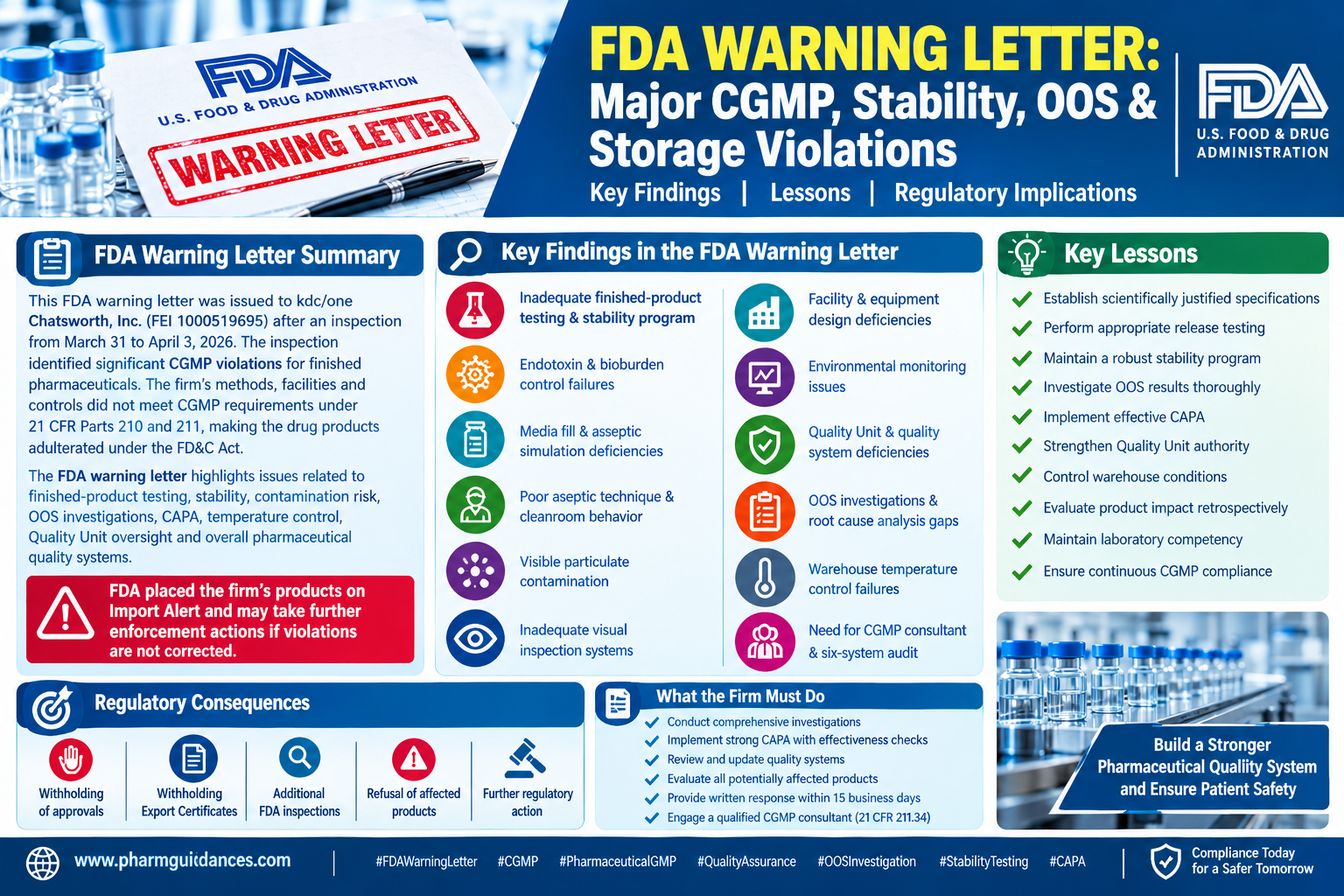
The major deficiencies identified in the FDA warning letter involve:
- Inadequate finished-product testing
- Deficiencies in the stability testing program
- Failure to adequately assess potential contamination risks
- Inadequate investigation of OOS results
- Weak root-cause analysis and CAPA
- Inadequate warehouse temperature controls
- Insufficient Quality Unit authority and oversight
- Need for comprehensive laboratory remediation
- Need for qualified CGMP consulting support
1. Inadequate Finished Product Testing and Stability Program
One of the major observations in the FDA warning letter concerns the firm’s failure to establish appropriate finished-product specifications and perform adequate laboratory testing before batch release.
FDA noted that the firm did not include certain appropriate testing as a release or stability requirement for affected OTC products. The FDA warning letter further explains that certain degradation and reaction pathways could result in the formation or accumulation of potentially harmful impurities during the product shelf life.
The firm had distributed at least one affected OTC batch without the relevant testing being performed.
The FDA warning letter therefore requires the firm to strengthen its testing program, including:
- Chemical and microbiological specifications
- Validated or appropriate analytical methods
- Finished-product testing before release
- Retain-sample testing
- Stability-indicating methods
- Stability studies using marketed container-closure systems
- Annual addition of representative batches to the stability program
- Evaluation of quality attributes throughout shelf life
FDA also requested a comprehensive assessment and CAPA plan for the firm’s stability program.
2. Failure to Properly Address a Known Contamination Risk
Another serious issue highlighted in the FDA warning letter was the firm’s response to a known contamination event involving products manufactured at the facility.
FDA noted that products manufactured using the same formulation, packaging, and labeling had been distributed in both the United States and Canada. Despite being informed about contamination associated with products recalled in Canada, the firm did not adequately determine whether potentially affected batches had entered the U.S. market or evaluate the potential risk to U.S. consumers.
The FDA warning letter requires a comprehensive evaluation of potentially affected batches and testing of retain samples for products that remained within expiry.
Where testing identifies substandard products, FDA expects appropriate market actions, which may include customer notification and product recalls.
3. Inadequate OOS Investigation and Root Cause Analysis
The FDA warning letter also identifies deficiencies in the investigation of unexplained discrepancies and failures to meet specifications under 21 CFR 211.192.
FDA specifically identified viscosity-related OOS results obtained during stability testing of distributed OTC drug products. According to the FDA warning letter, these investigations did not adequately establish root cause, CAPA, or scientific justification for the applicable specifications.
An effective OOS investigation should not simply attribute a failure to laboratory error without sufficient scientific evidence.
The FDA warning letter requires a retrospective independent review of invalidated OOS results, including:
- Evaluation of the scientific justification for invalidating each OOS.
- Determination of whether laboratory error was conclusively established.
- Identification of other laboratory methods potentially vulnerable to the same root cause.
- Review of manufacturing-related causes where laboratory root cause cannot be conclusively established.
- Evaluation of batch records, equipment, facilities, raw-material variability, process capability, deviations, complaints, and previous batch failures.
- Appropriate CAPA and manufacturing improvements.
Quality Unit (QU) oversight is another important theme of this FDA warning letter.
FDA determined that the Quality Unit did not have sufficient authority and resources to consistently perform its responsibilities.
The FDA warning letter requires the company to provide the Quality Unit with adequate authority and resources to oversee manufacturing and quality operations effectively. This includes appropriate review and approval of investigations, batch information, procedures, and final batch disposition.
A strong pharmaceutical Quality Unit should independently ensure that:
- Manufacturing procedures are appropriate.
- GMP requirements are followed.
- Investigations are scientifically sound.
- CAPA is implemented and monitored.
- Batch records are complete.
- Laboratory results are properly evaluated.
- Product quality, identity, strength, purity, and safety are protected.
5. Inadequate Warehouse Temperature Control
The FDA warning letter identified another significant deficiency involving storage conditions.
FDA found that finished drug products were stored in areas where recorded temperatures exceeded both the labeled storage conditions and the firm’s internal monitoring requirements. Historical temperature data also showed extended periods of elevated temperatures.
This is particularly important because inappropriate temperature exposure can affect pharmaceutical product quality and may increase the risk of degradation or impurity formation.
The FDA warning letter requires the company to perform a retrospective review of temperature monitoring data across storage and warehouse areas.
The assessment should determine:
- Which products were exposed to temperature excursions
- Which batches were potentially affected
- Whether product quality, safety, or efficacy could have been impacted
- Whether impurities or degradation products could have formed
- Whether corrective actions are necessary
FDA also requested updated procedures covering storage conditions on certificates of analysis and shipping documentation.
6. Laboratory System Remediation
The FDA warning letter requires an independent assessment of the laboratory system. The assessment should cover:
- Laboratory procedures
- Analytical methods
- Laboratory equipment
- Documentation
- Analyst competency
- OOS investigations
- Testing practices
- Method suitability
- Data evaluation
The objective is to identify systemic weaknesses and establish a comprehensive remediation plan.
This is an important lesson from the FDA warning letter: laboratory compliance is not limited to obtaining test results. Pharmaceutical laboratories must have scientifically justified methods, qualified personnel, appropriate equipment, reliable documentation, and robust investigation processes.
7. Stability Program Improvements
A major lesson from the FDA warning letter is the importance of a scientifically sound stability program.
The FDA expects the firm’s remediated stability program to include stability-indicating methods, studies for marketed products in their actual container-closure systems, annual placement of representative batches, and evaluation of relevant quality attributes throughout the shelf life.
A pharmaceutical stability program should therefore demonstrate that the assigned shelf life remains scientifically justified under labeled storage conditions.
8. CGMP Consultant Recommended
Because of the nature of the deficiencies, the FDA warning letter recommends that the company engage a qualified CGMP consultant under 21 CFR 211.34.
However, FDA makes clear that hiring a consultant does not transfer regulatory responsibility away from company management.
Executive management remains responsible for correcting deficiencies and systemic weaknesses and maintaining continuing CGMP compliance.
9. Cosmetics Manufactured at the Facility
The FDA warning letter also notes that some products manufactured by the facility may fall within the regulatory definition of cosmetics.
FDA reminds the firm that cosmetics distributed in the United States must comply with applicable requirements of the FD&C Act and the Modernization of Cosmetics Regulation Act of 2022 (MoCRA).
This demonstrates the importance of correctly determining the regulatory status of every product manufactured and distributed by a facility.
10. Regulatory Consequences
The FDA warning letter warns that unresolved violations may result in significant regulatory consequences.
FDA may consider actions including:
- Withholding certain approvals
- Withholding Export Certificates
- Restrictions involving new applications or supplements
- Additional FDA inspections
- Other regulatory actions where appropriate
The company is responsible for identifying root causes, implementing corrective and preventive measures, and demonstrating sustained compliance.
Also read – FDA Warning Letter: Major CGMP, Aseptic Processing and Sterile Manufacturing Violations
Key Pharmaceutical Quality Lessons
This FDA warning letter provides several important lessons for pharmaceutical manufacturers.
1. Establish scientifically justified specifications
Finished-product specifications should be supported by appropriate scientific and regulatory considerations.
2. Perform appropriate release testing
Each batch should undergo appropriate testing before disposition and release.
3. Maintain a robust stability program
Stability testing should adequately support the product’s shelf-life claim.
4. Investigate OOS results thoroughly
OOS investigations must establish scientifically supported root causes and should not prematurely assign failures to laboratory error.
5. Implement effective CAPA
CAPA should address systemic root causes and include measurable effectiveness checks.
The Quality Unit must have sufficient independence, authority, resources, and oversight.
7. Control warehouse conditions
Temperature, humidity, and other environmental conditions must remain within established and labeled requirements.
8. Evaluate product impact retrospectively
When a significant quality event is identified, manufacturers should evaluate potentially affected batches already distributed to the market.
9. Maintain laboratory competency
Analysts, methods, equipment, documentation, and laboratory procedures should be periodically assessed.
10. Maintain inspection readiness
Manufacturers should continuously monitor CGMP compliance rather than waiting for an FDA inspection.
Conclusion
The FDA warning letter issued highlights significant weaknesses involving finished-product testing, stability testing, contamination-risk assessment, OOS investigations, CAPA, warehouse temperature control, laboratory systems, and Quality Unit oversight.
The most important message from this FDA warning letter is that pharmaceutical quality systems must be proactive, scientifically justified, and capable of detecting and controlling risks before they affect patients or result in distribution of potentially substandard products.
Manufacturers should use the lessons from this FDA warning letter to strengthen their laboratory controls, stability programs, OOS investigations, CAPA systems, storage controls, and Quality Unit oversight.
The FDA warning letter also demonstrates that correcting an individual observation is not sufficient when the underlying problem is systemic. Companies must identify root causes, evaluate product impact, implement sustainable CAPA, and demonstrate continued CGMP compliance.
Reference Warning Letter Date – 09/08/2026 Issued to kdc/one Chatsworth, Inc. for CGMP/Finished Pharmaceuticals/Adulterated by Center for Drug Evaluation and Research (CDER)
Disclaimer
Educational & Awareness Purpose Only:
This article has been prepared for learning, training, educational, and pharmaceutical industry awareness purposes only. The information presented in this article is based on and/or summarized from publicly available information published on the official U.S. Food and Drug Administration (FDA) website, including FDA Warning Letters.
For the original and most up-to-date information, readers should refer directly to the official FDA Warning Letters database and related FDA publications.
This article is not an official FDA publication, communication, guidance, regulatory decision, or statement of the U.S. Food and Drug Administration. PharmGuidances is not affiliated with, endorsed by, or representing the FDA.
The information provided should not be used as a substitute for official FDA documents, applicable laws and regulations, regulatory guidance, legal advice, compliance advice, or professional consultation. It should not be relied upon for making regulatory, legal, manufacturing, quality, or business decisions.
Official Reference:
FDA Warning Letters – U.S. Food and Drug Administration
© PharmGuidances – For Educational, Training & Awareness Purposes Only.