FDA Warning Letter: Major CGMP, OOS Investigation and Quality System Violations – FDA Warning Letter Summary
This FDA warning letter identifies significant violations of Current Good Manufacturing Practice (CGMP) requirements for finished pharmaceuticals under 21 CFR Parts 210 and 211. FDA determined that the firm’s manufacturing methods, facilities, and controls did not conform to CGMP requirements and that the drug products were therefore considered adulterated under Section 501(a)(2)(B) of the Federal Food, Drug, and Cosmetic Act.
The FDA warning letter followed FDA’s review of the firm’s response to a Form FDA-483 and subsequent correspondence. FDA identified several significant deficiencies involving OOS investigations, incoming component testing, high-risk raw materials, Quality Unit oversight, quality systems, and organizational responsibilities.
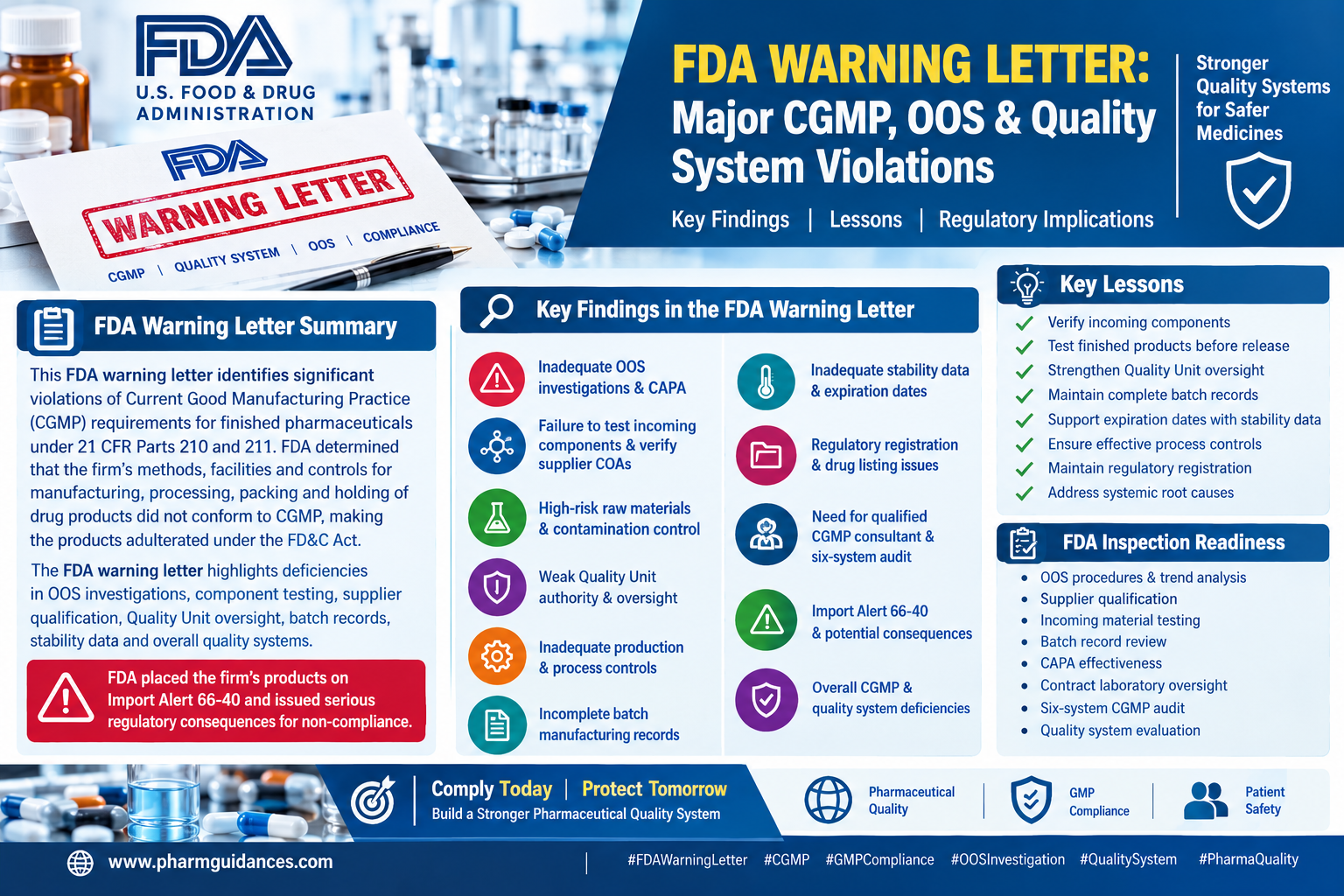
Key Findings in the FDA Warning Letter
The major observations described in this FDA warning letter include:
- Inadequate and delayed OOS investigation
- Inadequate root-cause determination and CAPA
- Failure to adequately test incoming components
- Inadequate supplier COA verification
- Use of a high-risk component without appropriate testing
- Inadequate retrospective assessment of potentially affected products
- Weak Quality Unit authority and oversight
- Inadequate production and process-control procedures
- Concerns regarding the independence of integrated organizations
- Need for comprehensive CGMP remediation and six-system audit
- Import Alert and potential regulatory consequences
1. Inadequate OOS Investigation
One of the most serious findings in this FDA warning letter concerns the firm’s handling of an out-of-specification (OOS) result.
FDA reported that a contract testing laboratory identified an OOS result on August 28, 2024, but the firm did not initiate its Phase II investigation until December 4, 2024.
Despite the unresolved investigation, the Quality Unit released the batch, and the batch was subsequently shipped for the U.S. market after a retest produced passing results.
FDA noted that the firm ultimately closed the investigation without determining the root cause of the original OOS result.
The FDA warning letter emphasized that simply obtaining a passing result after retesting does not adequately resolve an unexplained OOS result.
Key OOS Investigation Lessons
An effective OOS investigation should include:
- Prompt initiation of the investigation
- Appropriate Phase I and Phase II evaluation
- Scientific assessment of laboratory error
- Investigation of potential manufacturing causes
- Appropriate Quality Unit oversight
- Comprehensive investigation scope
- Scientifically justified root cause
- Appropriate CAPA
- Effectiveness evaluation
- Retrospective review where necessary
FDA requested a retrospective independent review of invalidated OOS results for applicable U.S. products currently on the market and within expiry.
2. Inadequate Incoming Component Testing
The FDA warning letter also identified deficiencies in the firm’s incoming-material testing program.
FDA found that the firm did not adequately test an incoming component for identity before it was used in manufacturing. The firm also relied on supplier Certificates of Analysis (COAs) without adequately establishing the reliability of supplier testing at appropriate intervals.
FDA considered the material to be at high risk for hazardous contamination and noted that the relevant lot used for manufacturing had expired.
This finding demonstrates the importance of robust supplier qualification and incoming-material control systems.
Manufacturers should ensure:
- Each incoming component is appropriately identified.
- Supplier qualification is documented.
- Supplier COA reliability is scientifically established.
- Periodic verification of supplier results is performed.
- Material expiration or retest dates are controlled.
- High-risk components receive appropriate additional testing.
- Unsuitable materials cannot enter production.
3. High-Risk Raw Materials and Contamination Control
A particularly important part of this FDA warning letter concerns high-risk raw materials and potentially hazardous contamination.
FDA stated that the firm had not performed the appropriate identity testing required to ensure that high-risk components met applicable safety limits. FDA also noted that the relevant USP identification testing includes testing capable of detecting hazardous impurities.
The firm was asked to provide testing results for retained samples of high-risk components and, where component retains were unavailable, to perform appropriate testing of implicated finished-product batches.
FDA also requested a comprehensive risk assessment for drug products within expiry that contained ingredients at risk of contamination, together with appropriate customer notification or recall actions where necessary.
Key Lesson
The FDA warning letter demonstrates that manufacturers should not rely solely on theoretical risk assessments when actual product and material testing information is available or required.
Risk assessments should be supported by:
- Scientific evidence
- Analytical testing
- Supplier qualification
- Material history
- Batch history
- Product impact assessment
- Appropriate regulatory and market actions
4. Quality Unit Oversight Deficiencies
Another major finding in the FDA warning letter relates to the firm’s Quality Control/Quality Unit.
FDA determined that the Quality Unit did not adequately exercise its authority and responsibilities to ensure that drug products were manufactured in compliance with CGMP and met established requirements for identity, strength, quality, and purity.
FDA identified concerns including:
- Inadequate Quality Unit procedures
- Insufficient QA responsibilities
- Production personnel performing functions that should fall under QA oversight
- Inadequate production and process-control procedures
- Inadequate oversight of manufacturing operations
- Inadequate batch disposition controls
FDA requested a comprehensive assessment and remediation plan to ensure that the Quality Unit has appropriate authority and resources.
5. Quality System and Process-Control Deficiencies
The FDA warning letter demonstrates that FDA viewed the deficiencies as broader quality-system issues rather than isolated incidents.
The firm was expected to evaluate whether its procedures were robust and appropriate and whether the Quality Unit had sufficient oversight throughout manufacturing operations.
Particular attention was required for:
- Production and process controls
- Batch review
- Investigation approval
- Quality Unit responsibilities
- Product disposition
- Identity, strength, quality, and purity
- Corrective and preventive actions
A strong pharmaceutical quality system should ensure that quality responsibilities are clearly defined and that decisions affecting product quality are appropriately reviewed and approved.
6. Concerns Regarding Organizational Independence
The FDA warning letter also identified concerns regarding two organizations that appeared to operate as closely integrated entities despite maintaining separate corporate identities.
FDA noted shared resources, manufacturing operations, utilities, equipment, document-management systems, personnel, and management oversight.
FDA requested clarification regarding the relationship between the entities and evidence demonstrating that each organization maintains distinct and adequate control over:
- Manufacturing operations
- Quality systems
- Quality assurance
- Regulatory compliance
- Corrective actions
The concern is that insufficient operational separation could allow compliance deficiencies to transfer or propagate between organizations.
7. CGMP Consultant and Six-System Audit
The FDA warning letter acknowledges that the firm had engaged a consultant to evaluate its operations.
FDA stated that the consultant should be qualified under 21 CFR 211.34 and should conduct a comprehensive six-system CGMP audit covering the firm’s operations.
The consultant should also evaluate the completion and effectiveness of corrective and preventive actions before the firm seeks resolution of its compliance status with FDA.
However, hiring a consultant does not remove the firm’s responsibility for CGMP compliance.
Executive management remains responsible for correcting deficiencies and ensuring sustained compliance.
FDA Warning Letter: Regulatory Consequences
The FDA warning letter states that the FDA placed drugs and drug products offered for import into the United States from the firm on Import Alert 66-40 on January 9, 2026.
FDA may also:
- Withhold approval of new applications or supplements listing the firm as a drug manufacturer.
- Conduct a follow-up inspection.
- Verify completion of corrective actions.
- Continue refusing admission of affected products.
- Detain or refuse products that appear to be adulterated.
- Take additional regulatory action if violations remain unresolved.
The warning letter also states that the firm must respond in writing within 15 working days, explaining the actions taken to correct the deficiencies and prevent recurrence.
Also read – FDA Warning Letter: Major CGMP, Aseptic Processing and Sterile Manufacturing Violations
Key Lessons from the FDA Warning Letter
This FDA warning letter provides important lessons for pharmaceutical manufacturers targeting the U.S. market.
OOS Investigation
OOS investigations must be timely, scientifically sound, appropriately scoped, and capable of identifying the actual root cause.
Supplier Qualification
Supplier COAs should not automatically be accepted without establishing the reliability of supplier testing.
High-Risk Materials
High-risk components require appropriate identity and impurity testing before use.
Quality Unit
The Quality Unit must have sufficient authority, resources, and independence to perform its CGMP responsibilities.
CAPA
CAPA should address the actual systemic root cause and should include appropriate effectiveness verification.
Product Impact Assessment
When a significant quality deficiency is identified, manufacturers should evaluate potentially affected batches that remain within expiry and on the market.
Regulatory Compliance
Manufacturers supplying the U.S. market must maintain effective CGMP systems and be prepared to demonstrate compliance through objective evidence.
FDA Warning Letter – Inspection Readiness Checklist
Pharmaceutical manufacturers can use the following areas when preparing for FDA inspection:
- OOS investigation procedures
- OOS trend analysis
- Laboratory investigations
- CAPA effectiveness
- Supplier qualification
- Incoming-material testing
- COA verification
- High-risk material controls
- Raw-material expiration/retest controls
- Quality Unit authority
- Batch-record review
- Production and process controls
- Product impact assessments
- Recall/customer notification procedures
- Contract laboratory oversight
- Internal CGMP audits
- Six-system quality-system audits
Conclusion
This FDA warning letter highlights how deficiencies in OOS investigations, incoming-material controls, supplier qualification, Quality Unit oversight, and pharmaceutical quality systems can result in significant regulatory consequences.
The FDA warning letter also demonstrates that correcting an individual observation is not sufficient when the underlying problem may involve systemic weaknesses.
Pharmaceutical manufacturers should focus on identifying root causes, strengthening Quality Unit oversight, improving supplier controls, implementing scientifically justified investigations, conducting retrospective product assessments, and verifying CAPA effectiveness.
For companies manufacturing pharmaceutical products for the U.S. market, this FDA warning letter provides valuable lessons for improving CGMP compliance, FDA inspection readiness, pharmaceutical quality systems, OOS investigations, supplier qualification, and patient-safety controls.
Reference Warning Letter Date – 02/09/2026 Issued to VeganicSKN Limited for CGMP/Finished Pharmaceuticals/Adulterated by Center for Drug Evaluation and Research (CDER)
Disclaimer
Educational & Awareness Purpose Only:
This article has been prepared for learning, training, educational, and pharmaceutical industry awareness purposes only. The information presented in this article is based on and/or summarized from publicly available information published on the official U.S. Food and Drug Administration (FDA) website, including FDA Warning Letters.
For the original and most up-to-date information, readers should refer directly to the official FDA Warning Letters database and related FDA publications.
This article is not an official FDA publication, communication, guidance, regulatory decision, or statement of the U.S. Food and Drug Administration. PharmGuidances is not affiliated with, endorsed by, or representing the FDA.
The information provided should not be used as a substitute for official FDA documents, applicable laws and regulations, regulatory guidance, legal advice, compliance advice, or professional consultation. It should not be relied upon for making regulatory, legal, manufacturing, quality, or business decisions.
Official Reference:
FDA Warning Letters – U.S. Food and Drug Administration
© PharmGuidances – For Educational, Training & Awareness Purposes Only.