FDA Warning Letter: CGMP and Aseptic Processing Violations
This FDA Warning Letter highlights significant regulatory and quality-system deficiencies identified during an FDA inspection of a facility producing compounded drug products. The FDA identified concerns involving Section 503A of the Federal Food, Drug, and Cosmetic Act (FD&C Act), aseptic processing, sterile drug manufacturing, CGMP compliance, media fills, smoke studies, environmental monitoring, quality oversight, data integrity, unapproved drug products, and misbranding.
During the inspection, FDA investigators collected evidence indicating that certain drug products produced by the firm did not satisfy the conditions required to qualify for exemptions under Section 503A of the FD&C Act.
The FDA issued a Form FDA 483 on November 14, 2025, and subsequently reviewed the firm’s responses dated December 8, 2025, March 18, 2026, and April 30, 2026.
This FDA Warning Letter indicates that the deficiencies identified by the FDA could potentially affect product quality and patient safety, particularly because some of the products were intended or expected to be sterile.
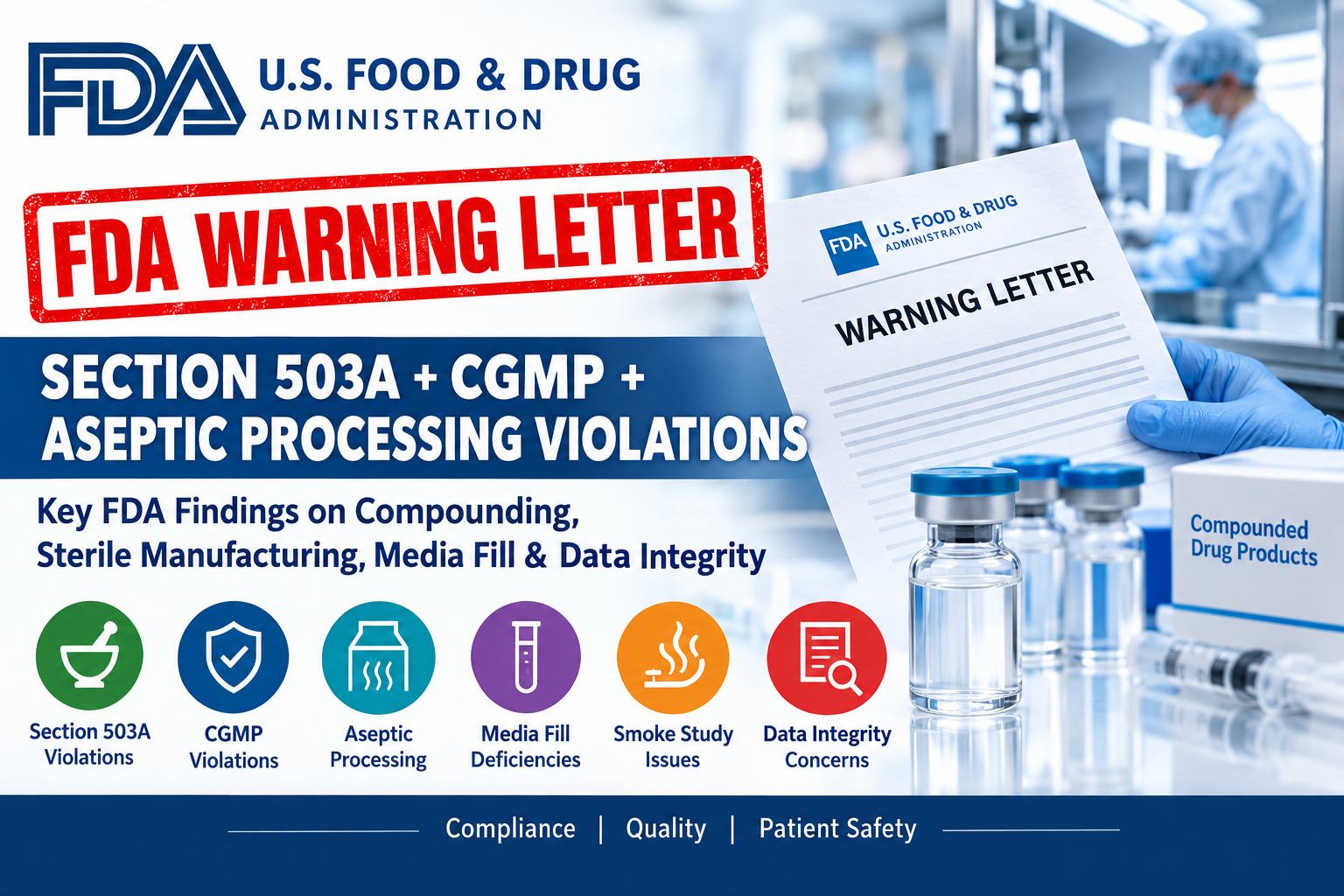
Key Findings in the FDA Warning Letter
The major observations described in this FDA Warning Letter include:
- Failure to meet the conditions of Section 503A.
- Compounding of products that appeared to be essentially copies of commercially available FDA-approved products.
- Regular or inordinate production of certain compounded drug products.
- Inadequate evidence demonstrating individualized prescriber determinations.
- Insanitary conditions associated with sterile drug products.
- Inadequate dynamic smoke studies.
- Deficiencies in aseptic media fill simulations.
- Inadequate environmental monitoring systems.
- Deficiencies in equipment maintenance and aseptic controls.
- Inadequate production and process-control procedures.
- Insufficient Quality Unit oversight.
- Marketing of applicable drug products without FDA approval.
- Misbranding due to inadequate directions for use.
- Documentation, transcription, and data-integrity concerns.
These observations make the FDA Warning Letter particularly relevant to pharmaceutical quality assurance professionals, sterile manufacturing facilities, compounding pharmacies, regulatory affairs professionals, and GMP compliance teams.
1. Section 503A Compounding Requirements
A major focus of this FDA Warning Letter was compliance with Section 503A of the FD&C Act.
Section 503A establishes certain conditions under which human drug products compounded by a licensed pharmacist or physician may qualify for exemptions from specific provisions of the FD&C Act.
These exemptions can include requirements related to:
- Current Good Manufacturing Practice (CGMP)
- Adequate directions for use
- FDA approval before marketing
However, these exemptions are conditional.
One important condition is that compounded drug products generally must be prepared pursuant to valid prescriptions for individually identified patients.
Therefore, a facility cannot simply assume that all compounded drug products automatically qualify for Section 503A exemptions.
2. Compounded Products That Were Essentially Copies
The FDA Warning Letter states that investigators collected evidence indicating that the firm compounded certain products that appeared to be essentially copies of commercially available drug products.
The products identified included formulations containing:
- Tirzepatide/Niacinamide
- Semaglutide/Cyanocobalamin
- Tirzepatide/Niacinamide at different concentrations and fill volumes
FDA noted that these products appeared to be essentially copies of FDA-approved semaglutide and tirzepatide products.
Section 503A contains requirements concerning compounded drugs that are essentially copies of commercially available drug products.
A compounded drug may not qualify for the applicable exemption when it is compounded regularly or in inordinate amounts, subject to the statutory requirements and exceptions.
3. Production Volume and Individualized Prescribing Concerns
The FDA Warning Letter describes substantial production volumes for several of the identified compounded products during July, August, September, and October 2025.
FDA considered the volume of products produced together with other evidence when evaluating whether the products were being compounded regularly or in inordinate amounts.
The investigators also found prescription records that:
- Did not contain a prescriber determination of a significant difference from the commercially available product; or
- Contained apparently repeated or identical statements concerning a significant difference.
FDA expressed concern that repeatedly pre-generated statements could undermine the individualized nature of the prescriber’s clinical judgment.
This is an important lesson from the FDA Warning Letter: documentation supporting compounded drug products should demonstrate genuine, patient-specific clinical decision-making.
The use of standardized or pre-selected statements may raise regulatory concerns if the records do not adequately demonstrate individualized clinical judgment.
4. Insanitary Conditions in Sterile Drug Manufacturing
Another major issue identified in the FDA Warning Letter involved products intended or expected to be sterile.
FDA investigators determined that certain products were prepared, packed, or held under conditions that could allow contamination or otherwise render the products potentially injurious to health.
The observations included deficiencies in:
- Smoke studies
- Aseptic processing
- Media fill simulations
- Environmental controls
- Equipment maintenance
- Contamination-control procedures
These findings are particularly important for sterile manufacturing operations because contamination-control failures can directly affect patient safety.
5. Inadequate Dynamic Smoke Studies
The FDA Warning Letter identified deficiencies in the firm’s smoke study program.
FDA investigators found that the firm had not adequately performed smoke studies under dynamic conditions to demonstrate unidirectional airflow within the ISO 5 area.
Smoke studies are an important tool for demonstrating airflow patterns and evaluating whether critical areas receive appropriate protection during aseptic operations.
A properly designed smoke study should evaluate relevant operating conditions and interventions and should provide scientifically meaningful evidence that the airflow system performs as intended.
The deficiency identified in this FDA Warning Letter therefore raised concerns regarding the firm’s ability to adequately protect sterile products from contamination.
6. Aseptic Media Fill Deficiencies
The FDA Warning Letter also identified concerns with the firm’s aseptic media fill program.
FDA noted that media fills were not performed under the most challenging or stressful conditions.
Aseptic process simulations, commonly referred to as media fills, are designed to provide evidence that an aseptic manufacturing process can consistently operate without introducing microbial contamination.
A robust media fill program should appropriately consider:
- Routine operations
- Personnel interventions
- Equipment interventions
- Worst-case conditions
- Shift changes
- Line configuration
- Container and closure systems
- Aseptic manipulations
- Maximum processing duration
- Other relevant risk factors
The FDA Warning Letter therefore emphasizes the importance of scientifically justified media fill design rather than simply completing a simulation without adequately challenging the process.
7. CGMP Violations Identified by FDA
Because the identified drug products did not qualify for the applicable Section 503A exemptions, FDA stated that they were subject to applicable CGMP requirements.
The FDA Warning Letter identified significant deficiencies under 21 CFR Parts 210 and 211.
Equipment and Aseptic Conditions
The firm failed to establish an adequate system for maintaining equipment used to control aseptic conditions.
FDA cited 21 CFR 211.42(c)(10)(vi).
Equipment used in sterile manufacturing must be appropriately designed, maintained, monitored, and controlled to support the intended manufacturing process.
Microbiological Contamination Controls
The firm failed to establish and follow appropriate written procedures designed to prevent microbiological contamination of products represented as sterile.
FDA cited 21 CFR 211.113(b).
Such procedures should include appropriate validation of aseptic and sterilization processes.
Quality Control Unit
The FDA Warning Letter stated that the Quality Control Unit failed to adequately exercise its responsibility to ensure that drug products were manufactured in accordance with CGMP and met established requirements for identity, strength, quality, and purity. FDA cited 21 CFR 211.22.
This observation reinforces the critical role of the Quality Unit in pharmaceutical manufacturing.
Environmental Monitoring
FDA also identified deficiencies in the system for monitoring environmental conditions in aseptic processing areas. The observation was associated with 21 CFR 211.42(c)(10)(iv).
An effective environmental monitoring program should be scientifically designed, appropriately risk-based, documented, trended, and capable of detecting adverse changes in the controlled environment.
Production and Process Controls
The firm also failed to establish adequate written production and process-control procedures designed to ensure that products possess the identity, strength, quality, and purity they are represented to possess. FDA cited 21 CFR 211.100(a).
8. Unapproved New Drug Products
Another significant issue discussed in the FDA Warning Letter was the marketing of applicable products without an FDA-approved application.
FDA stated that it did not have approved applications on file for the identified ineligible drug products.
Under Sections 505(a) and 301(d) of the FD&C Act, applicable new drugs generally cannot be introduced into interstate commerce unless an FDA-approved application is in effect.
Therefore, if compounded products do not qualify for the relevant statutory exemptions, the firm may become subject to applicable FDA approval requirements.
9. Misbranded Drug Products
The FDA Warning Letter also identified concerns regarding product labeling.
FDA stated that the identified ineligible products were intended for conditions that are not appropriate for self-diagnosis or treatment by individuals who are not medical practitioners.
Consequently, adequate directions for use could not be written in a manner that would allow a layperson to safely use the products for their intended purposes.
FDA therefore considered the products to be misbranded under Section 502(f)(1) of the FD&C Act.
This demonstrates why regulatory compliance must consider not only manufacturing controls but also applicable labeling requirements.
10. FDA Review of Corrective Actions
FDA reviewed the firm’s responses to the Form FDA 483.
The FDA Warning Letter states that some corrective actions appeared adequate; however, FDA could not fully evaluate other proposed corrective actions because sufficient supporting information and documentation had not been provided.
One example involved a smoke study conducted from March 30 through April 3, 2026.
The firm stated that the study remained under controlled post-execution review.
However, FDA had not received a finalized formal summary report.
Without the final documentation, FDA could not fully evaluate the effectiveness and adequacy of the corrective action.
11. Media Fill Documentation Discrepancies
The FDA Warning Letter identified additional problems involving the documentation of a January 2026 aseptic media fill simulation.
The firm’s summary stated that following the required incubation period, all vials were visually inspected and no contamination was observed.
However, FDA’s review of the underlying records identified discrepancies concerning the number of vials documented and the number reported in the summary.
FDA also identified records containing “N/A” entries without an adequate explanation of what the designation meant.
Because the records did not clearly account for all units, FDA could not verify the firm’s conclusion that all vials had been inspected and that no contamination was present.
This illustrates an important GMP principle:
A validation or qualification conclusion must be fully supported by the underlying raw data and documentation.
12. Data Integrity Concerns
Data integrity was another important issue highlighted by the FDA Warning Letter.
FDA noted that multiple media fill records had been transcribed onto Form Revision 3 because the original results had been recorded on the wrong form.
Although transcription may sometimes be necessary for legitimate administrative reasons, such activities must be properly controlled and documented.
A controlled transcription process should provide an appropriate audit trail showing:
- Original information
- Reason for transcription
- Date of transcription
- Person performing the transcription
- Reviewer or approver
- Authorization
- Confirmation that the original data were preserved
- Explanation of any changes
Uncontrolled transcription can create questions about the accuracy, reliability, and authenticity of GMP records.
13. FDA Expectations for Corrective Actions
The FDA Warning Letter makes clear that corrective actions must be supported by sufficient evidence.
FDA expects firms to investigate the causes of violations and implement appropriate measures to prevent recurrence. A strong corrective action program should address:
Root Cause
Determine the fundamental cause of the deficiency rather than simply correcting the immediate observation.
Corrective Action
Correct the identified problem and restore the system to a compliant state.
Preventive Action
Implement controls that prevent recurrence or similar failures elsewhere in the quality system.
Effectiveness Check
Verify through objective evidence that the implemented CAPA has effectively addressed the problem.
14. Comprehensive Facility Assessment
The FDA Warning Letter recommends that management conduct a comprehensive assessment of the firm’s operations. The assessment should include:
- Facility design
- Equipment
- Personnel
- Procedures
- Manufacturing processes
- Maintenance
- Materials
- Quality systems
- Aseptic processing
- Environmental monitoring
- Validation
- Documentation
- Data integrity
- Quality oversight
FDA also recommended assistance from a qualified third-party consultant with relevant sterile drug manufacturing expertise.
Such an assessment can help identify systemic weaknesses that may not be limited to the specific observations identified during an FDA inspection.
15. Important GMP Lessons From the FDA Warning Letter
This FDA Warning Letter provides several important lessons for pharmaceutical companies, compounding facilities, sterile manufacturing sites, Quality Assurance professionals, and regulatory affairs teams.
1. Section 503A exemptions are conditional
Facilities must demonstrate that all applicable statutory conditions are satisfied before relying on Section 503A exemptions.
2. Individualized prescriptions must reflect genuine clinical judgment
Prescriber determinations should be patient-specific and appropriately documented.
3. Production volume matters
Regular or inordinate production of essentially copied commercially available products can create significant regulatory concerns.
4. Smoke studies must adequately challenge airflow
Dynamic smoke studies should provide meaningful evidence regarding airflow patterns and contamination protection.
5. Media fills should represent challenging conditions
Aseptic process simulations should appropriately challenge the process and represent relevant worst-case conditions.
6. Environmental monitoring must be effective
Aseptic processing areas require appropriate environmental monitoring systems capable of detecting adverse trends.
7. Quality Unit oversight is essential
The Quality Unit must effectively oversee manufacturing activities and ensure compliance with applicable GMP requirements.
8. Documentation must be complete
Every critical manufacturing and validation conclusion should be supported by reliable underlying records.
9. Data integrity must be maintained
Corrections, transcriptions, revisions, and other documentation activities must preserve the integrity and traceability of original data.
10. CAPA must be evidence-based
Corrective actions should address root causes and include appropriate effectiveness checks.
FDA Warning Letter: Key Takeaways for Pharmaceutical Quality Professionals
The FDA Warning Letter demonstrates that regulatory compliance is not limited to having written SOPs.
A pharmaceutical facility must demonstrate that its procedures are:
- Scientifically justified
- Properly implemented
- Validated where applicable
- Followed by trained personnel
- Adequately documented
- Reviewed by the Quality Unit
- Supported by reliable data
- Periodically evaluated for effectiveness
For sterile manufacturing facilities, particular attention should be given to contamination control strategy, aseptic processing, environmental monitoring, smoke studies, media fills, equipment qualification, personnel practices, sterilization validation, cleaning, and data integrity.
Conclusion
This FDA Warning Letter highlights serious regulatory concerns involving Section 503A compounding requirements, aseptic processing, sterile drug manufacturing, CGMP compliance, product approval, labeling, quality oversight, corrective actions, and data integrity.
The central concern was that certain compounded drug products appeared not to satisfy the conditions required for Section 503A exemptions. Consequently, applicable requirements relating to FDA approval, adequate directions for use, and CGMP could apply.
The inspection also identified deficiencies in smoke studies, media fill simulations, environmental monitoring, equipment controls, production procedures, Quality Unit oversight, and documentation.
For pharmaceutical manufacturers and compounding facilities, the FDA Warning Letter demonstrates the importance of maintaining a comprehensive pharmaceutical quality system supported by robust procedures, scientifically sound validation, effective quality oversight, and reliable data.
Facilities should proactively evaluate their aseptic processing operations and contamination-control systems rather than waiting for regulatory inspection findings.
Management should also ensure that CAPA investigations identify true root causes and that corrective actions are supported by objective evidence and effectiveness checks.
Reference Warning Letter Date – 09/18/2026 Issued to Empower Clinic Services, LLC dba Empower Pharmacy for CGMP/Finished Pharmaceuticals/Adulterated by the Center for Drug Evaluation and Research (CDER)
Disclaimer
Educational & Awareness Purpose Only:
This article has been prepared for learning, training, educational, and pharmaceutical industry awareness purposes only. The information presented in this article is based on and/or summarized from publicly available information published on the official U.S. Food and Drug Administration (FDA) website, including FDA Warning Letters.
For the original and most up-to-date information, readers should refer directly to the official FDA Warning Letters database and related FDA publications.
This article is not an official FDA publication, communication, guidance, regulatory decision, or statement of the U.S. Food and Drug Administration. PharmGuidances is not affiliated with, endorsed by, or representing the FDA.
The information provided should not be used as a substitute for official FDA documents, applicable laws and regulations, regulatory guidance, legal advice, compliance advice, or professional consultation. It should not be relied upon for making regulatory, legal, manufacturing, quality, or business decisions.
Official Reference:
FDA Warning Letters – U.S. Food and Drug Administration
© PharmGuidances – For Educational, Training & Awareness Purposes Only.