FDA Warning Letter: Major CGMP, Aseptic Processing and Microbiological Contamination Violations
This FDA Warning Letter highlights significant violations of Current Good Manufacturing Practice (CGMP) requirements identified during an FDA inspection of a manufacturer of sterile prescription and over-the-counter (OTC) drug products.
FDA determined that the firm’s manufacturing methods, facilities, and controls for manufacturing, processing, packing, and holding drug products did not comply with applicable CGMP requirements under 21 CFR Parts 210 and 211.
As a result, the drug products manufactured by the firm were considered adulterated under Section 501(a)(2)(B) of the Federal Food, Drug, and Cosmetic Act (FD&C Act).
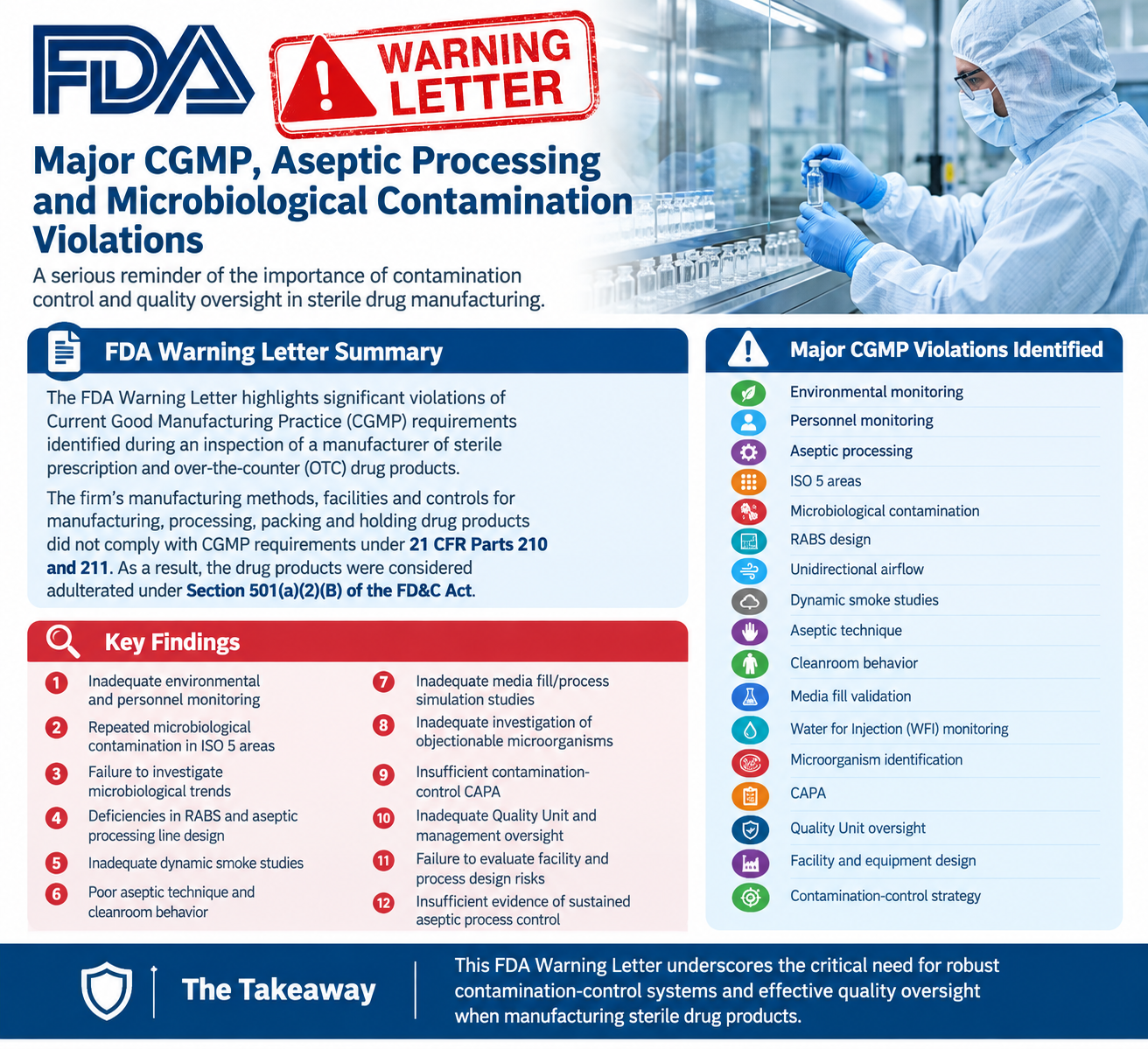
The inspection identified serious deficiencies involving:
- Environmental monitoring
- Personnel monitoring
- Aseptic processing
- ISO 5 areas
- Microbiological contamination
- Restricted Access Barrier System (RABS) design
- Unidirectional airflow
- Dynamic smoke studies
- Aseptic technique
- Cleanroom behavior
- Media fill validation
- Water for Injection (WFI) monitoring
- Microorganism identification
- CAPA
- Quality Unit oversight
- Facility and equipment design
- Contamination-control strategy
This FDA Warning Letter demonstrates the importance of maintaining robust contamination-control systems and effective quality oversight when manufacturing sterile drug products.
Key Findings in the FDA Warning Letter
The major observations described in this FDA Warning Letter can be summarized as follows:
- Inadequate environmental and personnel monitoring.
- Repeated microbiological contamination in ISO 5 areas.
- Failure to adequately investigate microbiological excursions and adverse trends.
- Deficiencies in RABS and aseptic processing line design.
- Inadequate dynamic smoke studies.
- Poor aseptic technique and cleanroom behavior.
- Inadequate media fill/process simulation studies.
- Inadequate investigation of objectionable microorganisms.
- Insufficient contamination-control CAPA.
- Inadequate Quality Unit and management oversight.
- Failure to adequately evaluate facility and process design risks.
- Insufficient evidence demonstrating sustained aseptic process control.
1. Inadequate Environmental Monitoring and Personnel Monitoring
One of the most significant findings in the FDA Warning Letter involved deficiencies in the firm’s Environmental Monitoring (EM) and Personnel Monitoring (PM) programs.
The facility manufactured sterile products using aseptic processing, making effective environmental and personnel monitoring essential to contamination control.
FDA determined that the firm’s monitoring program did not adequately cover significant locations within classified areas.
For example, important contamination-risk locations, including items such as phones used in aseptic processing areas, were not sufficiently monitored.
FDA also determined that some environmental monitoring procedures were inadequate.
In addition, the media used to support the environmental monitoring program was observed to have deficiencies, including cracked media that could compromise the ability to recover and evaluate microorganisms.
2. Repeated Microbiological Contamination in ISO 5 Areas
The FDA Warning Letter identified repeated recovery of microorganisms from ISO 5 areas between 2023 and 2025.
Microorganisms were recovered from:
- Air
- Surfaces
- Personnel
Some results were reported as out-of-limit (OOL). Of particular concern was the recovery of Gram-negative organisms such as:
- Serratia marcescens
- Stenotrophomonas maltophilia
These organisms can be associated with environmental or water-related contamination concerns.
FDA expressed concern that the firm continued production without implementing adequate CAPA to address persistent microbiological contamination in critical ISO 5 environments.
For sterile manufacturing, repeated recovery of microorganisms should trigger appropriate investigation, risk assessment, trend analysis, root-cause investigation, and effective corrective and preventive actions.
3. Failure to Adequately Investigate Microbiological Trends
Another important issue highlighted by the FDA Warning Letter was the firm’s failure to adequately investigate microbiological departures and adverse trends. FDA noted deficiencies involving:
- Environmental monitoring
- Personnel monitoring
- Water for Injection systems
- Microorganism identification
- Persistent microbiological recoveries
- Adverse trends
- Action-limit excursions
Investigations did not adequately evaluate the repeated recovery of microorganisms over time. FDA also identified concerns regarding microorganism identification. Some microorganisms recovered from the facility included:
- Pseudomonas aeruginosa
- Aspergillus brasiliensis
FDA noted that microorganisms from the same genus and species were also recovered from certain consumer complaint samples.
This finding increases the importance of a scientifically sound investigation linking environmental, personnel, water, product, and complaint microbiological data where appropriate.
4. Aseptic Processing and Manufacturing Design Deficiencies
The FDA Warning Letter also identified deficiencies in the design and control of the firm’s aseptic processing operations.
The firm’s Restricted Access Barrier System (RABS) line had design concerns, including equipment placement and ergonomic difficulties during aseptic operations.
FDA also identified insufficient barrier protection in certain areas.
These design deficiencies can increase the risk of contamination when operators perform interventions or manipulate sterile components.
Aseptic processing equipment and cleanroom design should minimize:
- Human intervention
- Operator movement
- Difficult manipulations
- Unnecessary exposure of sterile components
- Disruption of unidirectional airflow
- Transfer of contamination into critical areas
5. Inadequate Dynamic Smoke Studies
A significant observation in the FDA Warning Letter involved dynamic smoke studies.
FDA determined that the firm’s smoke studies did not adequately demonstrate unidirectional airflow protection across multiple aseptic processing lines.This included situations involving:
- Equipment setup
- Equipment assembly
- Filling operations
- Aseptic interventions
- Dynamic operator activities
Smoke studies are important because they provide visual evidence of airflow behavior in critical processing areas.
For sterile operations, airflow visualization should demonstrate that critical surfaces and sterile product-contact components remain adequately protected during routine and representative interventions.
FDA therefore requested a critical evaluation of airflow unidirectionality with assistance from a qualified consultant.
The smoke studies should be performed under appropriate dynamic conditions after remediation of the aseptic operation.
6. Sterility Testing Alone Cannot Demonstrate Process Control
An important lesson from this FDA Warning Letter is that a passing sterility test does not, by itself, demonstrate that an aseptic manufacturing process is adequately controlled.
Sterility testing is an important quality-control test for products intended to be sterile. However, sterility testing is only one element of a comprehensive contamination-control strategy. A robust sterile manufacturing system should incorporate:
- Facility design
- HVAC and airflow control
- ISO classification
- Personnel qualification
- Aseptic technique
- Environmental monitoring
- Personnel monitoring
- Cleaning and disinfection
- Equipment qualification
- Process validation
- Media fills
- Sterilization controls
- Microbiological monitoring
- Quality Unit oversight
The FDA Warning Letter emphasizes that quality must be built into the manufacturing process rather than relying solely on end-product testing.
7. Poor Aseptic Technique and Cleanroom Behavior
The FDA inspection identified multiple examples of poor aseptic practices. Operators were observed performing activities that could potentially compromise sterile product protection. Examples included:
- Reaching over exposed containers during interventions.
- Inadequate disinfection of equipment or components.
- Blocking unidirectional airflow.
- Contact with sterile portions of aseptic instruments.
- Improper handling of sterile components.
- Improper transfer of sterile materials.
- Inappropriate handling of waste near the processing line.
These practices demonstrate why aseptic behavior and operator qualification are critical components of sterile manufacturing.
Personnel working in ISO 5 and surrounding classified areas should understand how their movements and interventions can affect airflow and contamination risk.
8. Inadequate Media Fill / Aseptic Process Simulation
The FDA Warning Letter also identified deficiencies in the firm’s media fill program.
FDA determined that the number of units used in certain media fills was substantially smaller than the firm’s commercial aseptic batch sizes.
Therefore, the simulations did not sufficiently represent the contamination risks associated with actual commercial production.
Media fills should be appropriately designed to simulate routine and worst-case aseptic processing conditions. Relevant factors may include:
- Commercial batch size
- Processing duration
- Number of operators
- Operator interventions
- Equipment setup
- Line configuration
- Container handling
- Aseptic manipulations
- Shift changes
- Environmental conditions
- Equipment interventions
9. Media Fill Failure
The inspection also identified a documented media fill failure on one production line in July 2025. Two units demonstrated microbiological contamination involving:
- Neovaginatispora magiferae
- Geodermatophilus obscurus
A media fill failure requires a thorough investigation and appropriate evaluation of potential impact on the aseptic process. The investigation should consider:
- Root cause
- Personnel practices
- Equipment
- Facility design
- Environmental monitoring
- Interventions
- Cleaning and disinfection
- Sterilization
- Material transfer
- Previous media fills
- Related commercial batches
The investigation should lead to scientifically justified CAPA where appropriate.
10. Water for Injection and Microbiological Control
The FDA Warning Letter also raised concerns regarding the investigation of microbiological departures and adverse trends associated with the firm’s Water for Injection (WFI) system.
WFI is a critical utility in sterile pharmaceutical manufacturing. A robust WFI monitoring program should consider:
- Sampling locations
- Sampling frequency
- Microbial limits
- Alert and action levels
- Trend analysis
- Microorganism identification
- Sanitization
- System design
- Maintenance
- Temperature
- Distribution loops
- Points of use
Repeated microbiological excursions should be investigated comprehensively rather than treated as isolated events.
11. Inadequate CAPA
The FDA inspection indicated that the firm did not adequately implement CAPA to address persistent microbiological contamination. An effective CAPA system should identify the true root cause of the problem. Simply adding training or changing an SOP may not be sufficient if the underlying problem involves:
- Facility design
- Equipment design
- Airflow
- Personnel practices
- Process design
- Material flow
- Environmental controls
- Management oversight
- Quality system weaknesses
The FDA Warning Letter therefore emphasizes the need for systemic CAPA rather than superficial corrective actions.
12. Comprehensive Contamination Risk Assessment
FDA requested an independent and comprehensive assessment of contamination hazards associated with the firm’s aseptic processes, equipment, and facilities. The assessment should consider:
Human Interactions
Evaluate all human interventions within ISO 5 areas and identify opportunities to reduce or eliminate manual intervention.
Equipment Suitability
Evaluate:
- Equipment reliability
- Equipment capability
- Ergonomics
- Equipment placement
- Cleanability
- Maintenance
- Available cleanroom space
Airflow
Assess:
- Air volume
- Airflow direction
- Unidirectional airflow
- Air changes
- Critical-area protection
- Dynamic airflow conditions
Facility Layout
Evaluate whether the facility layout supports effective contamination control.
Personnel Flow
Review movement of personnel through:
- Cleanrooms
- Gowning areas
- Support rooms
- Aseptic processing areas
Material Flow
Evaluate movement and transfer of:
- Sterile components
- Raw materials
- Packaging materials
- Equipment
- Waste
The risk assessment should result in clearly defined CAPA and remediation actions.
13. Remediation of Aseptic Processing Operations
The FDA Warning Letter requested a detailed remediation plan addressing deficiencies in aseptic processing. The remediation plan should include:
- Specific improvements
- Responsible functions
- Completion timelines
- Facility modifications
- Equipment modifications
- Cleanroom improvements
- RABS improvements
- Airflow improvements
- Qualification requirements
- Validation requirements
- Personnel training
- Environmental monitoring improvements
- Media fill strategy
- CAPA effectiveness checks
Extensive modifications to aseptic processing lines and cleanrooms should be appropriately qualified and validated before routine commercial production resumes.
14. Quality Unit and Management Oversight
The inspection identified significant concerns regarding the firm’s overall quality system.
The FDA Warning Letter stated that the firm did not appear to operate an effective quality system consistent with CGMP requirements. FDA identified concerns regarding:
- Management oversight
- Quality Unit authority
- Quality Unit responsibilities
- Production oversight
- Aseptic process control
- Investigation effectiveness
- CAPA effectiveness
Executive management should therefore conduct a comprehensive review of the firm’s manufacturing operations. The review should determine whether quality systems, procedures, personnel, facilities, equipment, and processes are capable of consistently producing safe and quality drug products.
15. FDA Requested Corrective Actions
In response to the FDA Warning Letter, the firm was asked to provide extensive information and supporting documentation. The requested actions included:
Environmental Monitoring Program
An independent review covering:
- Limits
- Sampling methods
- Sampling locations
- Sampling frequency
- Trend analysis
- Investigation procedures
- Adverse trends
- CAPA
Manufacturing Design Assessment
A comprehensive assessment of manufacturing operations and microbiological hazards.
Product Risk Assessment
A detailed assessment of risks associated with potentially objectionable microbiological contamination. Potential actions could include:
- Customer notification
- Product evaluation
- Product hold
- Market withdrawal
- Recall, where appropriate
Batch Investigation
Complete investigations into batches associated with:
- Objectionable microorganisms
- OOL microbiological results
- Environmental excursions
- Personnel monitoring excursions
Microbiological Specifications
Appropriate microbiological release specifications for each drug product should be established based on the applicable product and manufacturing process.
Microbiological Testing Methods
The firm should provide the microbiological test methods used for each drug product.
Retain Sample Testing
FDA requested testing of appropriate retain samples from batches within expiry, including relevant quality attributes such as:
- Identity
- Strength
- Microbiological quality
- Total microbial counts
- Identification of objectionable microorganisms
16. Importance of Data Trending in Environmental Monitoring
One of the key lessons from this FDA Warning Letter is the importance of microbiological data trending. A facility should not only investigate individual excursions but should also evaluate long-term trends. Trending should consider:
- Location
- Room
- Personnel
- Organism
- Frequency
- Magnitude
- Time period
- Shift
- Product
- Batch
- Intervention
- Seasonality, where relevant
Repeated recovery of the same microorganism or recurring contamination patterns should trigger appropriate investigation and risk assessment.
17. Lessons for Pharmaceutical Quality Assurance
This FDA Warning Letter provides important lessons for Quality Assurance and Quality Control professionals.
Environmental Monitoring
The EM program should be capable of detecting contamination hazards before they affect product quality.
Personnel Monitoring
Personnel monitoring should provide meaningful information about operator contamination risk.
Aseptic Technique
Operators must be trained, qualified, observed, and periodically reassessed.
Media Fill
Media fills must represent actual aseptic manufacturing conditions and appropriate worst-case scenarios.
Smoke Studies
Dynamic airflow visualization should demonstrate adequate protection of critical areas.
CAPA
CAPA should address root causes and be verified for effectiveness.
Quality Unit
The Quality Unit must have sufficient authority and independence to identify and address manufacturing risks.
Management Responsibility
Senior management must provide adequate resources and oversight for an effective pharmaceutical quality system.
FDA Warning Letter: Key GMP Lessons
The FDA Warning Letter demonstrates several fundamental principles of sterile pharmaceutical manufacturing:
- Sterility must be built into the process.
- Environmental monitoring must be scientifically designed and effectively trended.
- Repeated microbiological contamination requires comprehensive investigation.
- Aseptic interventions must be minimized and appropriately controlled.
- Smoke studies must represent dynamic operating conditions.
- Media fills must adequately simulate commercial manufacturing.
- Facility and equipment design must support contamination control.
- Personnel behavior can significantly affect aseptic process control.
- CAPA must address systemic root causes.
- Quality Unit oversight must be effective and independent.
- Management must ensure adequate resources for GMP compliance.
- End-product testing cannot replace robust process controls.
Why This FDA Warning Letter Matters to the Pharmaceutical Industry
This FDA Warning Letter is relevant not only to the inspected company but also to sterile pharmaceutical manufacturers worldwide.
For companies supplying products to the United States, United Kingdom, European Union, and other regulated markets, the findings demonstrate the importance of maintaining globally aligned pharmaceutical quality systems.
Although the letter is based on U.S. FDA requirements, many of the underlying quality principles are also highly relevant to international GMP expectations, including:
- Contamination control
- Aseptic processing
- Environmental monitoring
- Personnel qualification
- Process simulation
- Quality Risk Management
- CAPA
- Data integrity
- Quality Unit oversight
- Facility and equipment design
Organizations should therefore use regulatory inspection findings as an opportunity to proactively evaluate their own systems.
Conclusion
This FDA Warning Letter identifies serious CGMP deficiencies involving aseptic processing, environmental monitoring, microbiological contamination, facility and equipment design, media fills, smoke studies, personnel practices, CAPA, and Quality Unit oversight.
The repeated recovery of microorganisms from critical ISO 5 environments and the deficiencies in contamination investigations demonstrate the importance of a robust contamination-control strategy.
The findings also show that sterile manufacturing requires much more than passing final-product testing. Facility design, airflow, personnel behavior, environmental monitoring, equipment suitability, process simulation, microbiological controls, and quality oversight must work together to protect sterile products.
Pharmaceutical manufacturers should proactively evaluate their aseptic operations, particularly where recurring environmental monitoring excursions, objectionable microorganisms, media fill failures, airflow deficiencies, or inadequate investigations are observed.
A comprehensive risk assessment, root-cause investigation, CAPA program, qualification and validation strategy, and management oversight system are essential to achieve sustainable GMP compliance.
Reference Warning Letter Date – 09/04/2026 Issued to Bausch & Lomb Inc. for CGMP/Finished Pharmaceuticals/Adulterated by the Center for Drug Evaluation and Research (CDER)Disclaimer
Educational & Awareness Purpose Only:
This article has been prepared for learning, training, educational, and pharmaceutical industry awareness purposes only. The information presented in this article is based on and/or summarized from publicly available information published on the official U.S. Food and Drug Administration (FDA) website, including FDA Warning Letters.
For the original and most up-to-date information, readers should refer directly to the official FDA Warning Letters database and related FDA publications.
This article is not an official FDA publication, communication, guidance, regulatory decision, or statement of the U.S. Food and Drug Administration. PharmGuidances is not affiliated with, endorsed by, or representing the FDA.
The information provided should not be used as a substitute for official FDA documents, applicable laws and regulations, regulatory guidance, legal advice, compliance advice, or professional consultation. It should not be relied upon for making regulatory, legal, manufacturing, quality, or business decisions.
Official Reference:
FDA Warning Letters – U.S. Food and Drug Administration
© PharmGuidances – For Educational, Training & Awareness Purposes Only.