FDA Warning Letter: Major CGMP Violations in Raw Material Testing, Stability, Validation and Quality Systems
This FDA Warning Letter highlights significant violations of Current Good Manufacturing Practice (CGMP) requirements identified during an FDA inspection of a pharmaceutical manufacturing facility.
The inspection found deficiencies involving raw material and API identity testing, supplier qualification, stability testing, Quality Unit oversight, process validation, cleaning validation, equipment qualification, CAPA, and management oversight.
FDA determined that the firm’s manufacturing methods, facilities, and controls did not comply with the requirements of 21 CFR Parts 210 and 211. Consequently, the drug products manufactured at the facility were considered adulterated under Section 501(a)(2)(B) of the Federal Food, Drug, and Cosmetic Act (FD&C Act).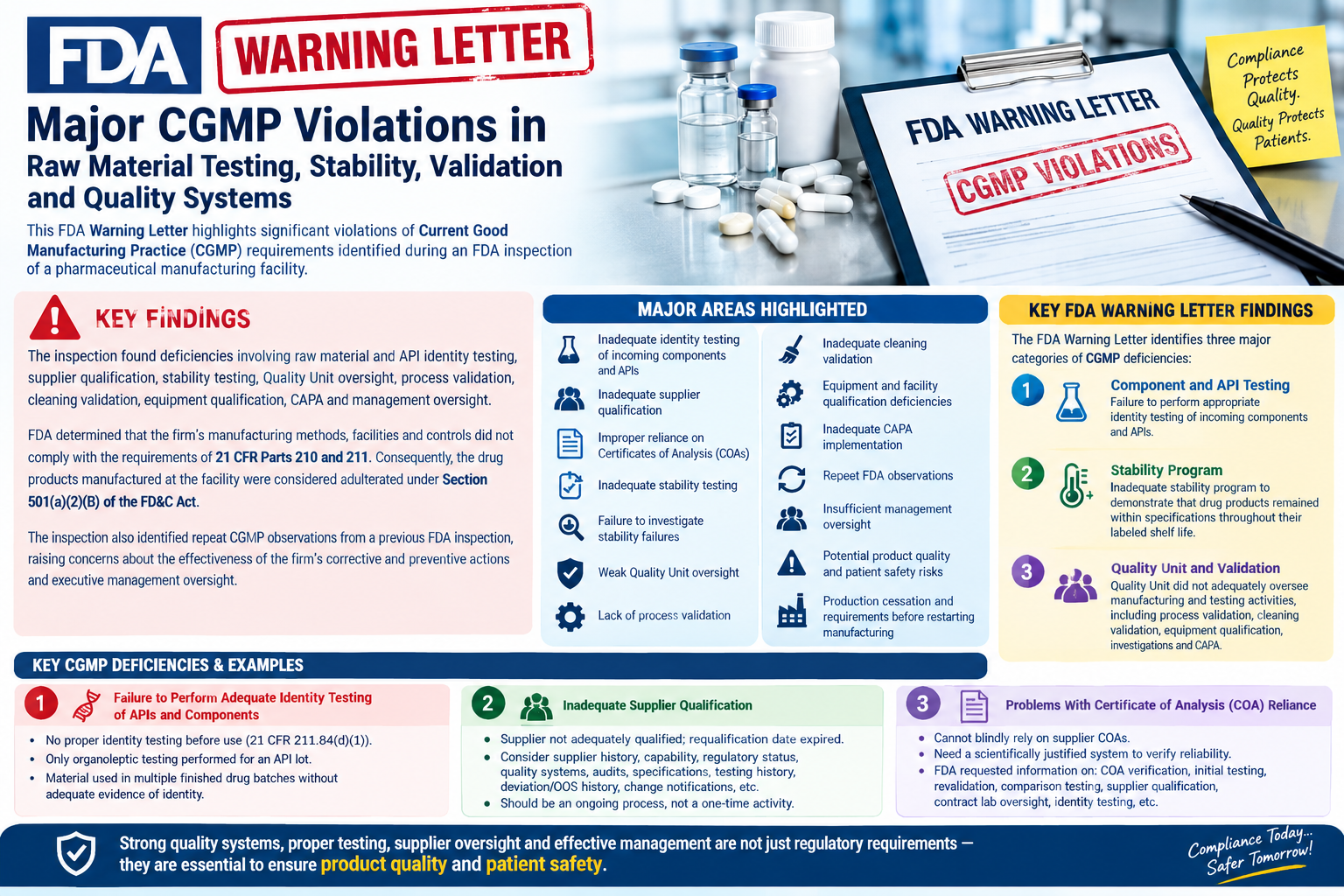
The inspection also identified repeat CGMP observations from a previous FDA inspection, raising concerns about the effectiveness of the firm’s corrective and preventive actions and executive management oversight. The major areas highlighted in this FDA Warning Letter include:
- Inadequate identity testing of incoming components and APIs
- Inadequate supplier qualification
- Improper reliance on Certificates of Analysis (COAs)
- Inadequate stability testing
- Failure to investigate stability failures
- Weak Quality Unit oversight
- Lack of process validation
- Inadequate cleaning validation
- Equipment and facility qualification deficiencies
- Inadequate CAPA implementation
- Repeat FDA observations
- Insufficient management oversight
- Potential product quality and patient safety risks
- Production cessation and requirements before restarting manufacturing
Key FDA Warning Letter Findings
The FDA Warning Letter identifies three major categories of CGMP deficiencies:
1. Component and API Testing
The firm failed to perform appropriate identity testing on incoming components, including APIs, before using them in drug manufacturing.
2. Stability Program
The firm’s stability program was inadequate to demonstrate that its drug products remained within established specifications throughout their labeled shelf life.
3. Quality Unit and Validation
The Quality Unit did not adequately oversee manufacturing and testing activities, including process validation, cleaning validation, equipment qualification, investigations, and CAPA.
1. Failure to Perform Adequate Identity Testing of APIs and Components
One of the most important findings in this FDA Warning Letter concerns the testing of incoming raw materials and components.
Under 21 CFR 211.84(d)(1), each component should be appropriately tested to verify its identity before use.
The FDA inspection found that the firm failed to perform appropriate identity testing on raw materials and APIs used to manufacture OTC drug products.
For example, records for an API lot showed that the firm performed only organoleptic testing rather than a specific identity test.
According to FDA’s findings, the material was subsequently used in multiple finished drug batches.
This created a significant concern because the firm lacked adequate scientific evidence demonstrating that the component met the required identity specifications before being used in manufacturing.
2. Inadequate Supplier Qualification
The FDA Warning Letter also identified deficiencies in the firm’s supplier qualification program.
FDA noted that the supplier had not been adequately qualified and that the supplier requalification date had expired.
A robust supplier qualification program should establish confidence that suppliers consistently provide materials meeting predefined quality requirements. Supplier qualification should consider:
- Supplier history
- Manufacturing capability
- Regulatory status
- Quality systems
- Audit results
- Material specifications
- Certificate of Analysis reliability
- Testing history
- Deviation history
- OOS history
- Change notification practices
- Periodic requalification
Supplier qualification should be an ongoing process rather than a one-time activity.
3. Problems With Certificate of Analysis (COA) Reliance
Another important lesson from this FDA Warning Letter is that pharmaceutical manufacturers cannot blindly rely on supplier Certificates of Analysis.
If a manufacturer intends to rely on supplier test results for certain quality attributes, it must have a scientifically justified system to establish and periodically verify the reliability of those results. The firm was asked to provide information regarding:
- COA verification
- Initial supplier testing
- Periodic revalidation
- Comparison testing
- Supplier qualification
- Contract laboratory oversight
- Identity testing of every incoming component lot
At least one specific identity test should be performed for each incoming component lot as required by applicable CGMP requirements.
4. Comprehensive Material Management System Required
FDA requested an independent review of the firm’s entire material management system. The review should include:
Supplier Evaluation
All suppliers of:
- APIs
- Excipients
- Containers
- Closures
- Other manufacturing components
should be appropriately evaluated and qualified.
Material Quality
The firm should determine whether materials consistently meet established quality specifications.
Expiry and Retest Dates
Assigned expiry and retest dates should be scientifically supported by appropriate data.
Supplier Disqualification
The supplier qualification system should define clear criteria for:
- Qualification
- Continued approval
- Requalification
- Suspension
- Disqualification
Incoming Material Testing
Each component should be tested against appropriate specifications for:
- Identity
- Strength
- Quality
- Purity
5. Inadequate Stability Program
The second major issue identified in the FDA Warning Letter concerns the firm’s stability program.
Under 21 CFR 211.166(a), pharmaceutical manufacturers must establish an adequate written stability testing program.
The purpose of stability testing is to demonstrate that drug products maintain their established quality attributes throughout the labeled shelf life.
FDA determined that the firm’s stability program did not adequately demonstrate that the chemical and microbiological characteristics of its drug products remained acceptable throughout the expiry period.
6. Stability Study Deficiencies
FDA identified several concerns with the firm’s accelerated and long-term stability studies.
The accelerated stability data included only a limited number of batches and lacked adequate documentation regarding controlled humidity conditions.
Some stability timepoints were reported as “Not Available.”
FDA also identified a failing result for viscosity that had not been adequately investigated.
A subsequent long-term stability study also identified a failing viscosity result at 12 months.
The failure to investigate these stability failures was a significant concern.
7. Stability-Indicating Analytical Methods
The FDA Warning Letter emphasized the need for scientifically appropriate stability-indicating analytical methods.
A stability-indicating method should be capable of detecting relevant changes in a drug product during storage.
Depending on the product, stability testing may include attributes such as:
- Appearance
- Assay
- Degradation products
- Dissolution
- pH
- Viscosity
- Microbiological quality
- Preservative content
- Physical characteristics
- Other critical quality attributes
The specific testing program should be scientifically justified for each product.
8. Ongoing Stability Program
FDA requested implementation of a comprehensive ongoing stability program.
The program should include representative batches of each marketed product on an annual basis.
The objective is to determine whether the established shelf-life claim remains valid. A robust stability program should define:
- Products included
- Batch selection
- Container-closure system
- Storage conditions
- Sampling intervals
- Tests performed
- Acceptance criteria
- Stability-indicating methods
- Investigation procedures
- OOS handling
- Trending requirements
9. Quality Unit Failed to Exercise Adequate Oversight
The FDA Warning Letter identified significant deficiencies in the firm’s Quality Control/Quality Unit.
Under 21 CFR 211.22, the Quality Unit has responsibility for ensuring that drug products are manufactured and tested in accordance with CGMP and established specifications.
FDA found that the Quality Unit failed to adequately oversee several critical areas. These included:
- Process validation
- Cleaning validation
- Equipment issues
- CAPA
- API release specifications
- Manufacturing operations
- Testing activities
This finding indicates a broader weakness in the firm’s pharmaceutical quality system.
10. Failure to Perform Process Validation
The firm had not adequately validated manufacturing processes for its OTC drug products.
Process validation is essential for demonstrating that a manufacturing process can consistently produce a product meeting predetermined quality requirements. A comprehensive process validation program should include:
- Process design
- Process qualification
- Process Performance Qualification (PPQ)
- Continued Process Verification (CPV)
- Ongoing monitoring
- Statistical evaluation of process performance
- Assessment of intra-batch variation
- Assessment of inter-batch variation
The FDA Warning Letter requested a timeline for completing appropriate PPQ for marketed drug products.
11. Failure to Perform Cleaning Validation
Another major issue identified in the FDA Warning Letter was inadequate cleaning validation for non-dedicated manufacturing equipment.
Cleaning validation is particularly important when the same equipment is used for multiple products.
FDA requested improvements based on scientifically justified worst-case conditions.
The cleaning validation program should evaluate:
Product Worst Cases
- Higher toxicity
- Higher potency
- Lower solubility
- Difficult-to-clean products
- Products with challenging physical or chemical properties
Equipment Worst Cases
- Difficult-to-clean locations
- Product-contact surfaces
- Dead legs
- Gaskets
- Valves
- Transfer lines
- Hard-to-access areas
Cleaning Parameters
- Maximum dirty hold time
- Maximum clean hold time
- Cleaning agent concentration
- Temperature
- Contact time
- Mechanical action
- Rinse conditions
12. Equipment Qualification and Maintenance
The FDA Warning Letter also raised concerns related to equipment management.
The firm experienced recurring gasket seal failures but did not adequately investigate and implement appropriate CAPA. A comprehensive equipment qualification program should include:
- Design Qualification (DQ)
- Installation Qualification (IQ)
- Operational Qualification (OQ)
- Performance Qualification (PQ)
- Preventive maintenance
- Calibration
- Periodic review
- Change control
- Breakdown investigation
Equipment problems should be investigated to determine whether they could affect product quality.
13. Change Management
FDA also emphasized the importance of an effective change management system. Before introducing:
- New manufacturing equipment
- New products
- New processes
- New materials
- Major facility modifications
the firm should perform an appropriate assessment of:
- Product quality impact
- Process impact
- Cleaning requirements
- Validation requirements
- Equipment qualification
- Regulatory requirements
- Documentation
- Training
- Stability implications
Change management should be integrated with Quality Risk Management and validation systems.
14. Repeat FDA Observations
One of the most serious aspects of this FDA Warning Letter was the identification of repeat observations. During an earlier inspection ending in March 2024, FDA had already identified similar deficiencies. The firm had committed to:
- Establishing an SOP for process validation
- Creating process validation protocols
- Performing validation studies
- Validating cleaning procedures for non-dedicated equipment
However, during the 2026 inspection, FDA determined that the firm had not completed the promised process validation or cleaning validation.
This raised concerns regarding the firm’s ability to implement CAPA effectively.
15. Ineffective CAPA Implementation
Repeat observations can indicate that previous CAPA systems did not adequately address the underlying root causes. An effective CAPA system should include:
Problem Identification → Investigation → Root Cause → Risk Assessment → Corrective Action → Preventive Action → Implementation → Effectiveness Check
CAPA should not simply address the immediate observation.
The organization should determine why the original system failed and implement sustainable measures to prevent recurrence.
16. Management Oversight Concerns
The FDA Warning Letter expressed concern regarding executive management oversight.
Repeated failure to implement previously committed corrective actions suggests that management may not have provided sufficient resources, oversight, or accountability. Senior management should periodically review:
- GMP compliance
- CAPA status
- Validation status
- Deviations
- OOS results
- Complaints
- Stability trends
- Supplier performance
- Equipment reliability
- Audit findings
- Regulatory commitments
Management review should result in documented actions and follow-up.
17. Product Quality and Patient Safety Risks
Because inadequate raw material testing, stability testing, process validation, and cleaning validation can potentially affect product quality, FDA requested an assessment of distributed products.
The firm was asked to evaluate potential risks associated with batches already distributed in the United States. Depending on the results of the risk assessment, appropriate actions could include:
- Additional testing
- Product hold
- Customer notification
- Market withdrawal
- Recall
- Regulatory notification
The appropriate action should be based on scientifically justified risk assessment and applicable regulatory requirements.
18. Drug Production Ceased
FDA acknowledged the firm’s plan to cease production of certain drugs at the facility.
The company was asked to clarify whether additional batches had been manufactured after the inspection or whether it intended to resume drug manufacturing operations.
If manufacturing is resumed, FDA expects the firm to address all identified deficiencies and systemic quality-system weaknesses.
FDA also recommended engagement of a qualified consultant meeting the requirements of 21 CFR 211.34.
The consultant should assist with CGMP compliance and perform a comprehensive assessment of the firm’s operations.
19. Six-System GMP Audit
The FDA requested a comprehensive six-system audit if the firm resumes manufacturing. A six-system audit typically evaluates major pharmaceutical GMP systems such as:
- Quality System
- Facilities and Equipment System
- Materials System
- Production System
- Packaging and Labeling System
- Laboratory Control System
The objective is to identify systemic weaknesses rather than addressing individual observations in isolation.
20. Cosmetics and MoCRA Requirements
The inspection correspondence also noted that some products manufactured by the facility may fall within the definition of cosmetics under the FD&C Act.
For products regulated as cosmetics, applicable requirements must also be met.
The Modernization of Cosmetics Regulation Act of 2022 (MoCRA) introduced additional requirements for applicable cosmetic facilities and products.
Therefore, companies manufacturing both pharmaceutical and cosmetic products should carefully determine the regulatory requirements applicable to each product category.
Major GMP Lessons From the FDA Warning Letter
This FDA Warning Letter provides several important lessons for pharmaceutical manufacturers.
Raw Material Testing
Never rely solely on organoleptic examination when specific identity testing is required.
Supplier Qualification
Suppliers must be properly qualified and periodically evaluated.
COA Verification
Supplier COAs must be supported by an appropriate verification and qualification program.
Stability
Shelf life must be supported by scientifically sound stability data.
Process Validation
Manufacturing processes must be validated and maintained in a state of control.
Cleaning Validation
Cleaning processes must demonstrate effective removal of residues under scientifically justified worst-case conditions.
Quality Unit
The Quality Unit must have sufficient authority, independence, resources, and expertise.
CAPA
CAPA must address root causes and demonstrate effectiveness.
Management Oversight
Executive management must ensure that regulatory commitments are actually implemented.
Repeat Observations
Repeated deficiencies are a major warning sign that the pharmaceutical quality system may not be effectively controlling manufacturing operations.
FDA Warning Letter: Key Takeaways for QA Professionals
For pharmaceutical Quality Assurance (QA) professionals, this FDA Warning Letter highlights the importance of maintaining an integrated pharmaceutical quality system. QA teams should periodically verify:
- All APIs have appropriate identity testing.
- Incoming components meet specifications.
- Supplier qualification is current.
- COA verification is scientifically justified.
- Stability programs are adequate.
- Stability failures are investigated.
- Process validation is completed.
- Cleaning validation is scientifically justified.
- Equipment is qualified and maintained.
- Deviations are thoroughly investigated.
- CAPA is implemented on time.
- CAPA effectiveness is verified.
- Quality Unit responsibilities are clearly defined.
- Management reviews GMP performance.
- Regulatory commitments are completed as promised.
Why This FDA Warning Letter Matters to the Global Pharmaceutical Industry
Although this FDA Warning Letter concerns FDA requirements in the United States, the underlying GMP principles are highly relevant to pharmaceutical manufacturers supplying regulated markets worldwide. Companies targeting the:
- USA
- UK
- European Union
- Canada
- Australia
- Other regulated pharmaceutical markets
should maintain strong systems for:
- Supplier qualification
- Material testing
- Stability
- Process validation
- Cleaning validation
- Equipment qualification
- CAPA
- Quality Risk Management
- Quality Unit oversight
- Management review
The findings provide a useful compliance checklist for pharmaceutical companies preparing for regulatory inspections.
Conclusion
This FDA Warning Letter identifies significant CGMP deficiencies related to component identity testing, supplier qualification, COA verification, stability testing, Quality Unit oversight, process validation, cleaning validation, equipment qualification, CAPA, and management oversight.
The most important concern is that several deficiencies had previously been identified, yet the firm’s earlier commitments were not fully implemented.
This demonstrates that regulatory compliance is not achieved simply by creating an SOP or promising corrective action. Pharmaceutical manufacturers must implement, document, verify, and demonstrate the effectiveness of corrective actions.
A robust pharmaceutical quality system should integrate:
Material Control + Supplier Qualification + Laboratory Controls + Stability + Process Validation + Cleaning Validation + Equipment Qualification + CAPA + Quality Unit Oversight + Management Review
Manufacturers should use the findings described in this FDA Warning Letter as an opportunity to conduct proactive internal audits and risk assessments before similar deficiencies result in regulatory action.
Reference Warning Letter Date – 09/01/2026 Issued to Happy Farm Botanicals, Inc. for CGMP/Finished Pharmaceuticals/Adulterated by the Center for Drug Evaluation and Research (CDER)
Disclaimer
Educational & Awareness Purpose Only:
This article has been prepared for learning, training, educational, and pharmaceutical industry awareness purposes only. The information presented in this article is based on and/or summarized from publicly available information published on the official U.S. Food and Drug Administration (FDA) website, including FDA Warning Letters.
For the original and most up-to-date information, readers should refer directly to the official FDA Warning Letters database and related FDA publications.
This article is not an official FDA publication, communication, guidance, regulatory decision, or statement of the U.S. Food and Drug Administration. PharmGuidances is not affiliated with, endorsed by, or representing the FDA.
The information provided should not be used as a substitute for official FDA documents, applicable laws and regulations, regulatory guidance, legal advice, compliance advice, or professional consultation. It should not be relied upon for making regulatory, legal, manufacturing, quality, or business decisions.
Official Reference:
FDA Warning Letters – U.S. Food and Drug Administration
© PharmGuidances – For Educational, Training & Awareness Purposes Only.