FDA Warning Letter: Major CGMP, Quality System and OTC Drug Violations
This FDA warning letter identifies significant violations of Current Good Manufacturing Practice (CGMP) requirements for finished pharmaceuticals under 21 CFR Parts 210 and 211. FDA concluded that the firm’s manufacturing, processing, packing, and holding controls did not conform to CGMP requirements, resulting in drug products being considered adulterated under the Federal Food, Drug, and Cosmetic Act.
The FDA warning letter also identified concerns involving certain OTC acne products.FDA determined that these products were unapproved new drugs and misbranded based on their labeling and applicable OTC requirements.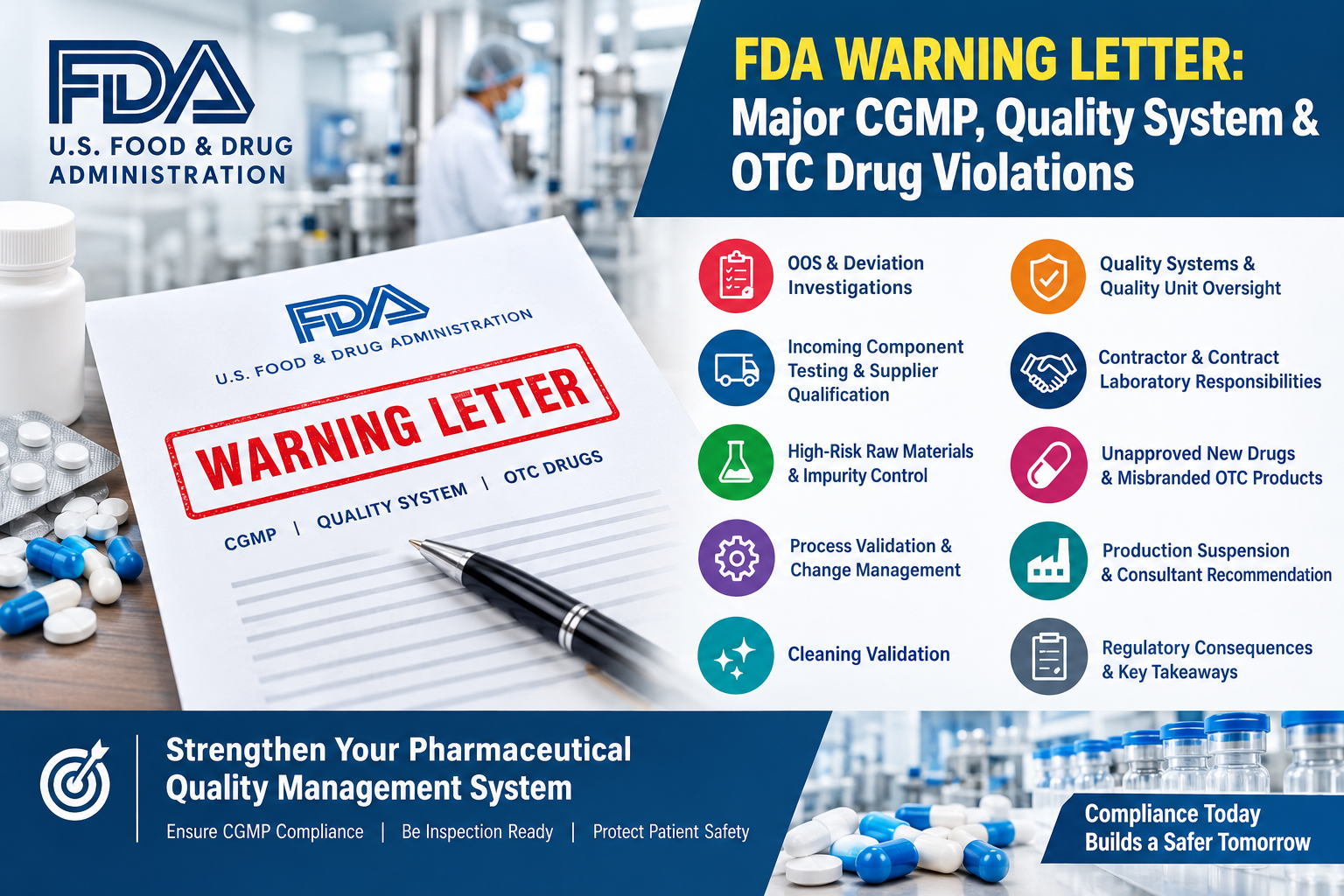
Key FDA Warning Letter Findings
The major observations can be grouped into several critical areas:
- Inadequate OOS and deviation investigations
- Inadequate incoming component testing and supplier qualification
- Inadequate control of high-risk raw materials and hazardous impurities
- Inadequate process validation and change management
- Inadequate cleaning validation
- Weak pharmaceutical quality systems and Quality Unit oversight
- Unapproved and misbranded OTC drug products
1. Inadequate OOS Investigations and CAPA
The FDA warning letter states that the firm failed to thoroughly investigate unexplained discrepancies, batch failures, and out-of-specification (OOS) results as required by 21 CFR 211.192.
FDA identified examples where OOS assay and pH results were not adequately investigated. The firm failed to scientifically determine root causes, evaluate the potential impact on products already on the market, and establish appropriate CAPA.
FDA also noted that the firm expanded a pH specification as a CAPA without adequate scientific justification.
FDA requested an independent assessment of the investigation and CAPA systems, including:
- Root cause analysis
- Investigation scope determination
- CAPA effectiveness
- Quality Unit oversight
- Investigation procedures and competencies
- Trend analysis
- Change management
- Assessment of product quality and patient safety risks
- Customer notifications and recalls where appropriate
2. Inadequate Incoming Component Testing and Supplier Qualification
Another major finding in the FDA warning letter concerns incoming raw materials and components.
The firm did not perform adequate identity testing on each shipment and lot of incoming components and relied on supplier Certificates of Analysis (COAs) without adequately establishing the reliability of supplier testing.
FDA emphasized that manufacturers must have appropriate systems to ensure that components meet specifications for identity, strength, quality, and purity before they are used in manufacturing.
The FDA requested:
- Comprehensive supplier qualification.
- Appropriate incoming-material specifications.
- Identity testing of each incoming component lot.
- Scientific evaluation of supplier COA reliability.
- Initial validation and periodic re-validation of supplier test results.
- CAPA to strengthen the vendor qualification program.
- Qualification and oversight of contract laboratories.
- Appropriate reconciliation and testing of retain samples.
3. High-Risk Raw Materials and Hazardous Impurity Control
The FDA warning letter identified additional concerns involving components at risk of contamination with hazardous impurities.
FDA noted that the firm manufactured drug products containing components associated with a known risk of dangerous contamination but did not adequately test incoming materials to ensure that they were free from the relevant impurities.
FDA stated that the firm needed stronger raw-material specifications and appropriate incoming testing. It also requested a risk assessment covering drug products within expiry that contained ingredients potentially at risk of contamination.
The firm was expected to evaluate whether affected batches required actions such as customer notification or product recall.
4. Inadequate Process Validation and Change Management
The FDA also identified deficiencies in manufacturing process validation under 21 CFR 211.100(a).
FDA found that the firm:
- Made major manufacturing process changes without appropriate revalidation.
- Did not always execute validation protocols completely.
- Deviated from its Validation Master Plan.
- Failed to retain required stability samples from validation batches.
- Did not adequately integrate significant process changes into the change-management system.
FDA emphasized that process validation should establish and maintain a state of control throughout the product lifecycle.
The firm was asked to provide a comprehensive validation program covering process performance qualification, ongoing monitoring, intra-batch and inter-batch variation, and risk assessment of distributed products manufactured using inadequately validated processes.
5. Inadequate Cleaning Validation
Cleaning validation was another significant concern.
The firm used non-dedicated manufacturing equipment but did not adequately validate cleaning processes. FDA also identified inadequately investigated OOS results associated with residual API testing during cleaning validation.
FDA requested improvements covering worst-case cleaning scenarios, including:
- Higher-toxicity products
- Higher-potency products
- Poorly soluble products
- Difficult-to-clean products
- Worst-case equipment and swab locations
- Maximum hold times before cleaning
- New equipment and new-product change management
- Cleaning verification and validation SOPs
- Retrospective cross-contamination assessment
FDA also requested an evaluation of whether inadequately cleaned equipment could have resulted in cross-contaminated products being released for distribution.
6. Weak Pharmaceutical Quality System and Quality Unit Oversight
The FDA states that the firm’s overall quality systems were inadequate.
FDA identified weaknesses in management oversight of production and laboratory operations and concluded that the Quality Unit was not sufficiently empowered or had not adequately implemented its responsibilities.
FDA therefore expected executive management to conduct a comprehensive assessment of the company’s manufacturing operations and ensure that systems, processes, and products comply with FDA requirements.
This finding demonstrates that the observations were not viewed as isolated laboratory or production problems. FDA considered them evidence of broader quality-system and management-control weaknesses.
7. Contractor and Contract Laboratory Responsibilities
The FDA also reinforces that contract manufacturers, testing laboratories, packagers, and labelers are considered extensions of the manufacturer.
The company remains responsible for ensuring that drugs manufactured by contractors comply with CGMP requirements, regardless of contractual agreements with product owners.
Therefore, pharmaceutical companies should maintain appropriate:
- Quality agreements
- Contractor qualification
- Supplier qualification
- Contract laboratory oversight
- Audit programs
- Technical agreements
- Ongoing performance monitoring
8. Unapproved New Drug and Misbranding Issues
In addition to CGMP deficiencies, FDA identified regulatory concerns with some products.
FDA determined that the products were intended for acne treatment based on their labeling claims and therefore met the definition of drug products.
FDA concluded that the products did not conform to the applicable OTC acne drug monograph requirements and had not otherwise been demonstrated to be generally recognized as safe and effective (GRASE). Consequently, FDA considered them unapproved new drugs.
FDA also determined that the products were misbranded under the FD&C Act.
Also read – FDA Warning Letter – Major CGMP deficiencies
9. Production Suspension and Consultant Recommendation
The firm committed to suspending production of OTC drug products that did not meet required testing and systemic quality requirements.
FDA stated that if the firm intends to resume regulated drug manufacturing operations, it should notify FDA before resuming production and resolve the identified deficiencies and systemic flaws.
FDA also recommended that the firm engage a qualified CGMP consultant under 21 CFR 211.34. The consultant should conduct a comprehensive six-system audit and evaluate the completion and effectiveness of CAPA before the firm seeks resolution of its compliance status.
Key Takeaways from the FDA Warning Letter
FDA expects pharmaceutical manufacturers to maintain an integrated and effective pharmaceutical quality system rather than addressing individual observations in isolation.
The major lessons include:
- OOS investigations must identify scientifically justified root causes.
- CAPA must address root causes and include effectiveness checks.
- Incoming components require appropriate identity and quality testing.
- Supplier COAs cannot simply be accepted without demonstrating supplier reliability.
- High-risk materials require appropriate impurity controls.
- Manufacturing changes must be managed through an effective change-control system.
- Process validation must establish and maintain a state of control.
- Cleaning validation must adequately address worst-case conditions.
- The Quality Unit must have sufficient authority and oversight.
- Contract manufacturers and laboratories must be appropriately qualified and monitored.
- Product quality and patient safety risks must be retrospectively assessed.
- Regulatory labeling and OTC monograph requirements must be carefully evaluated.
Regulatory Consequences
The FDA warning letter states that unresolved violations may have significant regulatory consequences, including potential withholding of export certificates and FDA approval of new applications or supplements identifying the company as a drug manufacturer.
FDA may also conduct a follow-up inspection to verify that corrective actions have been completed and are effective.
The company was instructed to submit a written response within 15 business days of receiving the letter, including information demonstrating how the identified deficiencies have been corrected and how continued compliance will be ensured.
Conclusion
This FDA warning letter highlights the importance of an effective pharmaceutical Quality Management System (QMS), strong laboratory controls, scientifically sound investigations, robust CAPA, validated manufacturing and cleaning processes, qualified suppliers, and effective Quality Unit oversight.
For pharmaceutical manufacturers targeting the U.S. and European markets, the observations provide valuable lessons for strengthening GMP compliance, inspection readiness, risk management, and regulatory remediation.
A successful remediation program should focus not only on correcting individual observations but also on identifying systemic root causes, strengthening management oversight, implementing sustainable CAPA, and demonstrating effectiveness through objective evidence.
Reference Warning Letter Date – 09/17/2026Issued to Bentley Laboratories LLC for CGMP/Finished Pharmaceuticals/Adulterated by Center for Drug Evaluation and Research (CDER)
Disclaimer
Educational & Awareness Purpose Only:
This article has been prepared for learning, training, educational, and pharmaceutical industry awareness purposes only. The information presented in this article is based on and/or summarized from publicly available information published on the official U.S. Food and Drug Administration (FDA) website, including FDA Warning Letters.
For the original and most up-to-date information, readers should refer directly to the official FDA Warning Letters database and related FDA publications.
This article is not an official FDA publication, communication, guidance, regulatory decision, or statement of the U.S. Food and Drug Administration. PharmGuidances is not affiliated with, endorsed by, or representing the FDA.
The information provided should not be used as a substitute for official FDA documents, applicable laws and regulations, regulatory guidance, legal advice, compliance advice, or professional consultation. It should not be relied upon for making regulatory, legal, manufacturing, quality, or business decisions.
Official Reference:
FDA Warning Letters – U.S. Food and Drug Administration
© PharmGuidances – For Educational, Training & Awareness Purposes Only.
2 thoughts on “FDA Warning Letter: Major CGMP, Quality System and OTC Drug Violations”
Comments are closed.