FDA Warning Letter
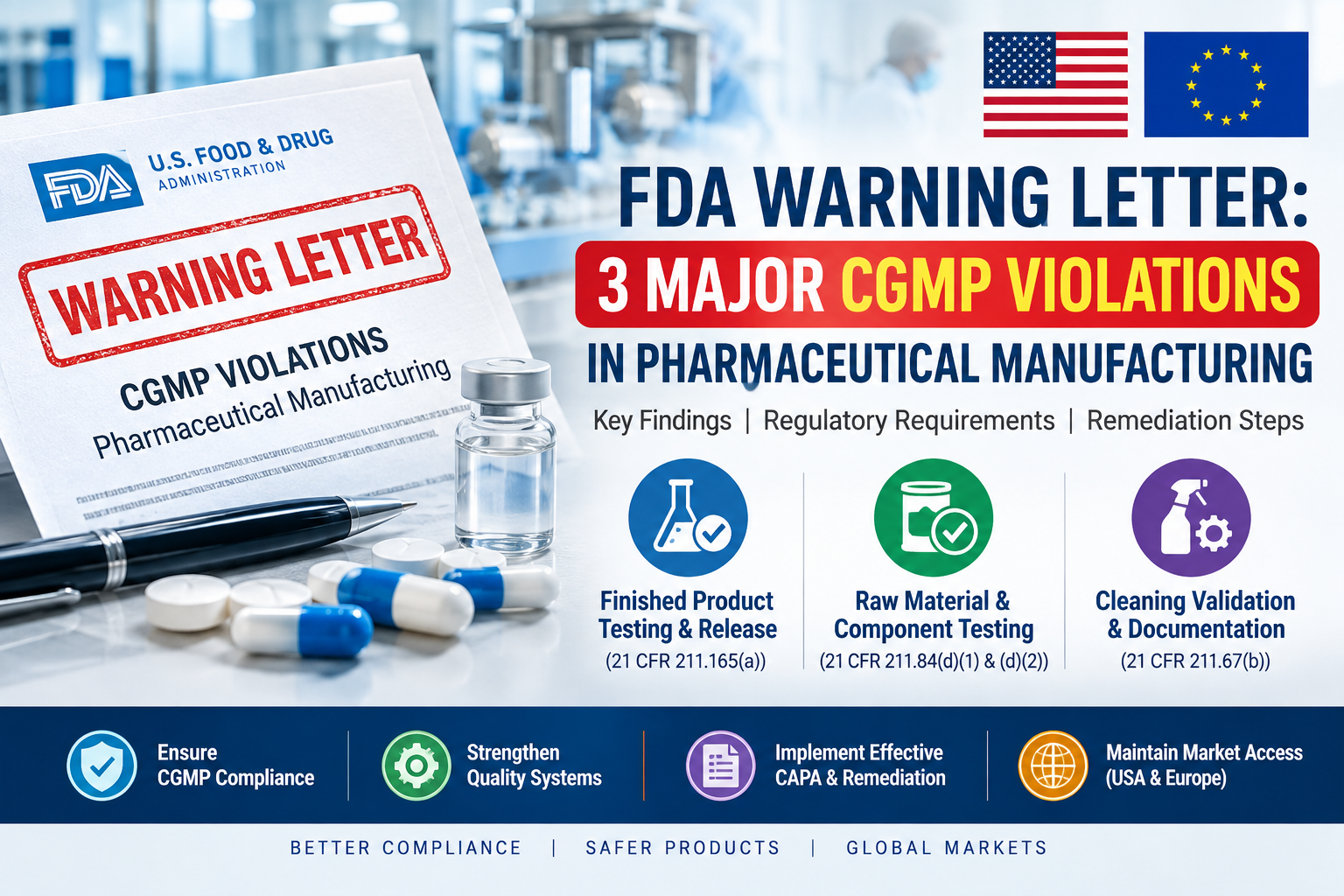
An FDA warning letter is a serious regulatory communication that identifies significant violations of FDA requirements and allows a pharmaceutical manufacturer to take corrective action. In this case, the FDA warning letter identifies three major CGMP deficiencies related to finished-product testing, incoming material controls, and cleaning validation.
These findings demonstrate the importance of maintaining a robust pharmaceutical quality system and ensuring that all drug products meet established specifications before release and distribution.
1. Inadequate Finished Product Testing and Release
The FDA warning letter states that the firm failed to perform adequate chemical and microbiological testing of finished OTC drug products before distribution, citing a violation of 21 CFR 211.165(a).
In one example, a bulk drug product batch underwent testing before additional manufacturing. However, after further processing, the resulting final drug product was not adequately tested before release. The same finished product batch was also released before documented approval by the Quality Unit.
Drug product batches must be appropriately tested for identity, strength, quality, and purity before release. Adequate testing provides documented evidence that the finished product conforms to established specifications and is suitable for its intended use.
The FDA found the firm’s response inadequate because it did not provide sufficient procedures to demonstrate that finished drug products would be appropriately tested before release. The firm also did not provide adequate third-party testing acceptance criteria or an appropriate assessment of products already distributed and still within expiry.
FDA-Requested Corrective Actions
The firm was asked to provide:
- An independent assessment of laboratory practices, procedures, analytical methods, equipment, documentation, and analyst competency.
- A detailed laboratory remediation and effectiveness plan.
- Chemical and microbiological specifications for drug products.
- Testing methods and written procedures used before batch disposition.
2. Inadequate Raw Material and Component Testing
The second major deficiency identified in the FDA warning letter concerns incoming raw materials and components, including APIs. The firm failed to perform appropriate identity testing before using materials in OTC drug manufacturing, resulting in violations of 21 CFR 211.84(d)(1) and 211.84(d)(2).
The firm relied on supplier Certificates of Analysis (COAs) instead of adequately testing each component lot for identity, purity, strength, and quality.
The FDA also identified the absence of an adequate supplier qualification program for evaluating the reliability of supplier test results.
FDA Expectations for Material Controls
The firm is expected to establish:
- A comprehensive supplier qualification program.
- Identity testing for each incoming component lot.
- Appropriate chemical and microbiological specifications.
- Procedures for evaluating supplier COA reliability.
- Initial validation and periodic re-validation of supplier test results when relied upon.
- SOPs governing the COA verification and validation program.
These controls are essential elements of a compliant pharmaceutical material management system.
3. Inadequate Cleaning Validation and Documentation
The third major issue highlighted in the FDA warning letter relates to cleaning and maintenance of manufacturing equipment under 21 CFR 211.67(b).
The firm failed to adequately validate cleaning procedures to demonstrate effective removal of API residues, cleaning agents, and potential microbial contamination from non-dedicated manufacturing equipment.
The FDA also identified weaknesses in cleaning documentation, including inadequate documentation of the type of cleaning performed and the specific cleaning agent used for equipment shared between OTC drug and cosmetic manufacturing.
FDA Cleaning Validation Expectations
The cleaning validation program should consider appropriate worst-case conditions, including:
- Products with higher toxicity.
- Products with higher potency.
- Products with low solubility in cleaning solvents.
- Products that are difficult to clean.
- Worst-case equipment and swab locations.
- Maximum dirty and clean hold times.
- Equipment and product change-management requirements.
- Potential cross-contamination risks.
A retrospective assessment should also determine whether inadequate cleaning could have resulted in cross-contamination of products previously manufactured and distributed.
Overall Significance of the FDA Warning Letter
The FDA warning letter demonstrates that the deficiencies were not limited to a single isolated event. The observations involve several interconnected elements of the pharmaceutical quality system, including:
Incoming Materials → Laboratory Testing → Finished Product Release → Cleaning Validation → Cross-Contamination Control → Quality Unit Oversight
The company must therefore take a comprehensive approach to remediation rather than addressing each observation as an independent issue.
Effective CAPA should address the root causes of the deficiencies, evaluate the potential impact on products already distributed, strengthen SOPs and laboratory controls, and establish appropriate effectiveness checks.
CGMP Consultant Recommendation
Because of the nature and scope of the deficiencies, FDA strongly recommends that the firm consider engaging a qualified CGMP consultant to assist with remediation.
However, the FDA warning letter makes clear that hiring a consultant does not transfer the firm’s regulatory responsibility. Executive management remains responsible for ensuring that identified deficiencies and systemic quality-system weaknesses are effectively corrected.
Also read – FDA Warning Letter: Major CGMP, Quality System and OTC Drug Violations
Potential Regulatory Consequences
Failure to adequately respond to the FDA warning letter may result in further regulatory or legal action. Potential consequences may include seizure, injunction, withholding of export certificates, and delays or withholding of approval of certain applications or supplements identifying the company as a drug manufacturer.
FDA may also conduct a follow-up inspection to verify whether corrective actions have been successfully implemented.
FDA Warning Letter Response Requirement
The firm is required to respond in writing within 15 working days of receiving the letter. The response should explain the actions already taken, corrective actions planned, measures implemented to prevent recurrence, and timelines for completing actions that cannot be completed within the required response period.
Key Takeaway for Pharmaceutical Manufacturers
This FDA warning letter highlights the importance of maintaining a comprehensive and effective pharmaceutical quality system.
Manufacturers should ensure that:
- Every finished drug product is appropriately tested before release.
- Incoming components receive appropriate identity testing.
- Supplier qualification and COA verification programs are scientifically justified.
- Cleaning processes are appropriately validated.
- Cross-contamination risks are assessed.
- Quality Unit approval is obtained before batch release.
- CAPA addresses root causes and includes effectiveness verification.
- Retrospective assessments are performed where product quality may have been affected.
For pharmaceutical manufacturers operating in the United States and Europe, these principles are also highly relevant when preparing for FDA, EU GMP, and other regulatory inspections.
Strong CGMP systems, effective laboratory controls, robust cleaning validation, and a proactive Quality Assurance function are essential for maintaining regulatory compliance and protecting product quality.
Reference Warning Letter Date – 02/02/2026 Issued to Stream2Sea, LLC for CGMP/Finished Pharmaceuticals/Adulterated by Center for Drug Evaluation and Research (CDER)
Disclaimer
Educational & Awareness Purpose Only:
This article has been prepared for learning, training, educational, and pharmaceutical industry awareness purposes only. The information presented in this article is based on and/or summarized from publicly available information published on the official U.S. Food and Drug Administration (FDA) website, including FDA Warning Letters.
For the original and most up-to-date information, readers should refer directly to the official FDA Warning Letters database and related FDA publications.
This article is not an official FDA publication, communication, guidance, regulatory decision, or statement of the U.S. Food and Drug Administration. PharmGuidances is not affiliated with, endorsed by, or representing the FDA.
The information provided should not be used as a substitute for official FDA documents, applicable laws and regulations, regulatory guidance, legal advice, compliance advice, or professional consultation. It should not be relied upon for making regulatory, legal, manufacturing, quality, or business decisions.
Official Reference:
FDA Warning Letters – U.S. Food and Drug Administration
© PharmGuidances – For Educational, Training & Awareness Purposes Only.