
Pharmaceutical Change Control: GMP Process, Risk Assessment & Implementation
Pharmaceutical Change: HVAC and Environmental Control
1. Proposed Pharmaceutical Change: Replace and upgrade an existing HVAC system serving a Grade C manufacturing area to improve temperature, relative humidity, pressure differential, air-change performance, and overall environmental control.
Reason for This Pharmaceutical Change:
- The existing HVAC system is approaching the end of its operational life.
- Increasing maintenance frequency has been observed.
- HVAC performance is showing variability.
- The change is required to improve reliability and maintain the validated environmental conditions.
- The change may potentially affect the classified area and manufacturing operations.
2. Change Control Initiation
I would first initiate a formal Change Control (CC) with a unique number, for example: CC No.:CC/QA/26/001. The change request would include:
- Current state
- Proposed state
- Reason/justification
- Scope of change
- Affected departments
- Affected equipment/areas
- Preliminary GMP impact
- Proposed implementation date
- Change owner
- Supporting documents
Current State: Existing AHU/HVAC system provides environmental control to the Grade C area.
Proposed State: Install a new AHU with improved filtration, temperature/RH control, pressure differential monitoring, and an upgraded control system.
Change Owner: Engineering
QA Classification: Major GMP Change — subject to detailed impact and risk assessment.
3. Impact Assessment of this Pharmaceutical Change: Assess the change systematically across all potentially affected areas.
| Area | Impact Assessment |
| Product Quality | Potential impact on temperature, RH, and contamination control |
| Manufacturing | Temporary interruption may be required |
| Environmental Monitoring | EM program may require additional monitoring |
| HVAC Qualification | IQ/OQ/PQ of AHU or appropriate requalification required |
| Cleaning | Cleaning procedures may require review |
| Validation | Existing validated state may be affected |
| Utilities | HVAC utility systems affected |
| Calibration | New instruments/sensors require calibration |
| SOPs | HVAC operation, alarm, and monitoring SOPs require revision |
| Training | Engineering, Production, and QA personnel require training |
| Data Integrity | Electronic HVAC/BMS records may be affected |
| Pest/Contamination Control | Potential impact during construction/installation |
| Regulatory | Regulatory reporting/approval assessment required |
| Stability | Assessment required if environmental excursions affect product |
| Batch Release | Potential impact on batches manufactured during implementation |
| Occupational Safety | Installation and maintenance risks assessed |
“Impact assessment is not limited to the equipment being changed. I assess the entire product and process lifecycle, including facilities, utilities, validation, procedures, training, environmental monitoring, regulatory commitments, data integrity, ongoing batches, and the validated state.”
4. Risk Assessment: After impact assessment, I would conduct a quality risk assessment, preferably using FMEA or another approved risk-management methodology consistent with the site’s QRM procedure.
FMEA Table
| Failure Mode | Potential Impact | Severity | Occurrence | Detectability | Risk |
| HVAC fails to maintain RH | Product/process impact | High | Medium | Medium | High |
| Pressure differential inadequate | Cross-contamination risk | High | Medium | Medium | High |
| HEPA filter integrity failure | Microbial/particulate contamination risk | High | Low | Medium | Medium/High |
| Temperature sensor inaccurate | Incorrect environmental monitoring | Medium | Medium | Medium | Medium |
| BMS alarm not functioning | Delayed detection of excursion | High | Low | High | Medium/High |
| Incorrect AHU installation | HVAC performance failure | High | Low | Medium | Medium/High |
| SOP not revised | Incorrect operation | Medium | Medium | High | Medium |
| Personnel not trained | Operational error | Medium | Medium | Medium | Medium |
Risk Controls: Based on the assessment of this Pharmaceutical Change, we would establish controls such as:
- Approved URS/design
- Qualified vendor
- Engineering drawings review
- FAT/SAT where applicable
- IQ/OQ/PQ or appropriate qualification
- HEPA filter integrity testing
- Airflow/velocity testing
- Air changes per hour verification
- Temperature/RH verification
- Pressure differential verification
- Alarm challenge testing
- BMS qualification
- Environmental monitoring
- Cleaning verification
- Updated SOPs
- Personnel training
- QA review and approval
5. Regulatory Assessment: We would determine whether the change affects:
- Marketing authorization/registered details
- Site Master File
- Regulatory commitments
- Validation commitments
- Registered manufacturing areas
- Product specifications
- Manufacturing process
- Stability commitments
- Regulatory filings
The change would be classified as: Internal Change / Regulatory Notification / Regulatory Approval Required, depending on the applicable market and registered information.
“I would never assume that a change is purely internal. I would perform a documented regulatory impact assessment against the markets and registered dossier before implementation.”
6. Change Classification: Based on risk and GMP impact, the change may be classified as:
Minor – Low GMP/product-quality impact.
Major – Potential significant impact on product quality, validated state, GMP compliance, or regulatory commitments.
Critical – Potential direct impact on patient safety, product quality, sterility assurance, or critical regulatory requirements.
For this HVAC Change, I would normally treat it as a major GMP change, subject to the site’s approved classification procedure and risk assessment.
7. Change Control Action Plan: The Change Control should contain a clearly defined implementation/action plan.
| Action | Responsible | QA Verification |
| Approve URS | Engineering/QA | Yes |
| Design qualification/review | Engineering/QA | Yes |
| Vendor qualification | Procurement/QA | Yes |
| FAT, | Engineering/QA | Yes |
| HVAC installation | Engineering | Yes |
| IQ | Engineering/Validation | Yes |
| OQ | Validation | Yes |
| PQ / performance verification | Validation/QA | Yes |
| HEPA integrity test | Engineering/Validation | Yes |
| Airflow verification | Engineering | Yes |
| Temperature/RH verification | Engineering | Yes |
| Differential pressure verification | Engineering | Yes |
| BMS/alarm challenge | Engineering/CSV as applicable | Yes |
| Environmental monitoring | QC/QA | Yes |
| SOP revision | QA/Engineering | Yes |
| Training | Department Heads | Yes |
| Regulatory assessment | QA/RA | Yes |
8. Implementation: Before implementation, I would verify that:
Change Control Approved → Risk Assessment Approved → Required Documents Approved → Resources Available → Implementation Authorized
During implementation:
- Existing system is safely isolated.
- Manufacturing impact is controlled.
- Required area clearance is performed.
- Installation is performed according to approved drawings/specifications.
- Any deviation from approved design is documented.
- Engineering and QA oversight is maintained.
- Critical installation records are generated.
- Calibration status is verified.
“Change implementation must follow the approved change plan. If something changes during implementation, I would not simply modify the plan informally; I would assess whether a deviation or additional change-control action is required.”
9. Qualification and Validation: After installation, appropriate qualification would be performed.
Typical sequence
Design Qualification / Design Review
↓
Factory Acceptance Test — if applicable
↓
Site Acceptance Test — if applicable
↓
Installation Qualification (IQ)
↓
Operational Qualification (OQ)
↓
Performance Qualification (PQ)
↓
Environmental/Process Verification
↓
QA Approval
The exact qualification strategy should be based on the approved validation procedure and risk assessment rather than applying a fixed sequence mechanically.
10. Documentation: All change-related documentation should be traceable and controlled. Documents include:
- Approved Change Control
- Impact Assessment
- Quality Risk Assessment/FMEA
- URS
- Design documents
- Drawings
- Vendor documents
- FAT/SAT records
- IQ/OQ/PQ protocols and reports
- Calibration certificates
- HEPA integrity test reports
- Airflow test reports
- Differential pressure records
- Temperature/RH mapping or verification
- BMS/EMS qualification documents
- Environmental monitoring results
- SOP revisions
- Training records
- Deviation reports, if applicable
- Regulatory assessment
- Updated validation documents
- Updated Site Master File, where applicable
- Updated equipment/facility records
- Change implementation evidence
11. Post-Implementation Verification: Completion of qualification alone does not necessarily mean that the change is fully effective. We would define Post-Implementation Verification (PIV) or an effectiveness check.
For the next 3 months or a predefined monitoring period, QA would review:
- Temperature trends
- RH trends
- Differential pressure trends
- Environmental monitoring trends
- HVAC alarms
- HVAC breakdowns
- Deviations
- Maintenance records
- Calibration results
- Product/process-related observations
- Cleaning observations
- Any environmental excursions
- Batch impact, if applicable
Acceptance Criteria: The new HVAC system should:
- Maintain specified environmental conditions consistently.
- Maintain required pressure differentials.
- Meet defined airflow/ACH requirements.
- Maintain acceptable HEPA integrity.
- Demonstrate reliable alarm functionality.
- Not generate unexplained environmental excursions.
- Not adversely affect product quality.
- Remain within the validated operating range.
12. Effectiveness Review: At the predefined review date, QA evaluates whether the change achieved its intended objective.
Objective: Improve HVAC reliability and environmental control.
| Before Change |
After Change |
| During the defined monitoring period: | |
|
|
QA Conclusion: “Based on review of qualification results, environmental monitoring trends, deviations, alarms, maintenance records, and applicable batch/product-quality data, the implemented HVAC change has demonstrated its intended effectiveness and has not adversely affected product quality or GMP compliance.”
The Change Control can then be formally closed by QA.
13. Complete Change Control Lifecycle: I recommend remembering this simple sequence:
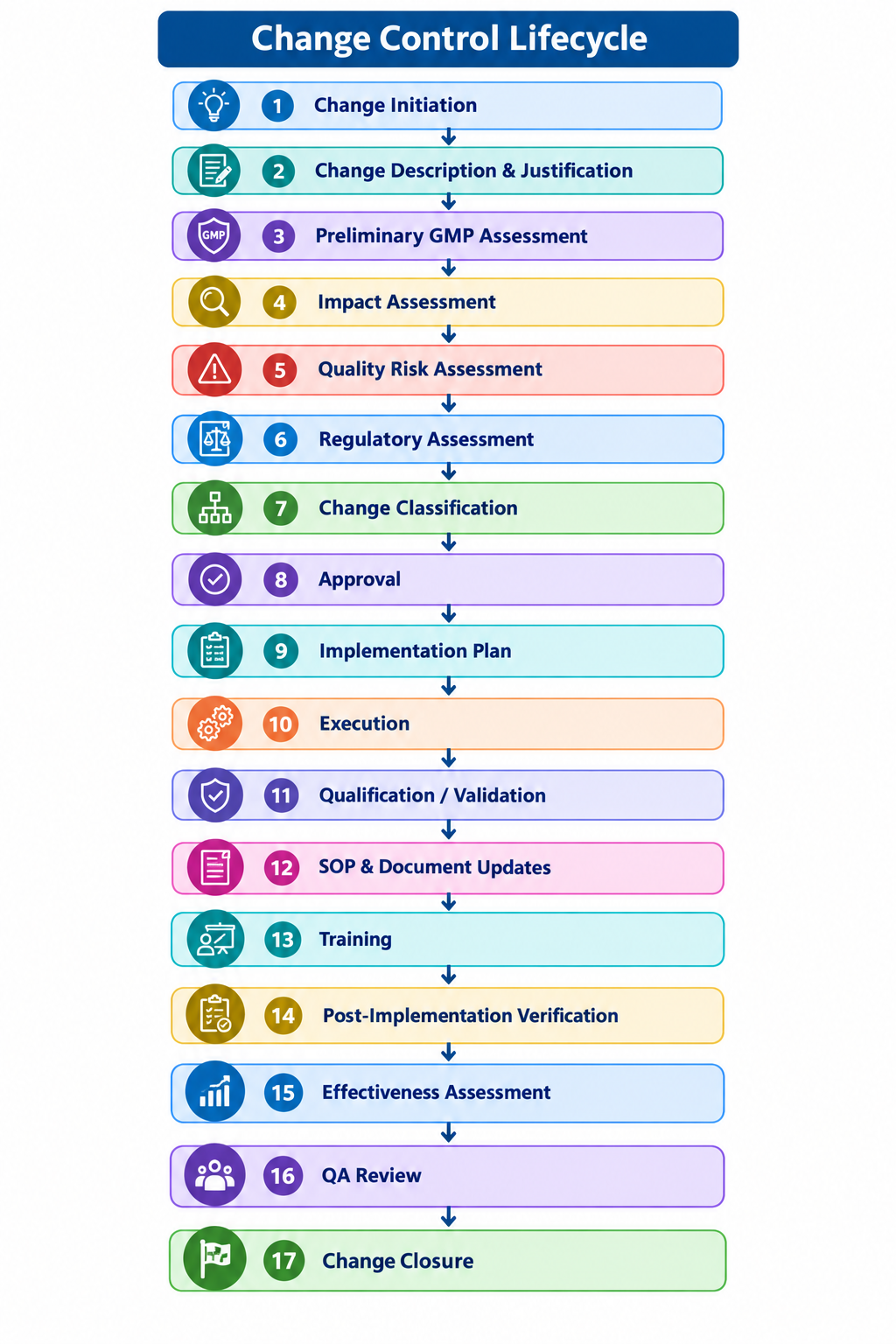
Synopsis of HVAC and Environmental Control Change
“I manage Change Control as a complete quality lifecycle rather than merely as a documentation activity. First, I ensure that the proposed change has a clear scientific and business justification. I then perform a comprehensive GMP impact assessment covering product quality, process, equipment, facility, utilities, validation, environmental control, regulatory commitments, documentation, training, data integrity, and ongoing batches.
Based on the impact assessment, I ensure that an appropriate quality risk assessment, such as FMEA, is performed to identify failure modes, evaluate severity, occurrence, and detectability, and establish suitable controls. I also ensure that the regulatory impact is assessed for all applicable markets before implementation.
After QA approval, we ensure that implementation follows an approved action plan with defined responsibilities, timelines, and acceptance criteria. Where applicable, qualification, validation, calibration, environmental monitoring and computerized-system assessments are completed before routine use. All affected SOPs, specifications, drawings, validation documents and training records are updated.
Most importantly, I do not consider a Change Control complete merely because the implementation activities are finished. I perform post-implementation verification and effectiveness assessment using predefined criteria. I review relevant trends, deviations, environmental monitoring, alarms, maintenance data, validation results, and product-quality information to confirm that the change achieved its intended objective without introducing a new risk.
Finally, QA verifies that all actions are satisfactorily completed, evaluates the effectiveness of the change, ensures traceability of all supporting documentation, and formally closes the Change Control.”
Definition of Change Control: Change Control is a formal, documented, and risk-based system used to initiate, evaluate, approve, implement, verify, and close a proposed change that may affect product quality, patient safety, validated state, regulatory compliance, data integrity, or the Pharmaceutical Quality System (PQS).
We would ensure that no GMP-impacting change is implemented without appropriate impact assessment, documented risk assessment, QA approval, and completion of required actions.
1 thought on “Pharmaceutical Change HVAC and Environmental Control”
Comments are closed.