FDA Warning Letter: Major CGMP Violations in Drug Manufacturing and Quality Systems
This FDA warning letter identifies significant violations of Current Good Manufacturing Practice (CGMP) requirements at a foreign drug manufacturing facility registered with the U.S. Food and Drug Administration (FDA) as a manufacturer of over-the-counter (OTC) drug products.
The FDA warning letter was issued following FDA’s review of records and other information submitted by the firm in response to a request made under Section 704(a)(4) of the Federal Food, Drug, and Cosmetic Act (FD&C Act).
FDA concluded that the firm’s methods, facilities, and controls for manufacturing, processing, packing, and holding drug products did not conform to CGMP requirements under 21 CFR Parts 210 and 211. As a result, the drug products manufactured by the firm were considered adulterated under Section 501(a)(2)(B) of the FD&C Act.
The FDA warning letter highlights deficiencies involving incoming component testing, finished-product testing, Quality Unit responsibilities, manufacturing documentation, stability data, process controls, establishment registration, and overall CGMP compliance.
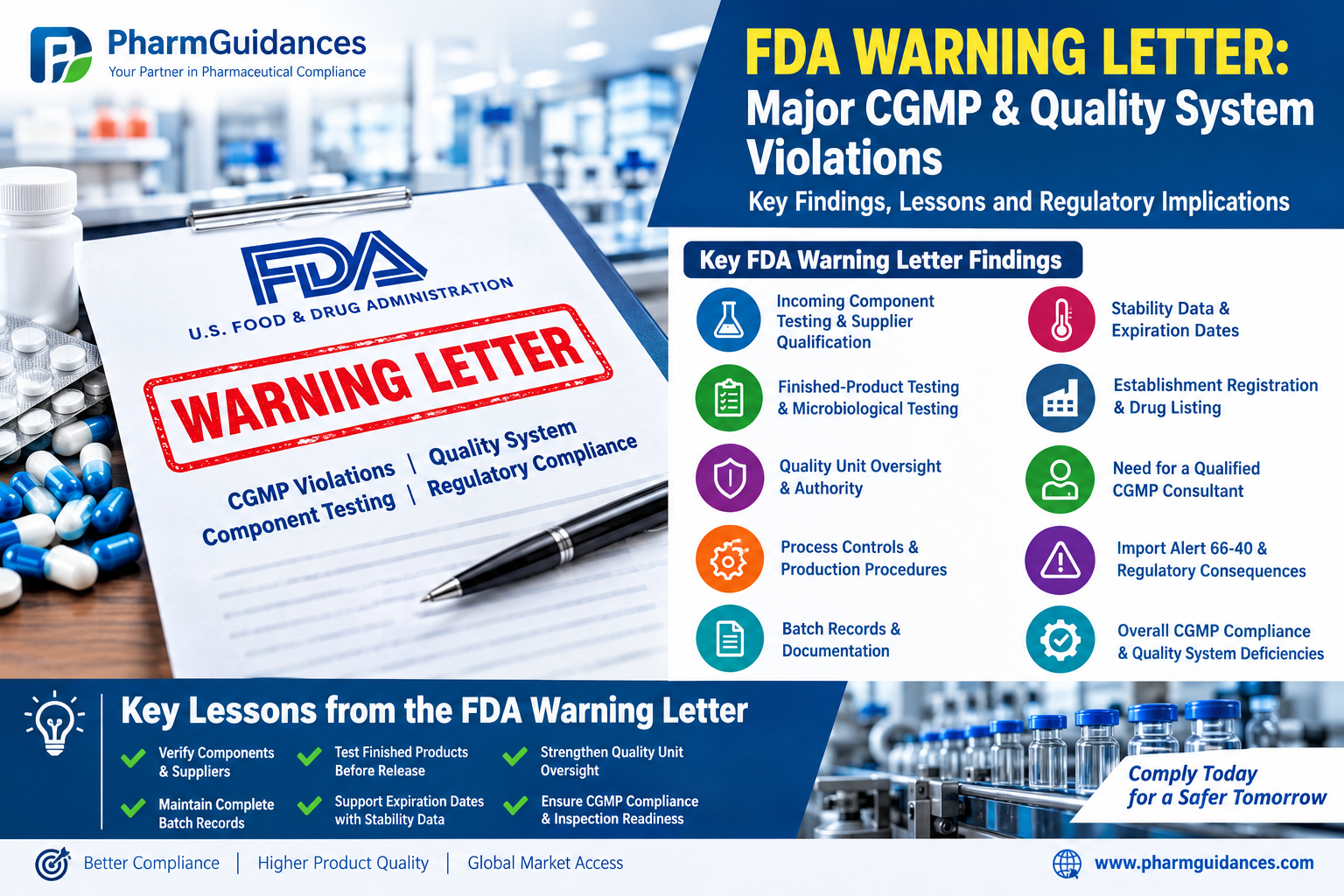
Key Findings in the FDA Warning Letter
The major observations identified in this FDA warning letter include:
- Inadequate identity testing of incoming components
- Inadequate verification of supplier Certificate of Analysis (COA) results
- Inadequate finished-product testing before release
- Inadequate microbiological testing
- Weak Quality Unit oversight
- Inadequate production and process-control procedures
- Incomplete batch manufacturing records
- Inadequate stability data supporting expiration dates
- Drug establishment registration and listing concerns
- Need for a qualified CGMP consultant and comprehensive six-system audit
- Import Alert and potential regulatory consequences
1. Inadequate Incoming Component Testing
One of the major observations in the FDA warning letter concerns the firm’s failure to adequately verify the identity of each incoming component used in drug manufacturing.
Under 21 CFR 211.84(d)(1), manufacturers are required to perform appropriate testing to verify the identity of each component before it is used in production.
FDA found that the firm did not test the identity of each incoming component before manufacturing. Instead, the company relied on supplier Certificates of Analysis without adequately verifying the reliability of the supplier’s analytical results at appropriate intervals.
The firm also failed to provide sufficient evidence demonstrating that certain active ingredients met applicable USP requirements.
Key lesson
Pharmaceutical manufacturers should establish a robust incoming-material control system that includes:
- Identity testing of incoming components
- Appropriate sampling procedures
- Supplier qualification
- Supplier COA verification
- Periodic verification of supplier analytical results
- Defined material specifications
- Risk-based supplier monitoring
- Documentation of testing and approval before use
The FDA warning letter demonstrates that simply relying on supplier COAs without establishing their reliability may not provide sufficient assurance of component quality.
2. Inadequate Finished-Product Testing
The second major finding in the FDA warning letter relates to laboratory testing of finished drug products.
FDA determined that the records provided by the firm did not demonstrate adequate testing of finished OTC drug products before release and distribution in the United States.
The submitted testing reports did not adequately demonstrate testing for:
- Identity of active ingredients
- Strength or assay of active ingredients
- Applicable impurities
- Microbiological quality
- Compliance with established final specifications
Under 21 CFR 211.165(a) and 211.165(b), appropriate laboratory testing must be completed before a batch is released for distribution.
Why this is important
Finished-product testing provides objective evidence that a manufactured batch meets predetermined specifications for identity, strength, quality, purity, and microbiological quality, as applicable.
The FDA warning letter emphasizes that inadequate release testing can prevent a manufacturer from scientifically demonstrating that its products meet established quality requirements.
3. Quality Unit Oversight Deficiencies
A significant part of the FDA warning letter concerns the responsibilities and effectiveness of the firm’s Quality Unit (QU).
FDA determined that the Quality Unit did not adequately exercise its responsibilities to ensure that drug products were manufactured in compliance with CGMP and met established specifications.
The Quality Unit failed to adequately ensure several important areas, including:
- Appropriate written production and process-control procedures
- Process performance qualification
- Qualification of the relevant manufacturing system
- Complete batch manufacturing documentation
- Adequate stability data
- Appropriate expiration-date justification
- Sufficient Quality Unit authority and procedures
These deficiencies indicate that the problem was not limited to an individual laboratory test or manufacturing activity. FDA identified broader weaknesses within the firm’s pharmaceutical quality system.
4. Inadequate Production and Process Controls
The FDA warning letter also identified concerns with production and process controls.
Under 21 CFR 211.100(a), written procedures must be established and followed to control production and process operations.
The firm did not demonstrate that adequate procedures were established to qualify process performance and qualify the relevant system used to produce a component incorporated into its drug products.
An effective process-control system should include:
- Defined manufacturing parameters
- Critical process parameter identification
- Critical quality attribute evaluation
- Process qualification
- Validation protocols
- Acceptance criteria
- Deviation management
- Change control
- Continued process verification, where applicable
5. Incomplete Batch Manufacturing Records
Another observation in the FDA warning letter relates to manufacturing documentation.
FDA found that the firm did not demonstrate that complete manufacturing information relating to production and control was maintained in batch records as required by 21 CFR 211.188.
Complete batch records are essential for demonstrating that:
- Approved procedures were followed
- Correct materials were used
- Manufacturing parameters were controlled
- Required testing was performed
- Deviations were documented
- Appropriate reviews were completed
- The batch was manufactured according to established specifications
Incomplete documentation can create significant concerns regarding product traceability and batch-release decisions.
6. Inadequate Stability Data and Expiration Dates
The FDA warning letter also identifies deficiencies related to stability data supporting labeled expiration dates.
Under 21 CFR 211.137(a), expiration dates must be supported by appropriate stability information.
A pharmaceutical manufacturer should maintain a scientifically justified stability program capable of demonstrating that the drug product continues to meet applicable quality specifications throughout its labeled shelf life.
Important stability-program elements may include:
- Stability protocols
- Appropriate storage conditions
- Testing intervals
- Stability-indicating analytical methods
- Assay and degradation-product monitoring
- Physical and microbiological attributes, where applicable
- Trend evaluation
- Ongoing stability commitments
The absence of adequate stability data can raise questions about whether the labeled expiration period is scientifically justified.
7. Drug Establishment Registration and Listing
The FDA warning letter also raises concerns regarding establishment registration and drug listing requirements.
FDA reminded the firm that establishments located outside the United States and engaged in manufacturing, preparing, processing, packing, or holding drugs intended for import into the United States must comply with applicable FDA registration requirements.
The warning letter references:
- Section 510 of the FD&C Act
- Section 301(p) of the FD&C Act
- Section 502(o) of the FD&C Act
- 21 CFR Part 207
Manufacturers supplying pharmaceutical products to the U.S. market should ensure that their establishments and applicable drug products are properly registered and listed in accordance with FDA requirements.
8. Need for a Qualified CGMP Consultant
Because of the nature and scope of the deficiencies, the FDA warning letter recommends that the firm engage a qualified consultant meeting the requirements of 21 CFR 211.34.
FDA expects the consultant to:
- Evaluate the firm’s manufacturing operations
- Assess CGMP compliance
- Conduct a comprehensive six-system audit
- Evaluate corrective and preventive actions
- Assess the effectiveness of remediation
- Identify systemic quality-system deficiencies
- Assist the firm in establishing sustainable compliance
However, FDA clearly emphasized that hiring a consultant does not transfer the firm’s regulatory responsibility to the consultant.
Executive management remains responsible for correcting deficiencies and ensuring continued CGMP compliance.
9. Import Alert and Regulatory Consequences
The FDA warning letter states that the FDA placed drugs and drug products offered for import into the United States from the identified firms on Import Alert 66-40 on June 22, 2026.
FDA may also:
- Withhold approval of new applications or supplements identifying the firm as a drug manufacturer
- Conduct follow-up inspections
- Verify implementation of corrective actions
- Continue refusing admission of affected products
- Detain or refuse products that appear to be adulterated
- Take additional regulatory action if violations remain unresolved
This demonstrates the potentially significant commercial and regulatory consequences of unresolved CGMP deficiencies.
Major CGMP Lessons from the FDA Warning Letter
This FDA warning letter provides several important lessons for pharmaceutical manufacturers, particularly companies manufacturing products for the U.S. market.
1. Verify incoming components
Do not rely solely on supplier COAs without establishing appropriate supplier qualification and verification systems.
2. Test finished products before release
Finished-product testing must provide documented evidence that each batch meets established specifications before release and distribution.
3. Strengthen Quality Unit oversight
The Quality Unit must have adequate authority, resources, procedures, and independence to perform its CGMP responsibilities effectively.
4. Maintain complete batch records
Manufacturing and testing information must be complete, accurate, traceable, and readily available for regulatory review.
5. Support expiration dates with stability data
Expiration dates should be scientifically supported by an appropriate stability program.
6. Maintain effective process controls
Manufacturing processes and relevant systems must be appropriately qualified and controlled.
7. Maintain regulatory registration
Foreign manufacturers supplying drugs to the U.S. market must comply with applicable FDA establishment registration and drug-listing requirements.
8. Address systemic root causes
Correcting individual observations is not enough. Pharmaceutical companies should identify systemic root causes and implement sustainable CAPA.
What Pharmaceutical Manufacturers Can Learn from This FDA Warning Letter
The most important lesson from this FDA warning letter is that CGMP compliance requires an integrated pharmaceutical quality system.
A manufacturer should not treat component testing, finished-product testing, batch documentation, stability, process validation, and Quality Unit oversight as independent activities.
These systems are interconnected. For example:
Supplier Qualification → Incoming Material Testing → Manufacturing Controls → Laboratory Testing → Batch Release → Stability Monitoring → Product Quality
Weakness in one part of this system can potentially affect the overall assurance of product quality.
Therefore, pharmaceutical manufacturers should regularly evaluate their systems through:
- Internal audits
- Quality risk assessments
- Supplier audits
- Process monitoring
- Data integrity reviews
- CAPA effectiveness checks
- Management review
- Quality metrics and trending
- Mock FDA inspections
FDA Warning Letter: Key Takeaways for FDA Inspection Readiness
For companies preparing for an FDA inspection, this FDA warning letter highlights several areas that should receive particular attention.
FDA Inspection Readiness Checklist
- Are all incoming components appropriately identified and tested?
- Is supplier COA reliability scientifically established?
- Are supplier qualification procedures documented?
- Is finished-product testing completed before release?
- Are microbiological requirements adequately evaluated?
- Does the Quality Unit have appropriate authority?
- Are batch records complete and accurate?
- Are stability studies adequate to support expiration dates?
- Are manufacturing processes appropriately qualified?
- Are equipment and systems qualified?
- Are deviations and CAPAs effectively managed?
- Are corrective actions verified for effectiveness?
- Are drug establishments properly registered?
- Are drug listings maintained as required?
- Are quality-system procedures periodically audited?
Conclusion
This FDA warning letter demonstrates how weaknesses in basic CGMP controls can develop into broader pharmaceutical quality-system deficiencies.
The observations cover several fundamental areas, including incoming component testing, supplier qualification, finished-product testing, microbiological testing, Quality Unit oversight, process controls, batch documentation, stability programs, establishment registration, and overall CGMP compliance.
The FDA warning letter also demonstrates that FDA expects pharmaceutical manufacturers to investigate the root causes of deficiencies and implement effective, sustainable corrective and preventive actions rather than simply correcting individual observations.
For pharmaceutical companies manufacturing products for the United States, the findings provide valuable lessons for strengthening CGMP compliance, pharmaceutical quality systems, supplier controls, laboratory controls, inspection readiness, and regulatory compliance.
Manufacturers should regularly evaluate whether their quality systems can provide objective evidence that every component, manufacturing process, laboratory result, batch record, and released drug product consistently meets applicable requirements.
Reference Warning Letter Date – 09/21/2026 Issued to Babikian Healthcare Products CJSC for CGMP/Finished Pharmaceuticals/Adulterated by Center for Drug Evaluation and Research (CDER)
Disclaimer
Educational & Awareness Purpose Only:
This article has been prepared for learning, training, educational, and pharmaceutical industry awareness purposes only. The information presented in this article is based on and/or summarized from publicly available information published on the official U.S. Food and Drug Administration (FDA) website, including FDA Warning Letters.
For the original and most up-to-date information, readers should refer directly to the official FDA Warning Letters database and related FDA publications.
This article is not an official FDA publication, communication, guidance, regulatory decision, or statement of the U.S. Food and Drug Administration. PharmGuidances is not affiliated with, endorsed by, or representing the FDA.
The information provided should not be used as a substitute for official FDA documents, applicable laws and regulations, regulatory guidance, legal advice, compliance advice, or professional consultation. It should not be relied upon for making regulatory, legal, manufacturing, quality, or business decisions.
Official Reference:
FDA Warning Letters – U.S. Food and Drug Administration
© PharmGuidances – For Educational, Training & Awareness Purposes Only.