
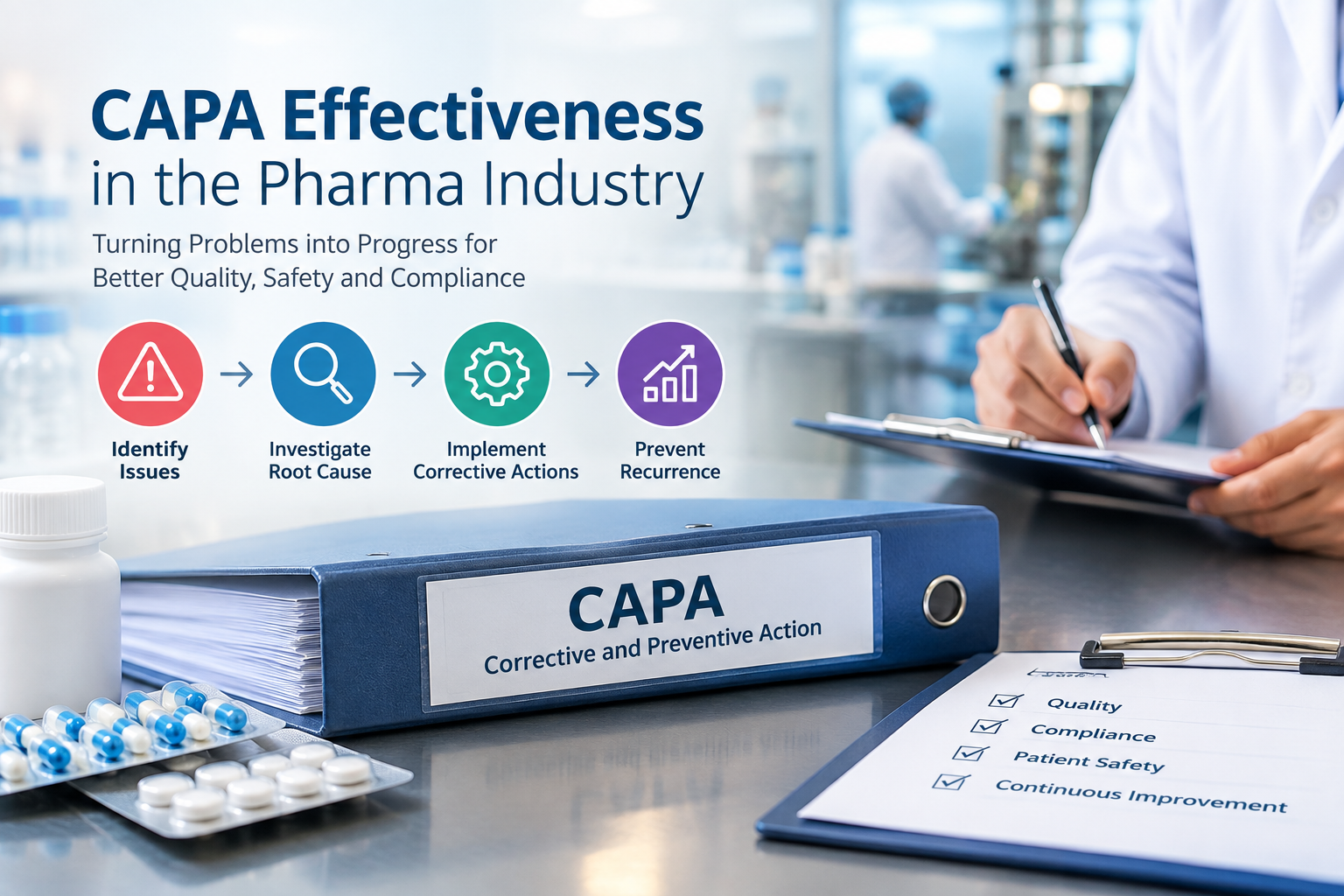
CAPA Effectiveness in the Pharma Industry
Repeated Environmental Monitoring Excursions
Scenario: During routine environmental monitoring of a Grade C manufacturing area, repeated excursions in microbial counts are observed at a specific monitoring location.
Initial Observation – Over three months:
- Multiple microbial excursions occurred at the same location.
- Initial investigations focused primarily on cleaning and operator practices.
- Cleaning records were found compliant.
- Personnel training records were current.
- No single assignable cause was identified.
Because the issue was recurrent, QA initiated a formal CAPA based on trend analysis and risk assessment.
3. CAPA Initiation
The CAPA record should clearly define:
Problem Statement: Recurrent microbial excursions have been observed at the defined Grade C environmental monitoring location during routine monitoring.
Source: Environmental Monitoring Trend / Deviation Investigation
CAPA Owner: QA / Microbiology / Production, as applicable
Risk Classification: Major, based on potential impact on contamination control and product quality.
“We would not open a CAPA merely because a deviation exists. I would determine whether the issue represents a systemic or recurring problem requiring actions beyond correction of the individual event.”
4. Immediate Correction / Containment
Before beginning root-cause analysis, immediate controls should be implemented where necessary. For example:
- Inform QA, Production, and Microbiology.
- Place potentially affected batches under appropriate QA status.
- Perform an impact assessment.
- Review environmental monitoring results.
- Increase monitoring frequency if justified.
- Perform additional cleaning/disinfection where scientifically appropriate.
- Verify disinfectant preparation and usage.
- Inspect the affected area.
- Review recent manufacturing activities.
The purpose of containment is to control the immediate risk while the investigation continues.
5. Impact Assessment
The impact assessment should determine whether the observed problem has affected:
Product
- Batches manufactured during the affected period
- Product quality
- Microbiological quality
- Sterility assurance, where applicable
- Released versus unreleased batches
Process
- Manufacturing operations
- Cleaning and disinfection
- Personnel practices
- Material/personnel movement
Facility
- HVAC performance
- Pressure differentials
- Temperature/RH
- Airflow
- HEPA filtration
- Room integrity
Quality System
- SOPs
- Training
- Environmental monitoring program
- Cleaning program
- Qualification/validation status
6. Root-Cause Analysis
Should avoid jumping directly to a convenient conclusion such as: “Operator error.”
The investigation should be evidence-based and scientifically justified.
Tools that may be used
- 5 Why Analysis
- Fishbone/Ishikawa
- Fault Tree Analysis
- Pareto Analysis
- Process Mapping
- Trend Analysis
- Data review
- Risk assessment
Fishbone Analysis
Potential causes are evaluated under:
Man
- Personnel practices
- Gowning
- Training
- Operator movement
Machine
- HVAC performance
- Airflow
- HEPA filters
- Equipment condition
Method
- Cleaning procedure
- Disinfection frequency
- Environmental monitoring procedure
Material
- Disinfectant
- Cleaning agents
- Raw/packaging materials
Environment
- Temperature/RH
- Pressure differential
- Room integrity
Measurement
- Sampling technique
- Incubation conditions
- Media performance
- Laboratory practices
CAPA within the Pharmaceutical Quality System
7. Root Cause
After reviewing:
- Environmental monitoring trends
- HVAC records
- Cleaning records
- Personnel practices
- Disinfectant preparation
- Training records
- Sampling practices
- Room pressure trends
- Historical deviations
The investigation identifies that the existing cleaning/disinfection frequency and rotation strategy did not adequately address the identified contamination trend in the affected area, and the existing environmental monitoring trend review process did not establish an appropriate early-warning trigger for repeated excursions.
This is more robust than simply stating: “Cleaning was inadequate.”
The root cause should explain why the system allowed the problem to occur and recur.
8. Corrective Action
Corrective action addresses the identified root cause or existing condition.
Corrective Action 1
Revise the cleaning and disinfection procedure based on documented risk assessment.
Corrective Action 2
Establish scientifically justified cleaning/disinfection frequency for the affected area.
Corrective Action 3
Review disinfectant preparation, contact time, application method, and storage requirements.
Corrective Action 4
Conduct additional environmental monitoring following implementation.
Corrective Action 5
Review HVAC and environmental conditions to confirm that no facility-related factor contributes to the trend.
9. Preventive Action
Preventive action should address potential recurrence or similar problems elsewhere.
- Perform a review of environmental monitoring trends across all classified areas.
- Establish predefined escalation criteria for recurring excursions.
- Introduce periodic trend review at QA management review meetings.
- Review cleaning/disinfection controls across similar areas.
- Evaluate whether the same risk exists at other monitoring locations.
- Update the environmental monitoring trend-analysis procedure.
- Provide targeted GMP training.
- Introduce risk-based periodic review of contamination-control measures.
“Corrective action addresses the identified problem and root cause, while preventive action extends the learning to prevent similar failures elsewhere. CAPA should therefore consider horizontal deployment where the risk is applicable.”
10. CAPA Action Plan
A strong CAPA system should have clearly defined actions.
| CAPA Action | Owner | Target Date | Acceptance Criteria |
|---|---|---|---|
| Revise cleaning procedure | QA/Production | 30 days | Approved revised SOP |
| Review disinfectant strategy | QA/Microbiology | 30 days | Documented scientific assessment |
| HVAC/environmental review | Engineering/QA | 20 days | Acceptable assessment |
| Additional EM monitoring | Microbiology | 90 days | Results meet established limits |
| Trend-analysis procedure revision | QA | 45 days | Approved procedure |
| Personnel training | Production/QA | 45 days | 100% applicable personnel trained |
| Horizontal assessment | QA | 60 days | Applicable areas assessed |
| Effectiveness verification | QA | 90 days | Predefined criteria achieved |
11. CAPA Effectiveness Verification
CAPA should not be closed merely because all actions have been completed. The QA department should verify whether the CAPA actually solved the problem.
CAPA Effectiveness Criteria :
For the next three months / predefined monitoring period for CAPA effectiveness verification:
- No recurrence of the identified microbial excursion.
- Environmental monitoring results remain within established limits.
- No related deviations are observed.
- No adverse trend is identified.
- Cleaning/disinfection compliance remains satisfactory.
- Personnel follow the revised procedure.
- No similar trend is observed in other applicable areas.
CAPA Effectiveness Review
QA reviews:
- EM trend data
- Deviation records
- Cleaning records
- Training records
- Disinfectant records
- HVAC/environmental data
- Microbiological investigation results
- Related CAPAs
- Product-quality impact
12. What If CAPA Is Not Effective?
If the CAPA effectiveness criteria are not met, we would:
- Document the failure of effectiveness.
- Reassess the original root cause.
- Determine whether the root cause was incomplete or incorrect.
- Perform a new/revised risk assessment.
- Identify additional or alternative actions.
- Extend monitoring where scientifically justified.
- Escalate the issue through the Quality Management System.
- Evaluate potential impact on other products/processes/areas.
- Reopen or replace the CAPA according to the site’s approved procedure.
“An ineffective CAPA is itself a quality-system signal and should not be closed simply because the original target date has been reached.”
13. CAPA Timely Closure
An effective CAPA system should have predefined:
- CAPA due date
- Action owner
- Milestones
- Priority
- Risk classification
- Extension criteria
- Escalation mechanism
- Effectiveness-check date
CAPA Aging Dashboard: QA should periodically monitor:
| Metric | Example |
|---|---|
| Open CAPAs | 18 |
| Overdue CAPAs | 2 |
| CAPAs due within 30 days | 5 |
| Average closure time | 42 days |
| Effectiveness checks pending | 3 |
| Repeat CAPAs | 1 |
| CAPAs extended | 2 |
The dashboard should be reviewed through appropriate Quality Management Review / Management Review processes.
14. CAPA Metrics and Trending
We would establish CAPA KPIs such as: CAPA Quality Metrics
- % CAPAs closed within target date
- Number of overdue CAPAs
- Average CAPA closure time
- CAPA aging
- % CAPAs requiring extension
- % CAPAs failing effectiveness checks
- Repeat deviations
- Repeat CAPAs
- Recurrence rate
- Root-cause categories
- CAPAs by department
- CAPAs by source
- CAPAs by risk classification
- Effectiveness-check completion rate
- Number of systemic CAPAs
- Trend of recurring quality events
Cleaning-related deviations → 35% of total CAPAs
This should trigger further analysis rather than simply reporting the percentage. QA should investigate:
- Common root causes
- Training gaps
- Procedure weaknesses
- Equipment/facility factors
- Resource issues
- Recurring locations
- Similar products/processes
15. CAPA Governance: A mature CAPA system should establish clear responsibilities.
QA
- Owns/governs the CAPA system.
- Reviews investigations.
- Challenges root-cause adequacy.
- Approves risk assessment.
- Ensures action quality.
- Verifies effectiveness.
- Monitors CAPA trends.
- Escalates overdue/ineffective CAPAs.
CAPA Owner
- Performs investigation.
- Develops action plan.
- Provides objective evidence.
- Completes actions within approved timelines.
Department Head
- Provides resources.
- Ensures implementation.
- Reviews progress.
QA Head
- Provides governance.
- Reviews significant/high-risk CAPAs.
- Ensures systemic issues are escalated.
- Reviews CAPA trends during management review.
16. CAPA Closure Checklist
Before closing a CAPA, QA should confirm:
☑ Root cause scientifically justified
☑ Immediate correction completed
☑ Impact assessment completed
☑ Risk assessment completed
☑ Corrective actions completed
☑ Preventive actions completed
☑ Required documents revised
☑ Training completed
☑ Validation/qualification completed where applicable
☑ Horizontal assessment completed
☑ Effectiveness criteria predefined
☑ Effectiveness verification completed
☑ No recurrence identified during defined monitoring period
☑ Supporting evidence attached
☑ All actions completed and verified
☑ QA approval obtained
☑ CAPA formally closed
“How do you establish and monitor a CAPA effectiveness & management system?”
“We establish CAPA as a risk-based and systemic quality-management process rather than simply a mechanism for closing deviations. First, I ensure that CAPA is initiated from appropriate sources such as deviations, OOS/OOT investigations, complaints, audit observations, regulatory observations, recurring failures, trend analysis, and management review.
For CAPA, we ensure that the problem statement is clearly defined and that an appropriate impact and risk assessment is performed. I challenge the investigation team to identify the true systemic root cause using appropriate tools such as 5-Why, Fishbone, Fault Tree Analysis, and trend analysis rather than accepting symptoms or assigning responsibility to an individual without objective evidence.
Based on the root cause, I ensure that corrective and preventive actions are specific, measurable, risk-based, and sustainable. Each action has a defined owner, target date, and acceptance criterion. Where applicable, I also perform a horizontal assessment to determine whether the same risk exists in other products, processes, equipment, or areas.
I establish predefined effectiveness criteria before CAPA implementation. Completion of an action does not automatically mean that the CAPA is effective. QA verifies effectiveness through appropriate evidence such as trend analysis, repeat deviation review, environmental monitoring, audit observations, process performance, or product-quality data.
I also maintain a CAPA dashboard covering open and overdue CAPAs, aging, risk classification, extensions, recurrence, effectiveness failures, and closure performance. High-risk or overdue CAPAs are escalated through the appropriate Quality Management Review process.
Finally, I ensure that CAPAs are closed only after all actions and CAPA effectiveness requirements are satisfactorily completed and objectively verified. If a CAPA fails the effectiveness check, I reassess the root cause and risk and initiate additional action rather than closing the CAPA administratively. My objective is not simply to achieve a high CAPA closure percentage, but to demonstrate sustained reduction in recurring quality problems and continual improvement of the Pharmaceutical Quality System.”
“CAPA effectiveness is not measured by how many CAPAs are closed; it is measured by whether root causes are eliminated, recurrence is prevented, effectiveness is demonstrated, and the overall quality system continuously improves.”
Definition: CAPA — Corrective and Preventive Action is a structured, risk-based quality-system process used to:
- Identify the root cause of a problem or potential problem.
- Correct the immediate issue.
- Eliminate the root cause.
- Prevent recurrence or occurrence elsewhere.
- Verify that the actions are effective.
- Monitor trends and quality metrics.
- Ensure timely and scientifically justified closure.
I would ensure that CAPA is risk-based, root-cause driven, measurable, sustainable, and independently verified for effectiveness.