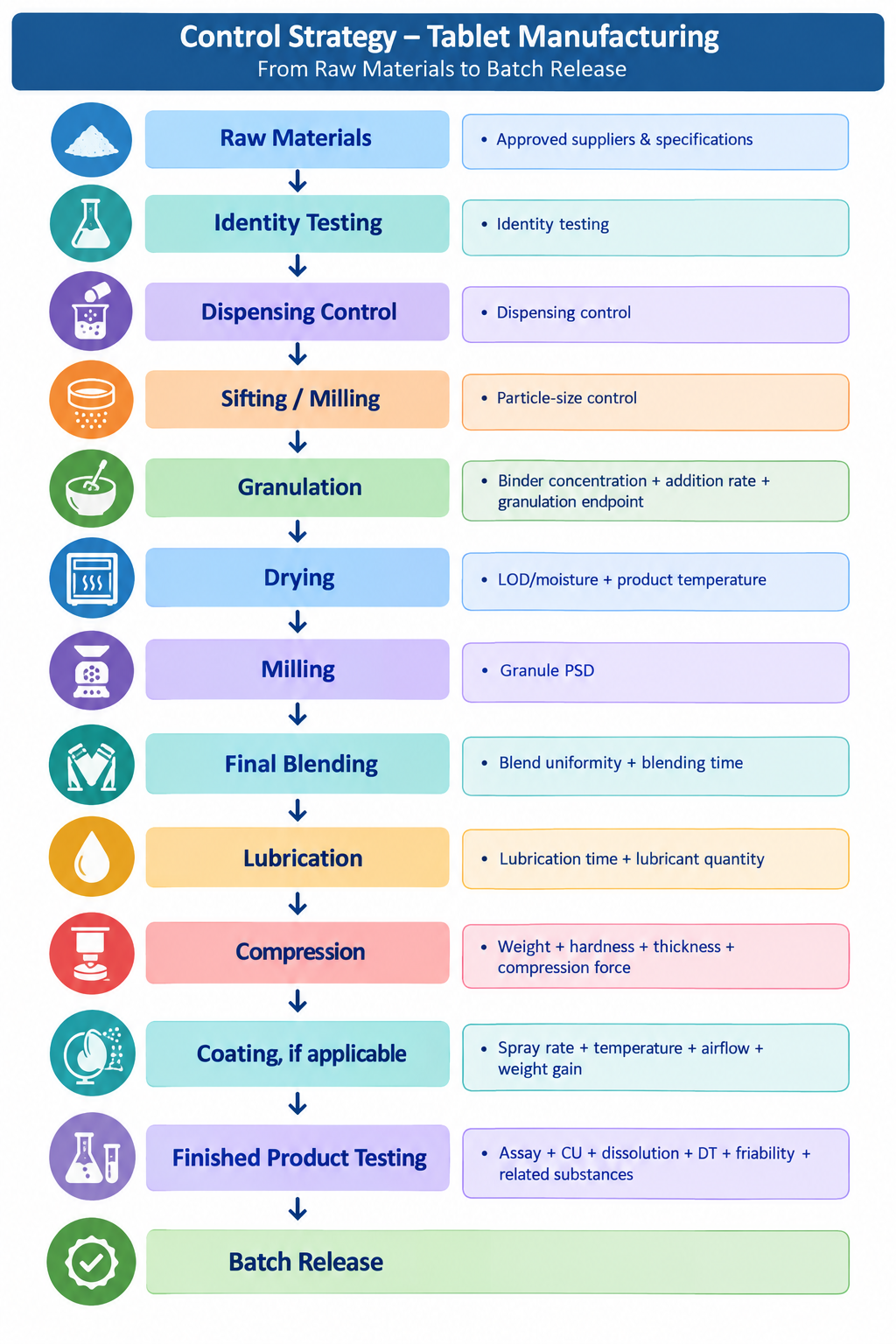
Quality by Design (QbD)
Framework for tablet manufacturing, covering Critical Quality Attributes (CQAs), Critical Process Parameters (CPPs), their relationship, and a practical risk assessment.
1. Tablet Manufacturing – Critical Quality Attributes (CQAs)
CQAs are physical, chemical, microbiological, or performance characteristics that must remain within an appropriate limit/range to ensure the finished tablet meets its intended quality and performance.
| No. | CQA | Typical Acceptance Criteria* | Why Critical |
|---|---|---|---|
| 1 | Appearance | Conforms to approved specification | Detects defects, contamination, and visual nonconformity |
| 2 | Identification | Conforms | Confirms correct API |
| 3 | Assay | Approved specification | Ensures correct potency |
| 4 | Content Uniformity / Uniformity of Dosage Units | Pharmacopoeial requirement | Ensures dose consistency |
| 5 | Weight Variation | Approved IPC/specification | Controls dose and process consistency |
| 6 | Hardness / Crushing Strength | Product-specific | Affects mechanical integrity and disintegration |
| 7 | Friability | Typically NMT 1.0% where applicable | Indicates resistance to abrasion |
| 8 | Disintegration Time | Product-specific/pharmacopoeial | Influences drug release |
| 9 | Dissolution | Product-specific specification | Critical for drug release and bioavailability |
| 10 | Moisture / LOD | Product-specific | Can affect stability, compression, and dissolution |
| 11 | Thickness | Product-specific | Indicates dimensional consistency |
| 12 | Related Substances / Degradation Products | Approved specification | Controls chemical purity and stability |
| 13 | Microbial Quality | Pharmacopoeial/product requirement | Controls microbiological quality |
| 14 | Residual Solvents | Approved specification, where applicable | Safety and product quality |
| 15 | Coating attributes, if applicable | Appearance, weight gain, defects, etc. | Ensures protection, identification or modified release |
*Acceptance criteria must be established from the approved product specification, pharmacopoeia, development studies and regulatory requirements.
2. Critical Process Parameters (CPPs)
A CPP is a process parameter whose variability can have an impact on a CQA and therefore should be monitored or controlled to ensure the process produces the desired quality.
A. Dispensing and Material Handling
| Process Parameter | Potential Impact on CQA | Criticality |
|---|---|---|
| Material identity | Assay, identification, CU | High |
| Material quantity/weighing accuracy | Assay, weight variation, CU | High |
| Sieve size | Blend uniformity, flow, dissolution | Medium |
| Sifting time | Particle characteristics | Medium |
| Material storage temperature/RH | Moisture, stability | Medium/High |
| Material hold time | Moisture, assay, microbial quality | Medium |
B. Granulation – Wet Granulation
| CPP | Potential CQA Impact |
|---|---|
| Impeller speed | Granule size, density, flow |
| Chopper speed | Granule size distribution |
| Binder concentration | Granule strength, dissolution |
| Binder addition rate | Granule properties |
| Binder quantity | Granule strength/disintegration |
| Granulation time | Granule size/density |
| End-point determination | Moisture, granule properties |
| Wet massing time | Granule characteristics |
| Wet granule temperature | Moisture/stability |
C. Fluid Bed Drying
| CPP | Potential CQA Impact |
|---|---|
| Inlet air temperature | Moisture, degradation |
| Product temperature | Stability/moisture |
| Airflow | Drying uniformity |
| Drying time | Moisture/LOD |
| Outlet air temperature | Drying endpoint |
| Final LOD | Compression, stability, dissolution |
| Filter condition | Drying efficiency/contamination control |
D. Milling
| CPP | Potential CQA Impact |
|---|---|
| Mill speed | Particle-size distribution |
| Screen size | Granule particle size |
| Feed rate | Milling efficiency |
| Mill type | Particle morphology |
| Milling time | Particle-size distribution |
E. Blending/Lubrication
| CPP | Potential CQA Impact |
|---|---|
| Blender speed | Blend uniformity |
| Blending time | Content uniformity |
| Lubrication time | Dissolution, hardness |
| Lubricant concentration | Dissolution, tablet strength |
| Order of addition | Blend uniformity |
| Blender load | Mixing efficiency |
| Material flow characteristics | Blend uniformity |
Over-lubrication is particularly important because excessive lubricant exposure can reduce tablet hardness and slow disintegration/dissolution.
F. Compression
| CPP | Potential CQA Impact |
|---|---|
| Pre-compression force | Hardness, thickness |
| Main compression force | Hardness, friability, dissolution |
| Turret speed | Weight variation, compression |
| Feeder speed | Weight variation, CU |
| Fill depth | Tablet weight |
| Compression dwell time | Hardness, CU |
| Ejection force | Capping, sticking |
| Tablet press temperature | Product stability |
| Punch/die condition | Appearance, defects |
| Dedusting efficiency | Appearance/contamination |
G. Film Coating
| CPP | Potential CQA Impact |
|---|---|
| Pan speed | Coating uniformity |
| Spray rate | Coating defects |
| Atomization pressure | Droplet size/coating quality |
| Inlet air temperature | Drying/coating defects |
| Product temperature | Coating quality |
| Airflow | Drying efficiency |
| Spray gun-to-bed distance | Coating uniformity |
| Coating suspension solids | Weight gain/coating thickness |
| Coating weight gain | Appearance, dissolution |
| Spray pattern | Uniformity |
| Exhaust temperature | Drying control |
3. Risk Assessment – FMEA Approach
A practical pharmaceutical risk assessment can use:
Severity (S): 1–5 , Occurrence (O): 1–5 , Detectability (D): 1–5
RPN = S × O × D
| Score | Risk Level |
|---|---|
| 1–20 | Low |
| 21–40 | Medium |
| 41–75 | High |
| 76–125 | Very High |
The exact risk bands should be defined in your site’s approved Quality Risk Management SOP.
4. Tablet Manufacturing CPP–CQA Risk Assessment
| Process Step | CPP / Parameter | Potential Failure Mode | Impact on CQA | S | O | D | RPN | Risk |
|---|---|---|---|---|---|---|---|---|
| Dispensing | Weighing accuracy | Incorrect quantity | Assay/CU | 5 | 2 | 2 | 20 | Low |
| Sifting | Screen size | Incorrect PSD | Flow/CU/dissolution | 4 | 3 | 3 | 36 | Medium |
| Granulation | Binder quantity | Excess/insufficient binder | Hardness/disintegration/dissolution | 5 | 3 | 3 | 45 | High |
| Granulation | Granulation time | Under/over granulation | PSD, hardness, dissolution | 5 | 3 | 3 | 45 | High |
| Granulation | Impeller speed | Incorrect granule formation | PSD/flow/compression | 4 | 3 | 3 | 36 | Medium |
| FBD | Inlet temperature | Excessive/insufficient drying | Moisture/degradation | 5 | 3 | 3 | 45 | High |
| FBD | Drying time | Improper LOD | Stability/compression/dissolution | 5 | 3 | 3 | 45 | High |
| Milling | Screen size | Incorrect granule size | Flow/CU/compression | 4 | 3 | 3 | 36 | Medium |
| Blending | Blending time | Under/over blending | CU/dissolution | 5 | 3 | 4 | 60 | High |
| Lubrication | Lubrication time | Over-lubrication | Dissolution/hardness | 5 | 3 | 4 | 60 | High |
| Lubrication | Lubricant quantity | Excess lubricant | Dissolution/hardness | 5 | 3 | 3 | 45 | High |
| Compression | Fill depth | Incorrect tablet weight | Weight variation/assay | 5 | 3 | 2 | 30 | Medium |
| Compression | Main compression force | Excessive force | Hardness/disintegration/dissolution | 5 | 3 | 3 | 45 | High |
| Compression | Turret speed | Excessive speed | Weight variation/CU/hardness | 4 | 3 | 3 | 36 | Medium |
| Compression | Feeder speed | Poor die filling | Weight variation/CU | 5 | 3 | 3 | 45 | High |
| Compression | Ejection force | Excessive force | Capping/sticking/appearance | 4 | 3 | 3 | 36 | Medium |
| Compression | Punch/die condition | Damaged tooling | Appearance/weight/hardness | 4 | 3 | 2 | 24 | Medium |
| Coating | Spray rate | Excessive spray | Picking/sticking/coating defects | 4 | 3 | 3 | 36 | Medium |
| Coating | Inlet air temperature | Improper drying | Coating defects/degradation | 5 | 3 | 3 | 45 | High |
| Coating | Pan speed | Poor coating distribution | Uniformity/appearance | 4 | 3 | 3 | 36 | Medium |
| Coating | Atomization pressure | Incorrect droplet size | Coating uniformity/appearance | 4 | 3 | 3 | 36 | Medium |
| Coating | Weight gain | Incorrect coating | Appearance/dissolution | 5 | 3 | 3 | 45 | High |
5. CPP–CQA Relationship Matrix
A useful approach for pharmaceutical process validation is to establish which CPPs have a direct relationship with CQAs.
H = High impact, M = Medium impact, and L = Low impact
| CPP | Assay | CU | Weight | Hardness | Friability | DT | Dissolution | Moisture |
|---|---|---|---|---|---|---|---|---|
| Weighing accuracy | H | H | M | L | L | L | L | L |
| Sieve size | L | M | M | M | M | M | M | L |
| Binder quantity | L | M | L | H | H | H | H | M |
| Granulation time | L | M | L | H | H | H | H | M |
| FBD temperature | M | L | L | M | M | M | M | H |
| Final LOD | M | M | L | H | H | H | H | H |
| Milling screen | L | M | M | M | M | M | M | L |
| Blending time | L | H | L | L | L | M | M | L |
| Lubrication time | L | M | L | H | H | H | H | L |
| Compression force | L | M | L | H | H | H | H | L |
| Fill depth | L | M | H | M | M | M | M | L |
| Feeder speed | L | H | H | M | M | M | M | L |
| Turret speed | L | M | H | M | M | M | M | L |
| Coating spray rate | L | L | L | L | L | M | H | M |
| Coating weight gain | L | L | L | L | L | M | H | L |
6. Recommended Control Strategy
For a tablet product, the control strategy should generally include: